
Dataset curation and exploration
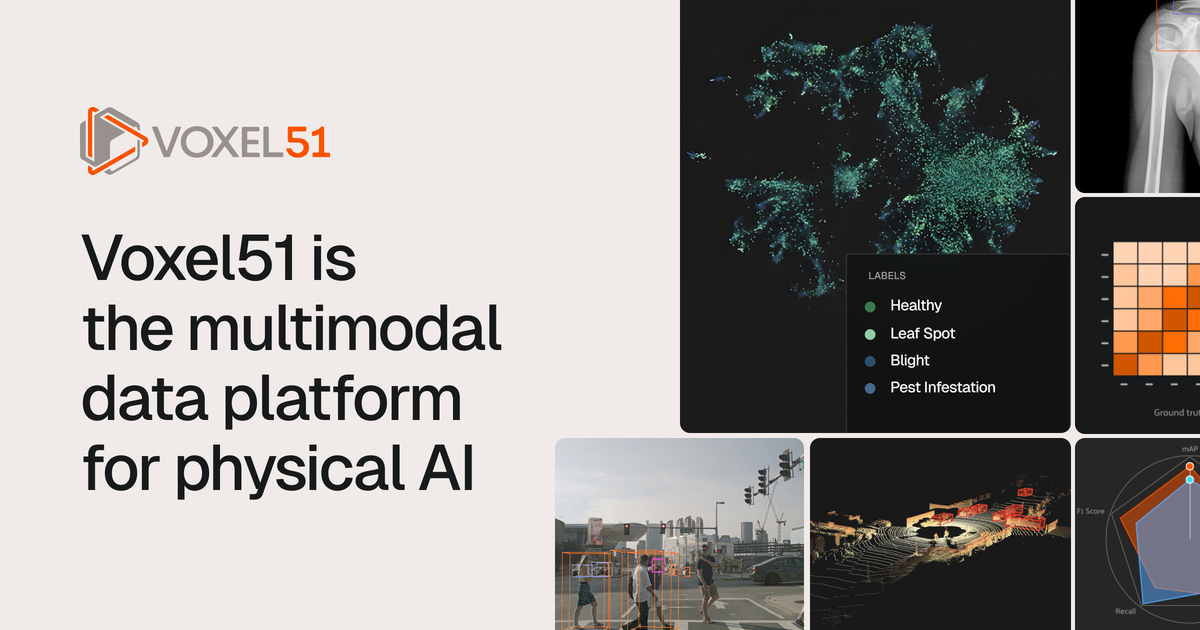
Slice, search, and filter large multimodal datasets, including natural language search, similarity search, and metadata management, so teams can inspect the samples that matter most.

FiftyOne is Voxel51’s physical AI data platform for multimodal data.
Voxel51 provides FiftyOne, a physical AI data platform for curating, annotating, evaluating, and generating multimodal data. The site positions the product around improving model performance by putting data quality, inspection, and iteration at the center of visual AI development.
The platform is designed for teams working with images, video, point clouds, medical scans, geospatial data, audio, and time-series data. It combines dataset exploration, annotation, automated labeling, and model evaluation in one workflow so users can find data issues, label efficiently, and measure model behavior across samples and scenarios.
Slice, search, and filter large multimodal datasets, including natural language search, similarity search, and metadata management, so teams can inspect the samples that matter most.
Work with interactive visualizations such as embeddings and dashboards to understand distribution, coverage, diversity, outliers, and other dataset properties.
Create and edit 2D and 3D labels for classification, detection, segmentation, polylines, keypoints, boxes, cuboids, and other scene geometry.
Use automated labeling, zero-shot prediction, active learning, and built-in QA workflows to reduce manual annotation work and focus review on edge cases.
Compare models, evaluate scenarios, version datasets and models, and review aggregate and sample-level metrics such as precision, recall, accuracy, F1, confusion matrices, and false positives.
Deploy with security and extensibility features such as role-based access controls, dataset versioning, plugins, custom workflows, custom dashboards, and infrastructure options including cloud, on-premise, and air-gapped deployments on eligible plans.
Inspect large datasets to find gaps, edge cases, duplicates, and distribution problems before training or retraining a model. The curation pages emphasize slicing, querying, filtering, embeddings, and metadata-driven analysis.
Annotate 2D and 3D scenes directly in FiftyOne, using bounding boxes, segmentation masks, cuboids, keypoints, and polylines. The product also supports auto-labeling and label editing with QA workflows.
Compare predictions with ground truth, review sample-level errors, and evaluate model behavior across scenarios using metrics, confusion matrices, and versioned datasets and models.
Use data lens, search, and retrieval workflows to pull relevant samples from a data lake quickly instead of waiting for manual sample delivery. This helps teams move from identification to inspection faster.
Adopt the platform across multiple projects or deployments when security, governance, and infrastructure requirements matter. The pricing page includes team, growth, and custom plans with options such as role-based access, deployment choices, and enterprise support.
FiftyOne is a platform for working with multimodal AI data. The source pages describe curation, annotation, and model evaluation workflows, but do not provide a step-by-step setup guide.
The source pages show support for images, video, point clouds, geospatial data, medical scans, audio, and time-series data, along with 2D and 3D annotation workflows.
The product is built around visual and multimodal data workflows such as dataset slicing and search, annotation, automated labeling, and model comparison. It is presented as a platform for teams building computer vision and physical AI systems.
The pricing page shows Team, Growth, and Custom plans. Team and Growth list seat, compute, and deployment limits, while Custom is for organization-wide needs and includes contact-sales pricing.
The pages do not describe every integration in detail, but they do mention integrations with annotation tools, cloud storage, SDKs and notebooks, vector search databases, models, experiment tracking, and datasets.
Traffic data is for reference only.

pangeanic.com
Pangeanic delivers multilingual AI data, alignment, and sovereign AI systems.

afterquery.com
Applied research lab creating training data and evaluation environments for foundation models.

myscale.com
MyScale is a managed SQL vector database for AI applications with vector search, SQL analytics, and hybrid retrieval.

roboflow.com
Computer vision platform for labeling, training, automation, and deployment

lancedb.com
AI-native multimodal lakehouse for data curation, feature engineering, search, and training datasets

ultralytics.com
End-to-end computer vision for data annotation, YOLO training, deployment, and monitoring