
Training on personal source material
The product is built around a clone that is trained on a user's own content and knowledge base, including calls, courses, messages, voice notes, SOPs, and written material.

AI clone service creating digital versions from your content
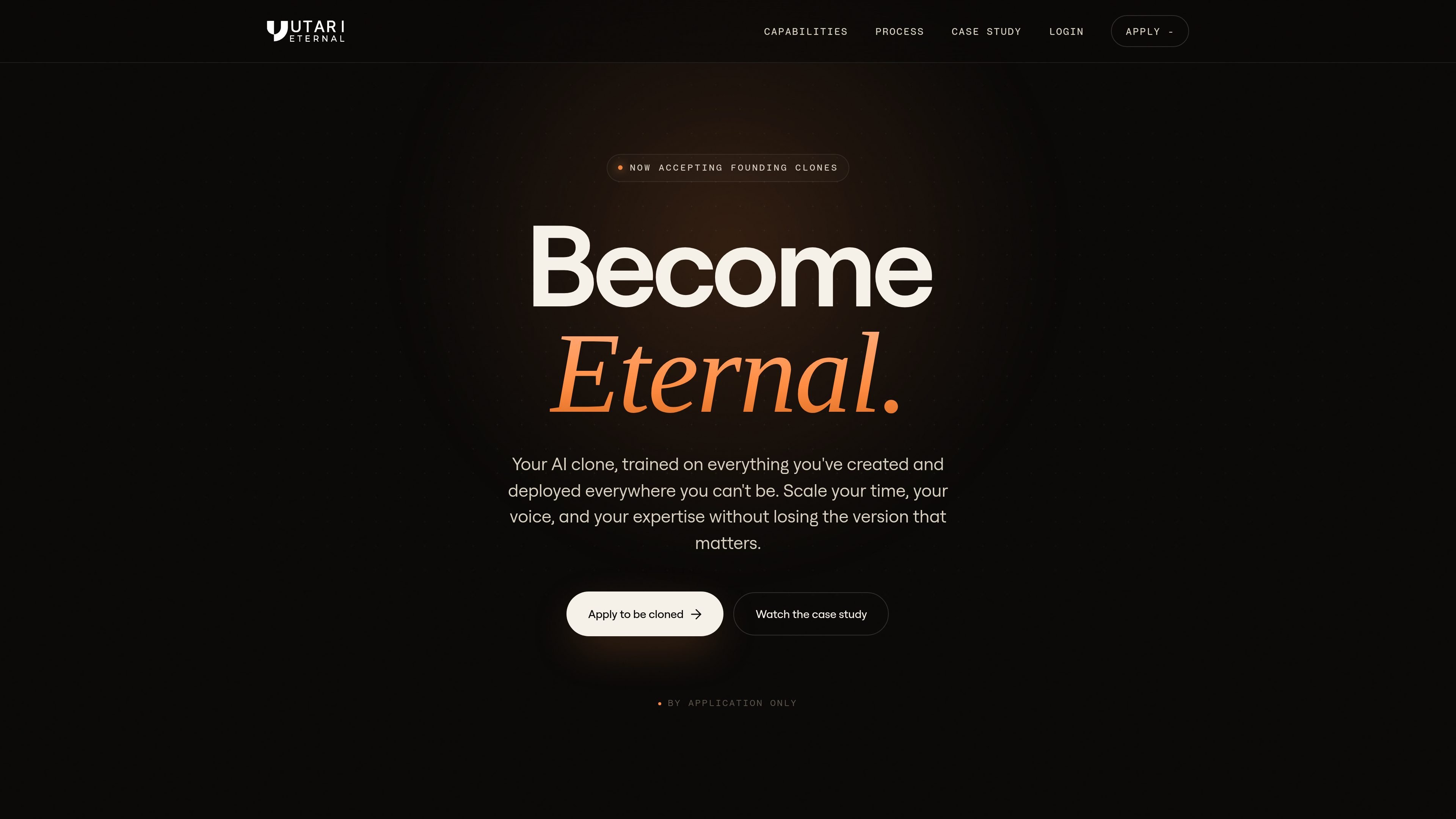
Utari Eternal is an AI clone service that builds a digital version of a person from their own created material. The homepage frames it as a way to scale a person's time, voice, and expertise without requiring them to personally handle every interaction.
The product is aimed at people whose expertise, responses, or delivery style are in demand. According to the site, the clone can answer questions, take calls, execute tasks, and be deployed across web, phone, SMS, and embedded product experiences.
The source describes a guided process: connect source material, train and refine the clone with Utari's team, then deploy it in customer-facing or offer-based workflows. The product emphasizes using the user's own knowledge and voice rather than a generic assistant.
The product is built around a clone that is trained on a user's own content and knowledge base, including calls, courses, messages, voice notes, SOPs, and written material.
Utari positions the clone as agentic software that can do work, not only answer questions. The homepage cites ad accounts, CRM edits, and report building as examples.
The clone is described as supporting real-time voice conversations with low latency, so it can take phone calls rather than only respond in text.
The homepage says the clone can auto-translate in real time across languages such as Spanish, French, Russian, and Mandarin.
The product can be deployed on the web, by phone, by SMS, and embedded in products, and the homepage also mentions standalone offers.
Utari says the clone can read long messages, files, and shared links without character limits, which is intended to preserve context from the user's source material.
An expert or consultant can use the clone to answer routine client questions and deliver a more consistent response without handling every message personally.
A coach or educator can offload repeated questions and support conversations while keeping the responses tied to their own methods, frameworks, and teaching material.
A founder or operator can route repeat operational work to the clone, including the kinds of tasks the homepage mentions such as CRM updates, reports, and account work.
A creator can turn a large body of existing content into a standalone offer that continues to speak in their voice after publication.
An agency can use the clone as a client-facing layer that responds across channels and supports multilingual communication where needed.
Utari Eternal is presented as a service that builds an AI clone trained on everything you have created. The homepage says the clone can answer, execute work, and be deployed across web, phone, SMS, and embedded product contexts.
The source describes an onboarding process that starts by connecting material such as calls, course videos, podcast catalogs, DMs, voice notes, SOPs, and written work. Utari says its team then models your skills, trains on your knowledge, and refines the clone with you.
The homepage says the clone can be deployed on the web, by phone, through SMS, and embedded in products, and that it can also be sold as a standalone offer.
The pricing page shows a login screen with Google, GitHub, and email sign-in options, but it does not expose public plan details in the provided source.
The supplied source does not include integration docs or setup specifications beyond broad references to ad accounts, YouTube, CRMs, calendars, and dashboards on the homepage.
Traffic data is for reference only.

vogent.ai
Vogent is a web platform for building, testing, and deploying AI voice agents with no-code flows, phone tools, and Voicelab.

elevenlabs.io
ElevenLabs is an AI voice and audio platform for speech generation, conversational agents, and localized audio and video content.

altered.ai
AI voice changer and voice content creation platform for media and live use.

synthflow.ai
Synthflow is an enterprise Voice AI platform that automates phone calls with custom AI agents, helping teams scale sales, support, and other workflows while connecting to existing business systems.

vocloner.com
Vocloner is a web-based AI voice cloning tool for creating custom voices from audio samples, with multilingual speech, inline emotion tags, and a free tier.

magicbuddy.ai
Telegram-based AI assistant for answers, writing, and code help