TextSynth logo

TextSynth

Claim

TextSynth is a REST API and playground for language, image, speech, transcription, translation, and embedding models. Free tier and paid per request, with servers in France.

TextSynth preview

Overview

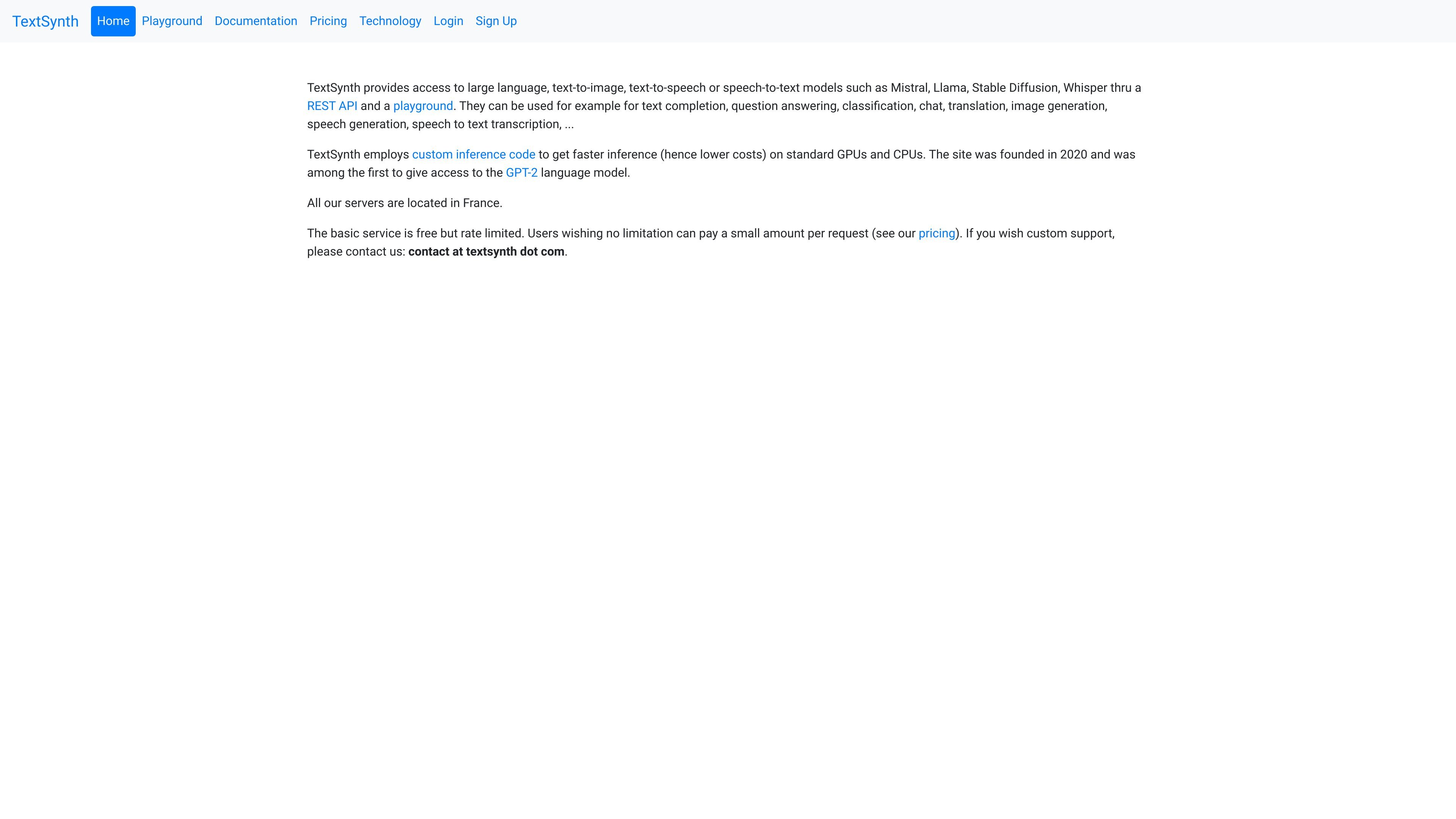
TextSynth is a model-access platform that exposes large language models and other generative AI models through a REST API and an online playground. The site presents text completion, chat, translation, image generation, speech generation, speech-to-text transcription, and embeddings as supported workflows.

The service is built around multiple named engines, including Mistral, Llama, Gemma, Stable Diffusion, Whisper, Parler-TTS, and BGE-Large-EN-v1.5. The documentation notes that TextSynth uses custom inference code to deliver faster inference on standard GPUs and CPUs, and that the servers are located in France.

The homepage says the basic service is free but rate limited, with an option to pay a small amount per request for unlimited usage. The documentation requires an API key for REST access, and the playground provides a browser-based way to try supported completion models.

Features

Text completion API

Run text completion requests against engines such as Mistral 7B, Llama 3.1 8B Instruct, Gemma 3 27B Instruct, and Llama 3.3 70B Instruct. The API supports prompt input, stop strings, streaming output, multiple completions, and sampling controls like temperature, top-k, and top-p.

Chat support

Use the chat endpoint for conversational workflows with supported chat models. The product site presents chat as one of its main model-access modes alongside text completion and translation.

Translation engine

Translate text with the MADLAD400 7B engine, which is described as supporting multilingual translation across about 400 languages.

Text-to-image generation

Generate 512×512 images from English prompts with Stable Diffusion. The API documentation exposes a text-to-image endpoint for this workflow.

Speech and embeddings endpoints

Convert speech to text with Whisper Large v3 or generate speech with Parler-TTS v1. The platform also lists embeddings through BGE-Large-EN-v1.5 for RAG-style workflows.

Use Cases

  • Text generation workflows

    Build applications that need generated text, with control over prompt length, sampling, stop strings, streaming responses, and multiple completions from the same prompt.

  • Conversational and language tasks

    Prototype chat assistants, Q&A tools, or translation features using the supported API endpoints and the named chat and translation engines.

  • Multimodal product prototyping

    Add image, speech, transcription, or embedding capabilities to a product through the same platform rather than integrating separate vendors for each modality.

  • Prompt testing and model selection

    Use the playground to test prompts and compare model behavior before wiring requests into an application.

Pros and Cons

Pros

  • Offers one API surface for text, chat, translation, image, speech, transcription, and embeddings.
  • Provides a playground for trying models without leaving the site.
  • Documents concrete request parameters for completions, including streaming, stop sequences, sampling controls, and structured output constraints such as grammar and schema.
  • Supports a range of named engines, from smaller completion models to larger chat and multimodal models.
  • States that custom inference code is used to improve speed on standard GPUs and CPUs.

Cons

  • The public pricing page was not available in the collected sources, so detailed plan limits and exact pricing are not confirmed here.
  • Some engines carry use restrictions, and the documentation indicates that model availability and context length vary by engine.
  • The documentation is API-oriented, so teams looking for a fully managed app workflow may need to build on top of the endpoints.

FAQ

What does TextSynth offer?

TextSynth provides access to large language, text-to-image, text-to-speech, and speech-to-text models through a REST API and a playground. The documentation also covers text completions, chat, translations, embeddings, tokenization, image generation, transcription, and speech synthesis.

How do I authenticate to the API?

Authentication requires an account and an API key, which is sent in the `Authorization: Bearer YOUR_API_KEY` header for REST API requests.

Is TextSynth free to use?

The basic service is free but rate limited. The site also says users who want no limitation can pay a small amount per request, with pricing information referenced on the site.

Where is TextSynth hosted?

The servers are located in France.

Which model families are exposed?

The playground includes model choices for text completion and related tools, while the API documentation lists engines such as Mistral 7B, Llama 3.1 8B Instruct, Gemma 3 27B Instruct, Llama 3.3 70B Instruct, Stable Diffusion, Whisper Large v3, Parler-TTS v1, and BGE-Large-EN-v1.5.

Quick Facts

Category
AI API Platform
Access model
REST API plus web playground
Primary use
Model access for text and multimodal generation
Hosting
Servers located in France
Domain
textsynth.com
Pricing note
Basic service is free but rate limited; paid per-request option is mentioned