
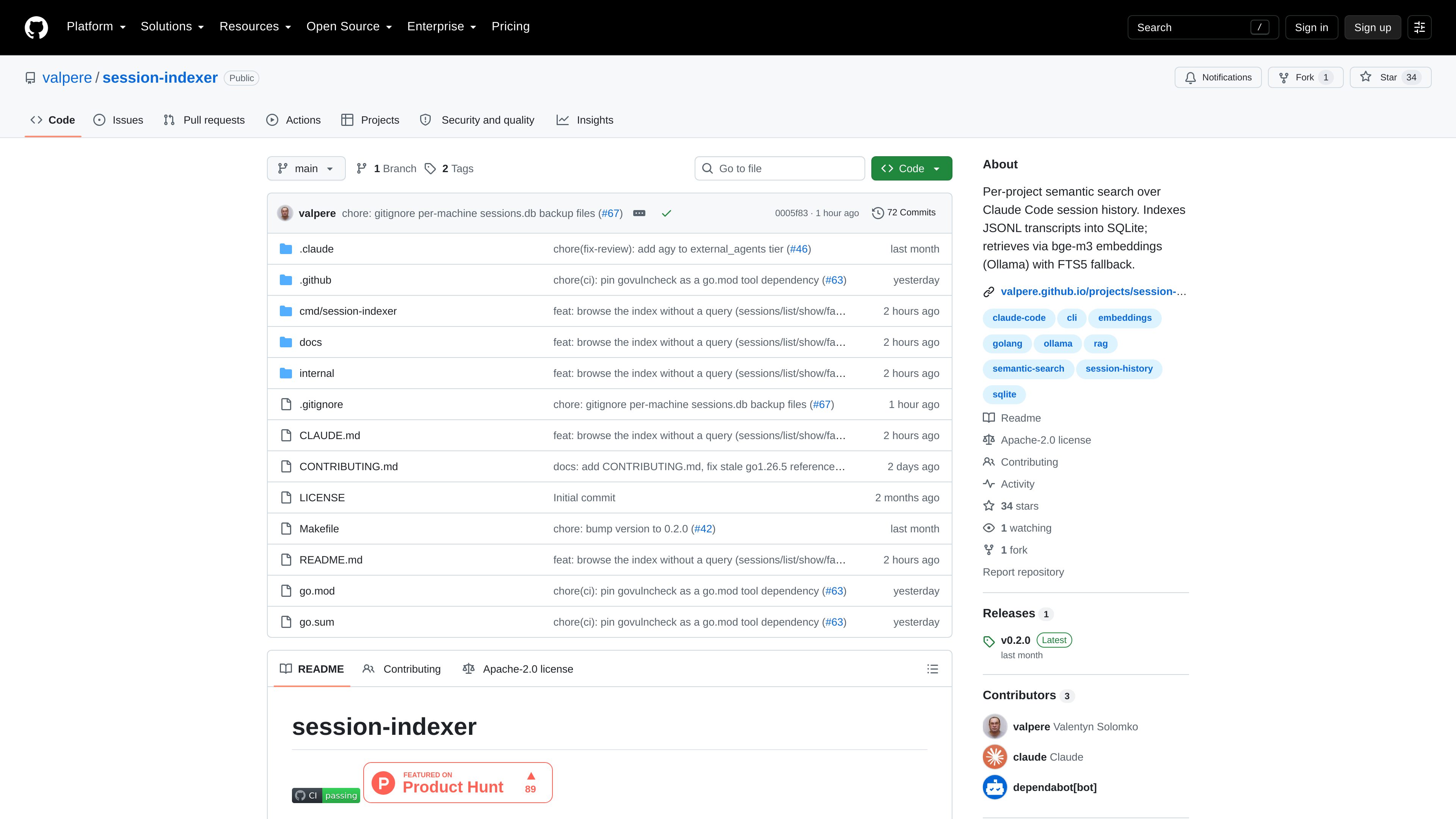
Indexes JSONL transcripts into SQLite
The project stores session history in SQLite, which makes the transcript data queryable in a structured local database instead of leaving it only as raw files.

session-indexer is a GitHub-hosted developer tool that indexes Claude Code session transcripts in SQLite and lets you search them semantically. It’s designed for per-project retrieval across JSONL session history, with FTS5 as a fallback when embedding-based retrieval isn’t available.
Session-indexer is a developer tool for searching Claude Code session history on a per-project basis. It indexes JSONL transcripts into SQLite and then lets users retrieve past sessions with semantic search powered by bge-m3 embeddings through Ollama, with FTS5 available as a fallback.
The project is presented as a GitHub repository and appears to be aimed at developers who want a local, queryable record of Claude Code sessions rather than a generic note-taking or search app. Its core purpose is to make past sessions easier to find by turning transcript files into a searchable index.
The project stores session history in SQLite, which makes the transcript data queryable in a structured local database instead of leaving it only as raw files.
The page description states that search is performed using bge-m3 embeddings via Ollama, which indicates embedding-based matching for searching by meaning rather than exact text alone.
When semantic retrieval is not used or not available, the project can fall back to SQLite FTS5, providing a text-search path over indexed transcript content.
The product is described as per-project search over Claude Code history, suggesting the index is organized around individual project contexts rather than one global transcript pool.
The repository contains a docs directory and a .claude directory, indicating that usage and project-specific configuration/documentation are part of the codebase.
A developer can search session history for a specific project when they need to recover a decision, command, or troubleshooting thread from earlier Claude Code work.
Semantic search is useful when the user remembers the topic of a session but not the exact phrase used in the transcript.
If the embedding path is not in use, FTS5 provides a fallback for users who still need text-based retrieval over the indexed transcripts.
Developers can keep JSONL transcripts in SQLite so session history is easier to inspect and reuse later.
It indexes JSONL transcripts from Claude Code session history into SQLite.
The project uses bge-m3 embeddings through Ollama for semantic retrieval, with FTS5 as a fallback.
The source describes a repository that indexes data into SQLite and does not indicate a hosted SaaS product.
Yes. The page explicitly mentions FTS5 fallback.
The repository includes docs and project files, but the provided page text does not show a full usage guide.
Traffic data is for reference only.
| Jul | 0 |
|---|---|
| Aug | 0 |
| Sep | 0 |
Traffic analytics are not available yet.
Traffic analytics are not available yet.

skillsmp.com
SkillsMP is a free marketplace for discovering open-source agent skills from public GitHub repositories, with search, browsing, REST API, and MCP access for Claude Code, Codex CLI, and ChatGPT.

algolia.com
Algolia is an AI search and retrieval platform for building search, discovery, recommendations, and generative experiences across websites and apps, helping teams deliver relevance, personalization, and retrieval.

tablo-cat.netlify.app
tablo is a desktop cat widget that monitors Claude Code and OpenAI Codex sessions from the corner of your screen. See live context usage, permission requests, notifications, and per-session activity previews.

sourcegraph.com
Search and navigate code across repositories with Sourcegraph, investigate questions with cited AI answers and coordinate reviewed changes at scale.