Quiver logo

Quiver

Freemium
Visit

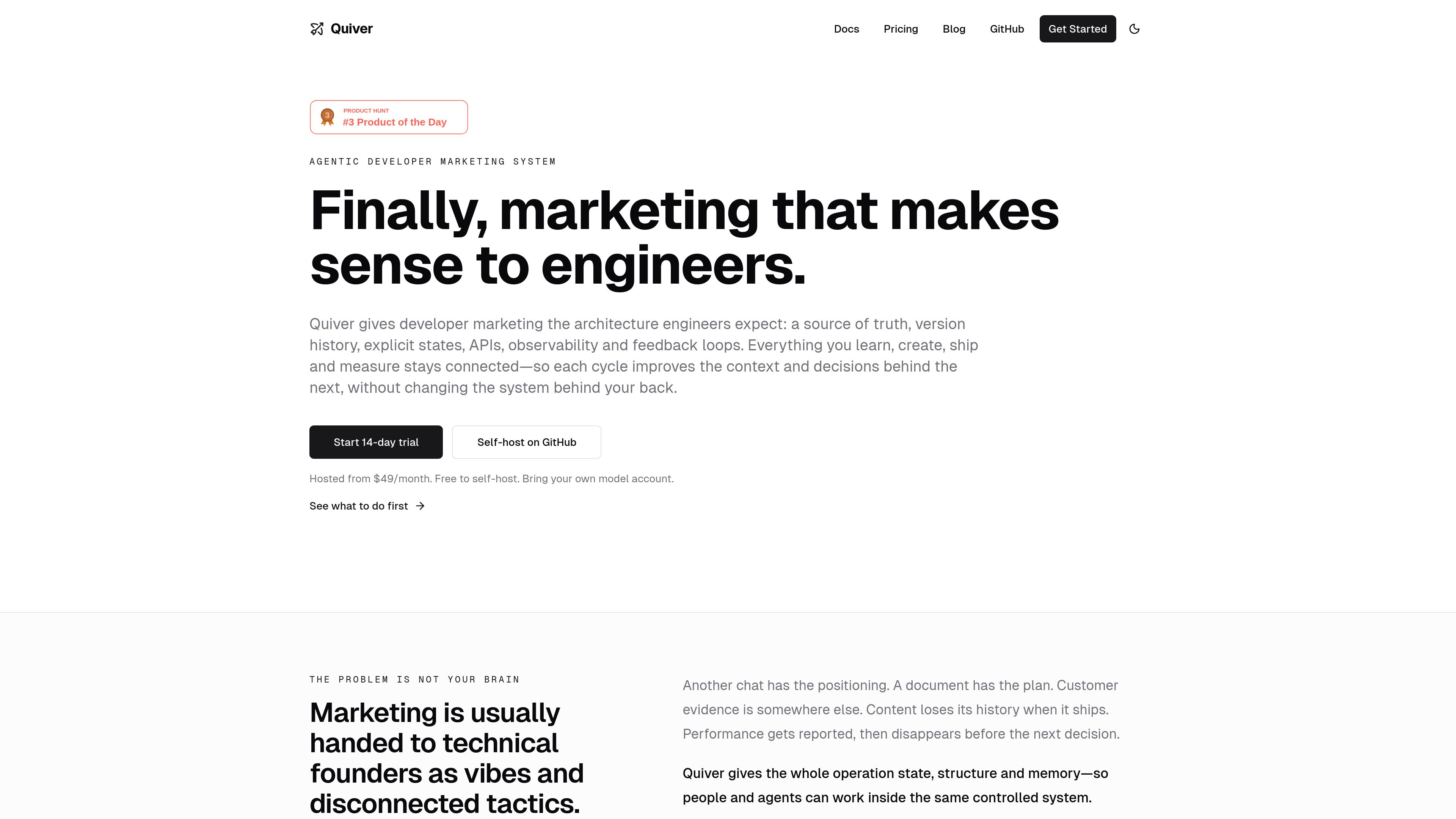
Quiver is an agentic developer marketing system for technical founders, developer marketing teams, and the agents they use. It brings approved product context, customer research, campaigns, content, publishing states, tasks, and performance results into one versioned workflow.

What is Quiver?

Quiver is an agentic developer marketing system designed for technical founders, developer marketing teams, and agents working alongside them. It provides a shared operating layer for product context, customer evidence, marketing work, published content, and measured results.

Instead of leaving positioning in one document, research in another tool, and content history in chat conversations, Quiver connects those records through version history, explicit production states, campaign relationships, APIs, and feedback loops. People approve context changes and content transitions, while agents operate within the same controlled system.

What can Quiver do?

Versioned marketing context

Store product details, audience information, positioning, customer language, proof points, and hypotheses in an active context. Changes can be reviewed, inspected, and restored rather than silently replacing prior knowledge.

Structured agent sessions and MCP access

Use Strategy, Create, Feedback, Analyze, and Optimize sessions, or connect an external agent through MCP. Sessions begin from the active approved context and write work back into the system.

Explicit artifact and publishing states

Move work through Draft, Review, Approved, Live, and Archived states. This separates generated output from approved knowledge and published content.

Customer evidence and hypothesis tracking

Process calls, surveys, reviews, and field notes into themes, Voice of Customer quotes, product signals, and evidence for or against active hypotheses.

Content operations and API delivery

Manage content versions, SEO and social metadata, repurposing lineage, distribution records, and content metrics. The Content API serves approved content as structured JSON for websites and other presentation layers.

Campaign and performance feedback loops

Link research, sessions, artifacts, content, tasks, and outcomes to campaigns. After work goes live, record quantitative results and qualitative notes, then review proposed context updates before they influence future work.

Use Cases

“Establishing a marketing operating system”

A technical founder can paste a website or describe a product to generate an initial context, review its assumptions, connect a model provider, and begin operating from an approved foundation instead of a blank chat.

“Coordinating developer marketing work”

A marketing team can connect strategy sessions, research, campaigns, artifacts, content, tasks, and results to the initiatives they support. Hosted workspaces add invitations, shared access, assignments, due dates, and reminders.

“Publishing approved content through an existing site”

Teams that want their website to control presentation can keep content and its approval history in Quiver, then use the Content API to deliver approved content as JSON.

“Turning customer conversations into messaging evidence”

Teams can synthesize calls, surveys, reviews, and field notes into reusable customer language, themes, and product signals, then make that evidence available to later marketing sessions.

“Measuring and improving marketing cycles”

After content or other work goes live, teams can record performance and qualitative observations, connect those results to the originating campaign, and review proposed changes to the active context.

Frequently Asked Questions

Who is Quiver for?

Quiver is intended for technical founders, developer marketing teams, and agents supporting developer marketing operations.

How do I get started?

Create a workspace, connect an Anthropic, OpenAI, Google, OpenRouter, or other OpenAI-compatible model account, and paste a website or describe the product. Quiver drafts initial context for review before you rely on it.

How does approval work?

Context and artifacts retain version history and explicit states. Agents can propose changes, but a person reviews and approves what becomes active context or progresses from draft to live.

Can Quiver replace my CMS, CRM, or analytics tools?

No. Quiver provides the context and decision layer around those systems. Its Content API, MCP interface, and publishing workflows preserve related reasoning, approvals, and learning.

Can a team self-host Quiver?

Yes. The self-hosted edition is MIT licensed and runs on the customer’s infrastructure, where the customer is responsible for the app, database, deployment, and model account. Hosted plans provide managed infrastructure and shared workspace features.

Quick Facts

Category
Developer marketing system
Primary users
Technical founders, developer marketing teams, and marketing agents
Workflow
Context → research and work → approval and publishing → measurement → reviewed learning
Agent interface
MCP server and hosted MCP endpoint
Content delivery
Public Content API for approved content as structured JSON
Deployment options
MIT-licensed self-hosting or managed hosted workspace

Quiver Traffic Analysis

Traffic data is for reference only.

Domain Rating
10

Quiver Alternatives

Charted Data logo

Charted Data

charted.blog

Charted Data is a source-code blog platform for publishing MDX content with interactive charts directly on a site. It helps technical writers, analysts, founders, and data-focused teams present metrics and data stories without relying on screenshot-based charts or third-party embeds.