
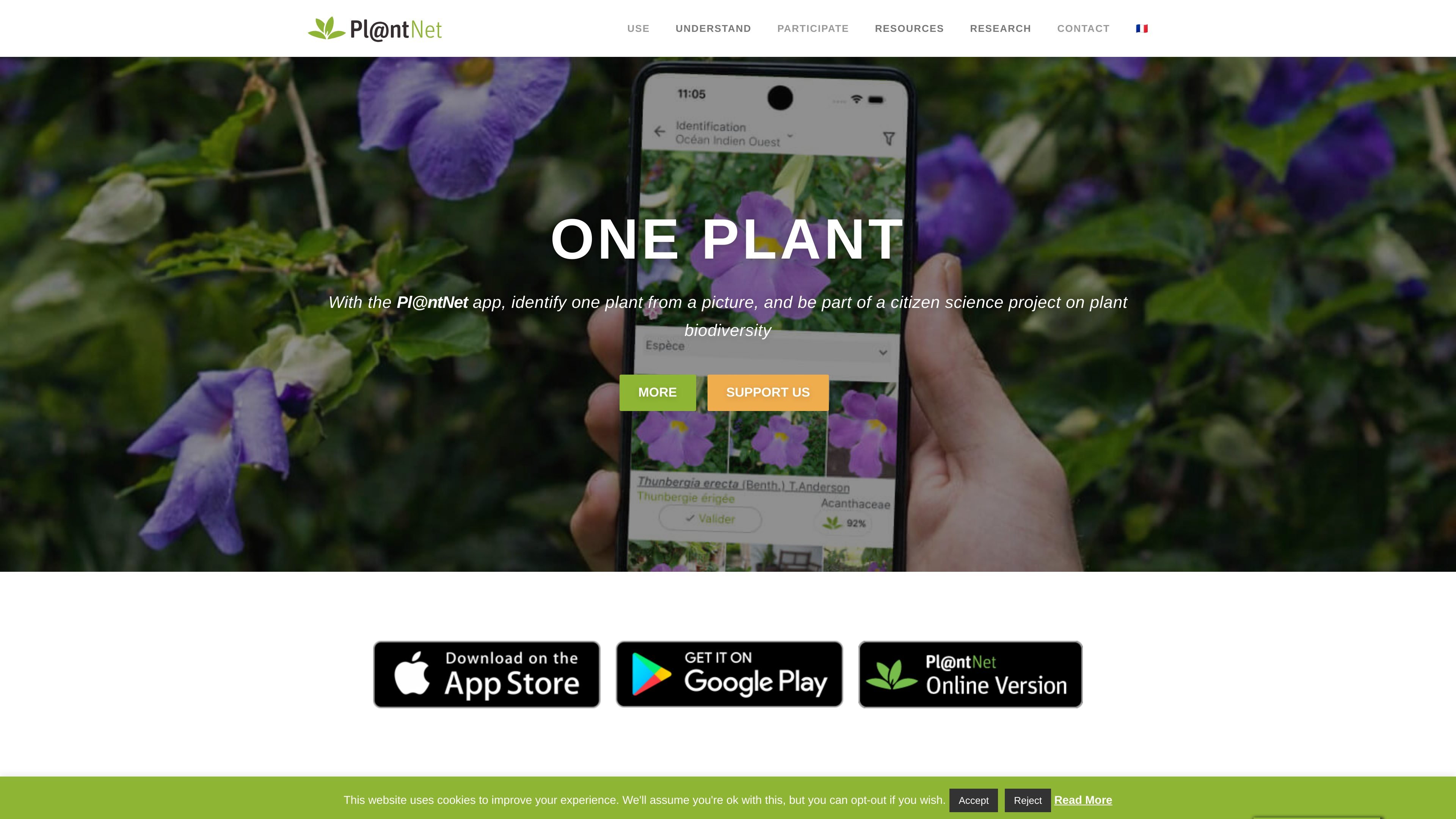
Photo-based plant identification
Identify plants from photos in the web app or mobile app by using image recognition to compare submitted images with the platform’s species database.

Pl@ntNet identifies plants from photos and supports biodiversity research on web, Android, and iOS.
Pl@ntNet is a citizen-science platform for identifying and inventorying plant species from photos. It combines a plant-recognition application with a community review process and a broader biodiversity data project.
The product is available on the web and on smartphones for Android and iOS. Users can submit plant photos, receive identification help, and, if they create an account, contribute observations that may be reviewed by the community and used to improve the AI model and public biodiversity datasets.
Identify plants from photos in the web app or mobile app by using image recognition to compare submitted images with the platform’s species database.
Use the service on both smartphone and browser, with explicit support for Android, iOS, and the web.
Create an account to share observations that can be reviewed by the community and contribute to the platform’s learning loop.
Confirm a suggested species or propose a different determination when you have botanical knowledge, adding human review to the workflow.
Contribute geolocated observations that may later support mapping and biodiversity research, with GPS data highlighted as important.
Benefit from a model that is retrained regularly, described as roughly monthly, to incorporate new observations and revisions.
Take a picture of an unknown plant and use the web or mobile app to get an identification suggestion based on image recognition.
Share your own observations from a created account so they can be reviewed by other users and potentially contribute to the AI model.
Confirm or correct a proposed species identification if you have botanical expertise, helping improve the quality of shared observations.
Record geolocated plant sightings for biodiversity mapping and research projects that rely on public observation data.
Use the help pages on iOS or Android to learn how to capture better plant photos before submitting observations.
Pl@ntNet is available on the web and on smartphones, with versions for Android and iOS. The site also points users to specific guidance for iOS and Android in its usage help pages.
Pl@ntNet uses image recognition, so it works best with clear photos. The help page advises taking good-quality images and sharing several photos of the plant organs when possible.
Users can share observations from a created account. Those observations may be reviewed by the community and, when they reach sufficient confidence, added to the public database and used to train the AI.
The site presents Pl@ntNet as a free participatory science platform, supported by donations, with no advertising and no resale of data.
Not every observation is shared. The site notes that only observations with enough confidence and acceptable image quality are added to the public database, and GPS location is important for mapping species.
Traffic data is for reference only.

qwen.ai
Qwen Studio is an AI assistant powered by Qwen series models for chat, research, image generation, multimodal understanding, and web-based creation. Free to use on web, iOS, Android, macOS, and Windows.

tap.pm
Tap Mobile builds AI-powered mobile apps for scanning documents, enhancing photos, personalizing phones, and managing calls across iOS and Android worldwide.

calorieasy.app
AI calorie counter that estimates calories from food photos and logs meals on iOS and Android.

whatbreedismydog.com
Free web app that identifies dog breeds from photos

calpulse.ai
CalPulse is an AI nutrition tracker that estimates calories and macros from meal or menu photos for faster logging and goal-based progress tracking on iOS and Android.