
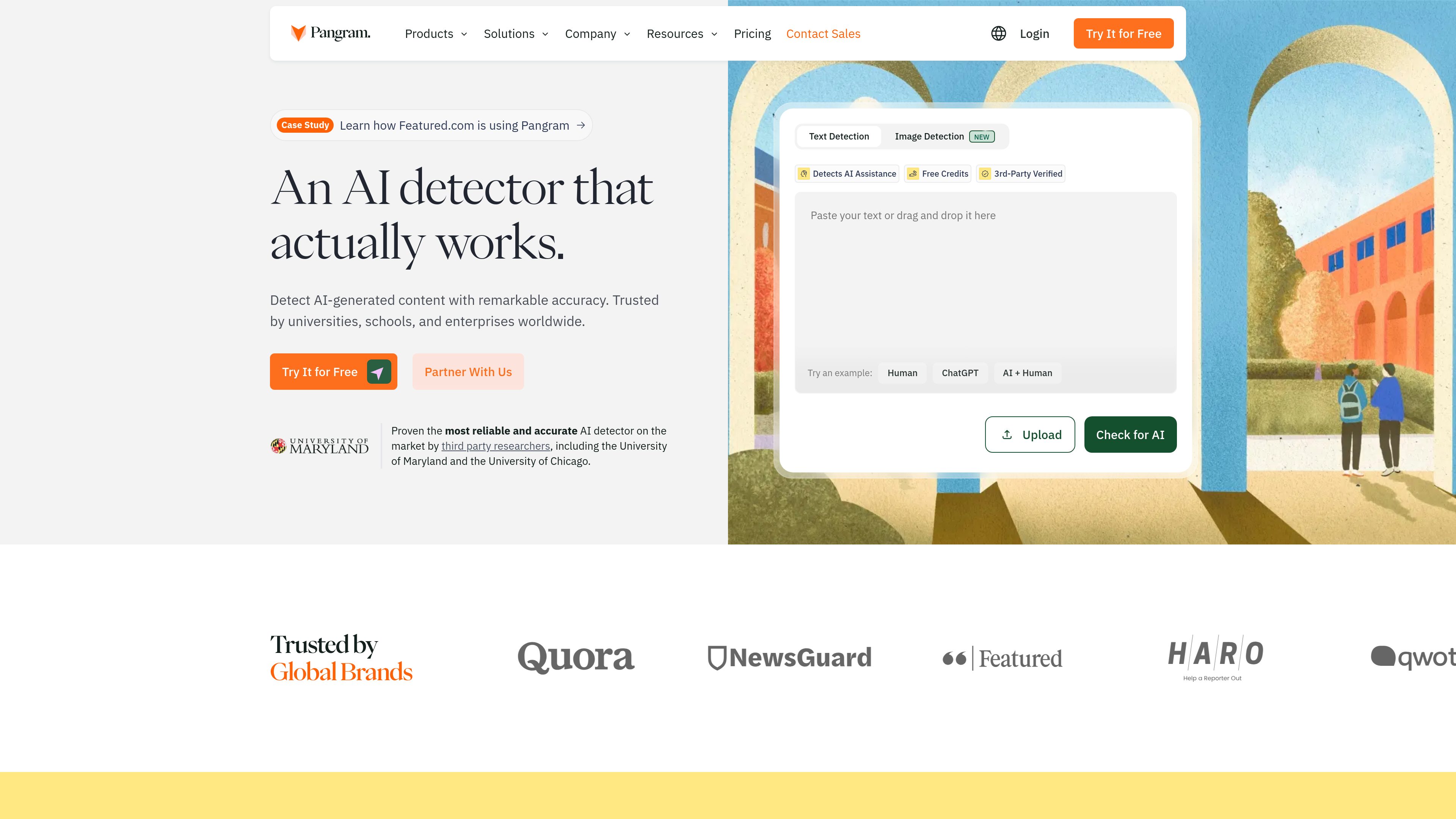
Text AI detection
Analyzes structural, stylistic, and semantic patterns in writing to identify likely AI-generated text from major language-model families, including ChatGPT, Claude, Gemini, Grok, and Llama.

Pangram is an AI detection service for analyzing text and images for signs of generative-AI assistance. It is designed for educators, publishers, businesses, and other users who need to assess content authenticity alongside plagiarism.
Pangram is an AI detector for text and images. It analyzes structural, stylistic, and semantic patterns in writing to identify likely AI-generated content from models including ChatGPT, Claude, Gemini, Grok, and Llama, and it also offers image detection.
The service is built for content-authenticity workflows in education, publishing, media, and business. In addition to an overall assessment, it can indicate how much of a document appears AI-generated, identify passages showing AI assistance, and check for plagiarism in the same workflow. Text can be pasted, dragged and dropped, or uploaded; the homepage also supports image uploads.
Analyzes structural, stylistic, and semantic patterns in writing to identify likely AI-generated text from major language-model families, including ChatGPT, Claude, Gemini, Grok, and Llama.
Checks uploaded images for signs of AI generation. The homepage lists JPG, PNG, and WebP uploads, with a minimum size of 512×512 pixels and a maximum file size of 30 MB per image.
Reports not only an overall confidence assessment but also how much of a document appears to be AI-generated, giving reviewers a more granular result.
Highlights text segments that may have been edited with AI rather than treating the entire document as fully AI-generated.
Combines plagiarism detection with AI detection so users can check text authenticity and potential copied content in one workflow.
The site states that its AI detection works across more than 20 languages, supporting use by institutions and businesses working with multilingual content.
Teachers and schools can use text analysis as one input when reviewing essays or other assignments, then use segment-level results to discuss possible AI assistance with students.
Editors and publishers can assess submitted articles, drafts, or documents for likely AI-generated passages and potential plagiarism before publication.
Media and communications teams can add an AI-origin check to workflows where readers, clients, or stakeholders need clearer information about how content was produced.
Businesses can review internal or externally supplied writing for AI involvement and plagiarism when evaluating documents, reports, or other written materials.
Users can upload supported image files to check whether visual material may have been AI-generated, alongside the service's text-analysis workflow.
Pangram analyzes written text and uploaded images. The homepage lists JPG, PNG, and WebP image uploads, with each image required to be at least 512×512 pixels and no larger than 30 MB.
The homepage indicates that users can paste text, drag and drop it, or upload a file. The result can include an overall AI assessment, segment-level analysis, and indications of AI assistance.
Yes. Pangram describes a combined workflow that checks for plagiarism and AI-generated content together, including a one-click AI and plagiarism check.
The homepage states that the free experience includes three scans per day. The supplied pricing-page evidence does not provide further plan prices or limits.
Pangram says it is trained to detect models from frontier labs including OpenAI, Anthropic, Google, Meta, DeepSeek, and xAI, and that it retests detection performance after major model releases. Results should still be interpreted in context rather than as definitive proof of authorship.

sensity.ai
Sensity AI is a deepfake and synthetic-media detection platform for analyzing videos, images, and audio. It combines pixel, file, metadata, and voice analysis with explainable forensic reporting and supports cloud, API, web-app, and on-premise deployments.

realitydefender.com
Reality Defender’s web-based deepfake detection for analysts, investigators, and verification teams.

isthisai.com
IsThisAI is a web-based detector for AI-generated and AI-manipulated images, video, and audio. It helps people assess suspicious media using model analysis, source detection, and visual heatmaps.

facia.ai
Deepfake and liveness detection for identity and media authenticity

walterwrites.ai
Walter Writes AI humanizes AI text and checks for AI signals

zerogpt.cc
ZeroGPT is a web-based AI text detector and writing utility that checks whether text appears human-written or AI-generated. It also offers readability, word-count, and text-splitting tools for editors, students, teachers, publishers, and marketers.