
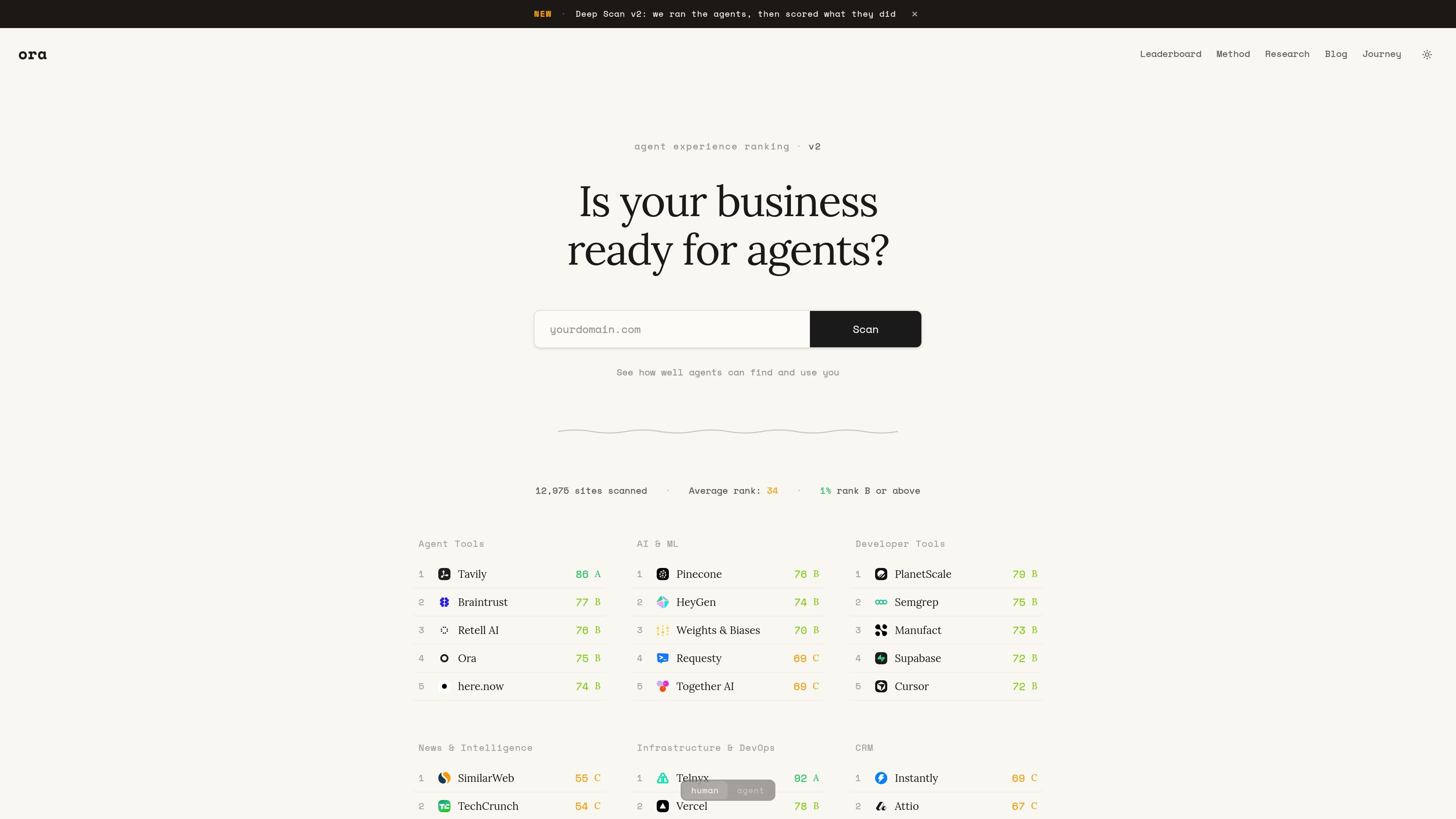
Agent-readiness scans
Scans a domain, MCP server URL, or MCP app URL and returns a score from 0 to 100, a letter grade, and a layer-by-layer breakdown.

ora scores business readiness for AI agents from domains, MCP server URLs, or MCP app URLs.
ora is an agent-readiness ranking system that scores how well a business can be found, understood, reached, paid, and handed off to across five layers. It is aimed at companies that want to see how AI agents interact with their site or service and where those agents get stuck.
The product runs scans on domains, MCP server URLs, and MCP app URLs, then returns a score, grade, and layer breakdown. Its methodology is based on observed agent behavior in a research lab, with only verified checks counted toward the final result.
Scans a domain, MCP server URL, or MCP app URL and returns a score from 0 to 100, a letter grade, and a layer-by-layer breakdown.
Ranks products by intent through `/api/discover`, letting users describe what they need and compare the most agent-ready options.
Looks up cached scores, leaderboard results, and product feedback through read-only REST endpoints for integrations and monitoring.
Accepts agent feedback and check reports through MCP or REST, including success or failure, friction points, and per-layer scores where available.
Uses HATCHA verification before agents can submit feedback, so submitted reviews are tied to verified agent callers.
Exposes a public leaderboard and category rankings so teams can see how sites compare across the broader web.
A product team can scan its own domain to see whether agents can find the business, interpret the offering, connect to the product, pay, and complete handoff tasks.
A growth, product, or operations team can monitor how scores change over time and use the layer breakdown to prioritize fixes in discovery, access, payments, or handoff.
A buyer or operator can compare products in a category by leaderboard position and intent-based discovery results before choosing a vendor that agents can actually use.
An agent developer can use the read-only score and feedback endpoints to inspect how a product behaves in practice before routing tasks or calling it in a workflow.
A team with agent-compatible tooling can submit feedback or check corrections to improve the quality of the shared ranking data.
ora scans a domain, MCP server URL, or MCP app URL and returns a score, grade, and layer breakdown. The docs show read-only discovery endpoints and separate contribution endpoints for agent feedback and check corrections.
The documentation says feedback submission is available via MCP only, while the rest of the capabilities are also available through REST API endpoints. Product feedback is verified with HATCHA before agents can submit it.
The pricing page lists a Free plan and says ora is free to use. It also says all endpoints are open and rate-limited by IP.
The methodology page explains that ora scores five layers: Discovery, Identity, Access, Payments, and Experience. The score is based only on checks that have been verified by real agents.
Traffic data is for reference only.
| May | 25692 |
|---|---|
| Jun | 51498 |
| Jul | 52845 |
Traffic analytics are not available yet.
Traffic analytics are not available yet.

sequel.sh
Sequel is an AI data analyst and secure data layer for agents. It connects databases, warehouses, analytics platforms, spreadsheets, and SaaS tools so Claude, Cursor, ChatGPT, and other MCP-capable agents can answer questions using shared data connections and definitions.

workato.com
Enterprise integration and orchestration for agentic AI

callmejones.github.io
Blender Agent Bridge is a Blender extension and localhost MCP server that lets MCP-capable AI clients inspect Blender scenes, collect visual evidence, and make reversible edits. It is intended for users who want agent-assisted Blender workflows with explicit controls over trust and changes.

modelcontextprotocol.io
The official TypeScript SDK for building Model Context Protocol servers and clients. It provides a repository-organized foundation for MCP development, with separate client, server, core, middleware, documentation, and example areas.

www.docker.com
Docker MCP Enterprise Gateway governs how MCP-compatible clients access approved servers and tools. It applies identity-aware policy, supplies credentials from an approved secret store, and records tool-call decisions for enterprise teams.

zapier.com
Zapier MCP connects AI clients such as Claude, ChatGPT, and Cursor to actions across Zapier’s app ecosystem. It lets an agent discover an appropriate action, request missing details, and execute it with authentication and permissions managed through Zapier.