
Durable agent sessions
Sessions can survive worker restarts, deployments, and lost browser connections, then resume from the point where work stopped.

Open-source infrastructure for building agent experiences into products.
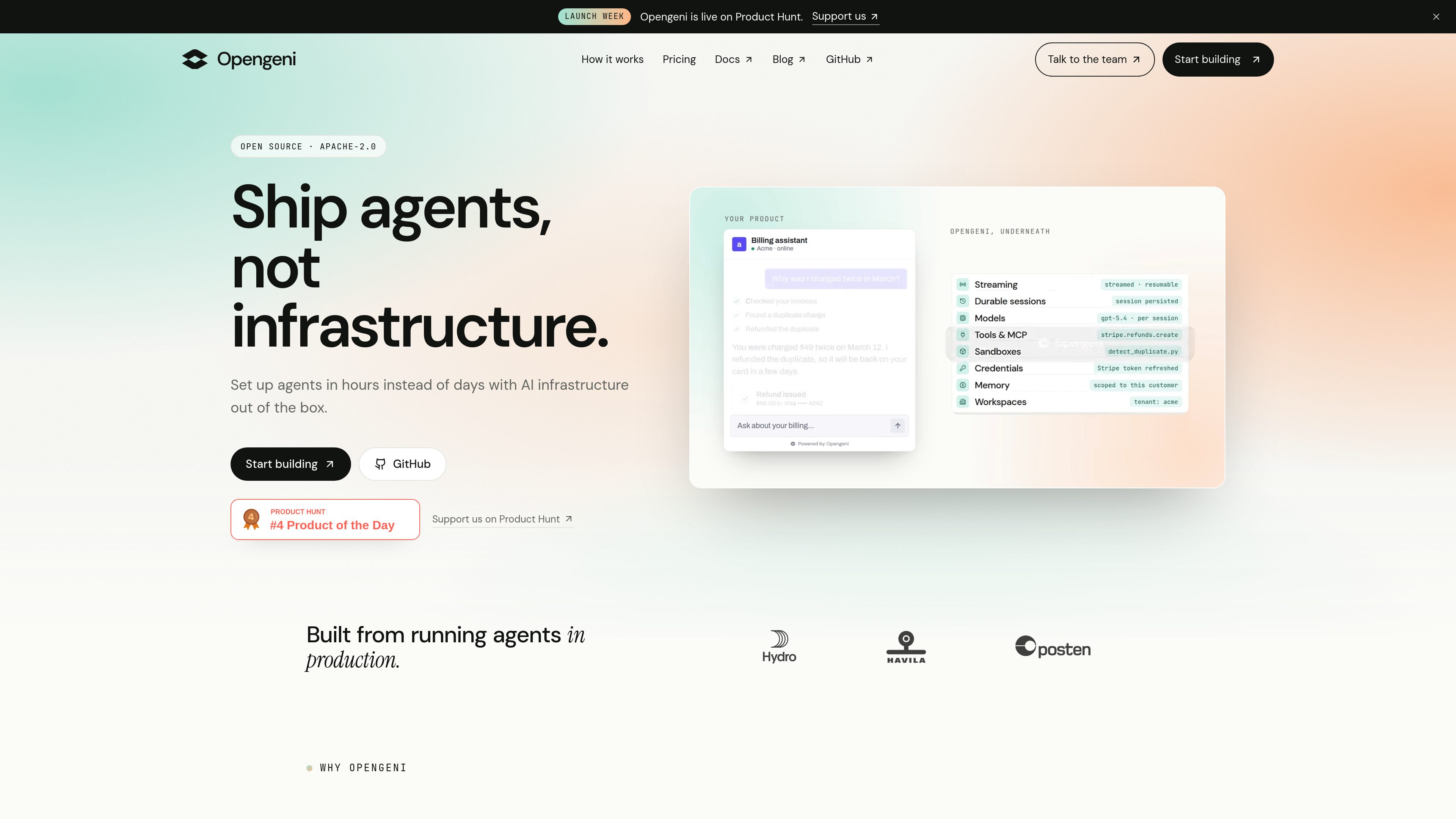
Opengeni is open-source AI infrastructure for teams that want to put agent experiences inside their own products. It provides an API for creating sessions, sending input, and streaming events, while handling the execution layer for sessions, tools, sandboxes, credentials, files, and workspace state.
Teams can embed the experience with TypeScript SDKs, React components, or plain HTTP. Long-running sessions are designed to continue through worker restarts, deploys, and disconnected browser tabs, and product-started sessions can also be followed and reviewed in the Opengeni app.
Opengeni can run locally, on a team’s infrastructure, or in the hosted cloud. The project is available under Apache 2.0; the hosted option is billed at model cost plus 5%, while self-hosting has no software license fee and requires the customer to cover infrastructure and model costs.
Sessions can survive worker restarts, deployments, and lost browser connections, then resume from the point where work stopped.
Configured sandbox backends provide isolated execution for agent tools, files, and session workspace state.
Agents can use connected tools and credentials, including OAuth tokens and API workflows, without requiring each product to build the entire wiring layer itself.
Use the TypeScript SDK for sessions, workspaces, tools, files, and event streams, or embed a styled session interface with React hooks, a composer, and timeline components.
Run the stack locally or on your infrastructure, including Kubernetes with Helm and Terraform options for AWS, Azure, and GCP, or use the managed Opengeni cloud.
The site lists support for OpenAI, Azure OpenAI, OpenRouter, and OpenAI-compatible endpoints, allowing teams to change model providers without changing the Opengeni layer.
Add a branded session interface to a product so customers can ask questions and receive responses tied to product data and actions, such as checking invoices or issuing a refund.
Give teams agents that can connect to business tools, inspect files, run isolated scripts, and complete recurring tasks such as reviewing failed webhooks or updating documents.
Use durable sessions for jobs that may outlast a request or browser connection, allowing teams to resume work after restarts and review the event stream afterward.
Build agent functionality into a product with product, tenant, user, workspace, and conversation mappings handled through a server-side integration pattern.
Run the open-source stack on infrastructure controlled by the organization when deployment, access, or security requirements call for a self-hosted setup.
The site describes three integration paths: the TypeScript SDK, the React package, and plain HTTP. The SDK supports sessions, workspaces, tools, files, and event streams; React provides session hooks, a composer, and timeline surfaces.
Yes. Opengeni is available under Apache 2.0 and can run locally or on your infrastructure. The site also describes Kubernetes deployment with Helm and Terraform options for AWS, Azure, and GCP.
Durable sessions are designed to keep work running through worker restarts, deployments, and closed or disconnected browser tabs, then resume from the recorded point.
The pricing page states that Opengeni Cloud charges model provider cost plus 5%. It also states there is no per-seat fee, platform fee, or minimum commitment.
Sessions started by your product can appear in the Opengeni app, allowing teammates to follow and review the work in one place.
Traffic data is for reference only.

autoloops.ai
Autoloops provides speech infrastructure for voice agents, combining streaming speech-to-text with realtime serving for open-weight language models. It offers serverless APIs and on-demand clusters for teams building or testing realtime voice and agent workloads.

steel.dev
Steel is open-source browser infrastructure for AI agents and web automation. It provides cloud browser sessions through an API, with support for common browser automation tools and workflows such as scraping, research, RPA, and agent-driven web tasks.

digitalocean.com
Cloud infrastructure, AI inference, and agent services for developers building applications.

oceanprotocol.com
Open-source infrastructure for developers to monetize AI models and data with privacy controls.

superlinked.com
Open-source inference for agents, serving embeddings, rerankers, extractors, and open LLMs on your infrastructure.

phonic.ai
Speech-to-speech voice agent infrastructure for teams building phone and audio workflows.