
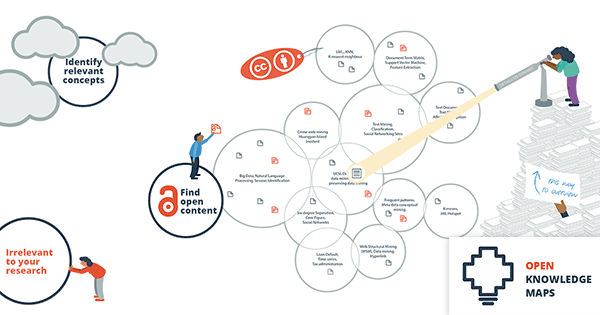
Visual topic overviews
Enter a topic or keyword to get a topical overview of matching research outputs. The map groups similar resources so you can see main areas at a glance.

Web-based research discovery with visual knowledge maps
Open Knowledge Maps is a visual discovery tool for scientific literature. It takes a research question or keyword and turns matching publications into a knowledge map that shows the main areas of a topic, related resources, and key concepts.
The service is positioned as an open, charitable non-profit platform. It is designed to support literature search for researchers, students, and institutions that want a clearer starting point before they dig into individual papers.
Enter a topic or keyword to get a topical overview of matching research outputs. The map groups similar resources so you can see main areas at a glance.
The AI pipeline clusters related publications together, which helps separate broad search results into subject areas and makes ambiguous queries easier to scan.
Area labels are generated from subject keywords and related metadata so users can identify the concepts that define each cluster.
Open access resources are highlighted, and many can be opened directly in the interface. When they are not available there, the full text is only a click away.
The FAQ explains that maps are built from live requests to selected data providers, currently including PubMed and BASE, using a controlled set of top results.
Organisations can use Custom Services to embed Open Knowledge Maps components in their own discovery systems and workflows.
Start a literature review with a visual map that shows the main areas of a topic, so you can move from a broad question to the papers most likely to matter.
Use the clustered bubbles to break apart an ambiguous or multidisciplinary query and focus on the sub-areas that are actually relevant to your work.
Identify open access papers quickly when you want content you can read immediately or share with others without leaving the interface.
Use the map as a teaching or orientation aid when introducing a research field, since it gives newcomers a visual way to learn the field’s concepts and structure.
Embed Open Knowledge Maps components into an internal discovery system when an organisation wants AI-based literature discovery within its own workflows.
Open Knowledge Maps uses a live query workflow. A search is sent to a selected data source such as PubMed or BASE, and the system then builds a knowledge map from the returned results.
The FAQ says the current maps use the top 100 resources from the selected data source. This keeps the map manageable, but it can also mean some relevant items are not shown.
The map is built from article metadata rather than full text. The FAQ says it uses titles, abstracts, authors, journals, and subject keywords to cluster related publications.
The product is designed to work with common scholarly search tasks. It helps you get an overview of a topic, separate related areas, and identify concepts before you continue a literature search.
The site states that organisations can use Custom Services to embed Open Knowledge Maps components into their own discovery systems and workflows.
Traffic data is for reference only.

askstockgpt.com
AI financial research assistant for S&P 500 and Nasdaq data

jina.ai
Search-focused AI platform with APIs and models for web reading, search, embeddings, reranking, and multimodal or multilingual retrieval.

ontosight.ai
AI research assistant for scientific search, document chat, and cited writing

bochaai.com
博查AI搜索 is a multimodal search engine for AI apps, helping developers and agents access external knowledge and search results.

citely.ai
Citely finds original sources, verifies citations, and supports academic research workflows.

minduck.com
Minduck is a web-based AI platform for creating and researching with mind maps.