
Linkable explorer views
Tabs, filters, entity pages, and focused map views can be linked directly, so a demo or saved state can be shared as a URL and revisited with the browser back button.

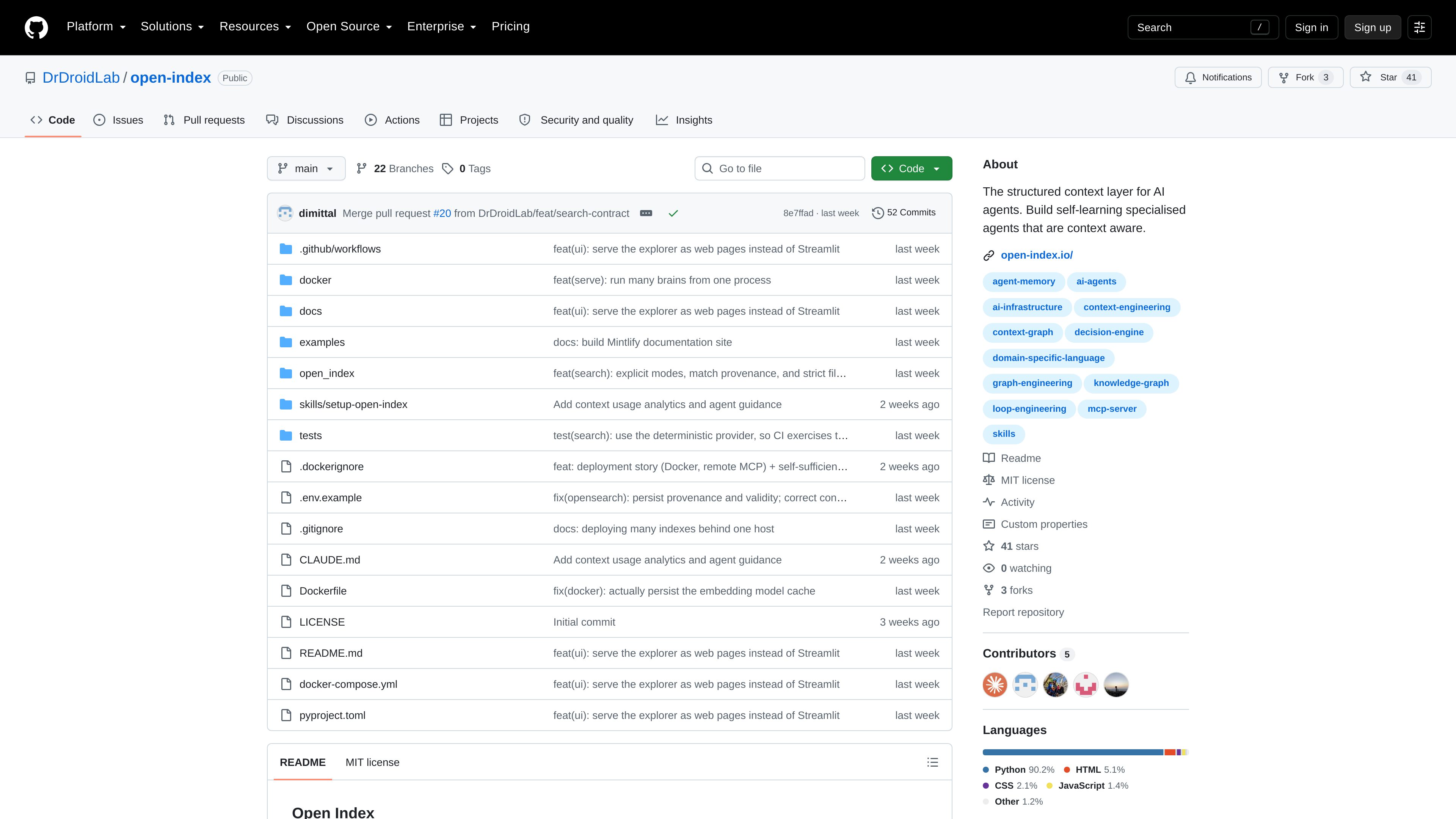
open-index is a structured context layer for AI agents, designed to help teams build self-learning, specialized agents that remain context-aware.
open-index is a structured context layer for AI agents. Its stated purpose is to help teams build self-learning specialized agents that stay context aware.
The project’s interface exposes browsable, linkable views for tabs, filters, entities, and maps. It is designed to work as a web application rather than a session-state-only interface, with pages that render directly and support normal browser navigation.
The repository also shows support for serving multiple brains from one process, using per-brain tokens, and handling proxy-aware endpoints. Those choices point to a deployment model that is meant to remain practical in containers and behind reverse proxies.
Tabs, filters, entity pages, and focused map views can be linked directly, so a demo or saved state can be shared as a URL and revisited with the browser back button.
The UI renders as HTML on first byte, with map data fetched separately. That helps the page appear before larger graph data has finished loading.
The project supports routes such as entity views, filtered exploration, and map-focused pages, which makes navigation based on path and query parameters rather than hidden browser state.
The map uses Cytoscape, vendored into the package so it remains installable and usable offline without depending on a separate front-end build step.
The repository describes mounting multiple brains under one process and one port, instead of running a separate container per brain.
Endpoint handling honors forwarded protocol information, and per-brain tokens are used so access to one endpoint does not automatically open the rest.
Use open-index when you need a structured layer that presents context in a way AI agents can query and navigate consistently.
Run several brains in one process and expose each under its own path, which is useful when separate indexes need to share infrastructure without separate containers.
Because tabs, filters, entities, and maps are linkable, a specific view can be copied and shared instead of reconstructed manually.
The project is built to respect forwarded protocol handling, which matters when it sits behind TLS-terminating infrastructure.
Since the page renders before map data is fetched, a large graph does not have to block the initial UI from appearing.
It is described as a structured context layer for AI agents, intended to help build self-learning specialized agents that remain context aware.
The repository text indicates the explorer was moved to server-rendered web pages, with HTML rendered on first byte and map data fetched separately.
Yes. The source text says tabs, filters, entities, and focused map views are all linkable, so a demo or saved state can be sent as a URL.
Yes. The repository text describes mounting multiple brains under one process and one port, with each brain exposed under its own path.
No pricing for open-index itself is shown in the provided source. The evidence is primarily from the GitHub repository page and related GitHub pricing pages.
Traffic data is for reference only.

songcleaner.com
Web-based AI audio editor for cleaner song versions

compup.io
Compensation management for pay decisions, rewards, offers, and HR data

www.cluing.io
Cluing helps people capture and organize insights from webpages, PDFs, videos, social posts, and other online sources so they can reuse that context with AI and collaborate around it.

decart.ai
Decart AI Lab builds real-time world models and infrastructure for Physical AI, including Oasis 3 and DOS.
hika.fyi
AI-powered intelligence for tracking trending Polymarket markets in English and Chinese

playperidot.com
Peridot is Niantic’s AI pet and AR franchise for mobile, headsets, glasses, and web.