
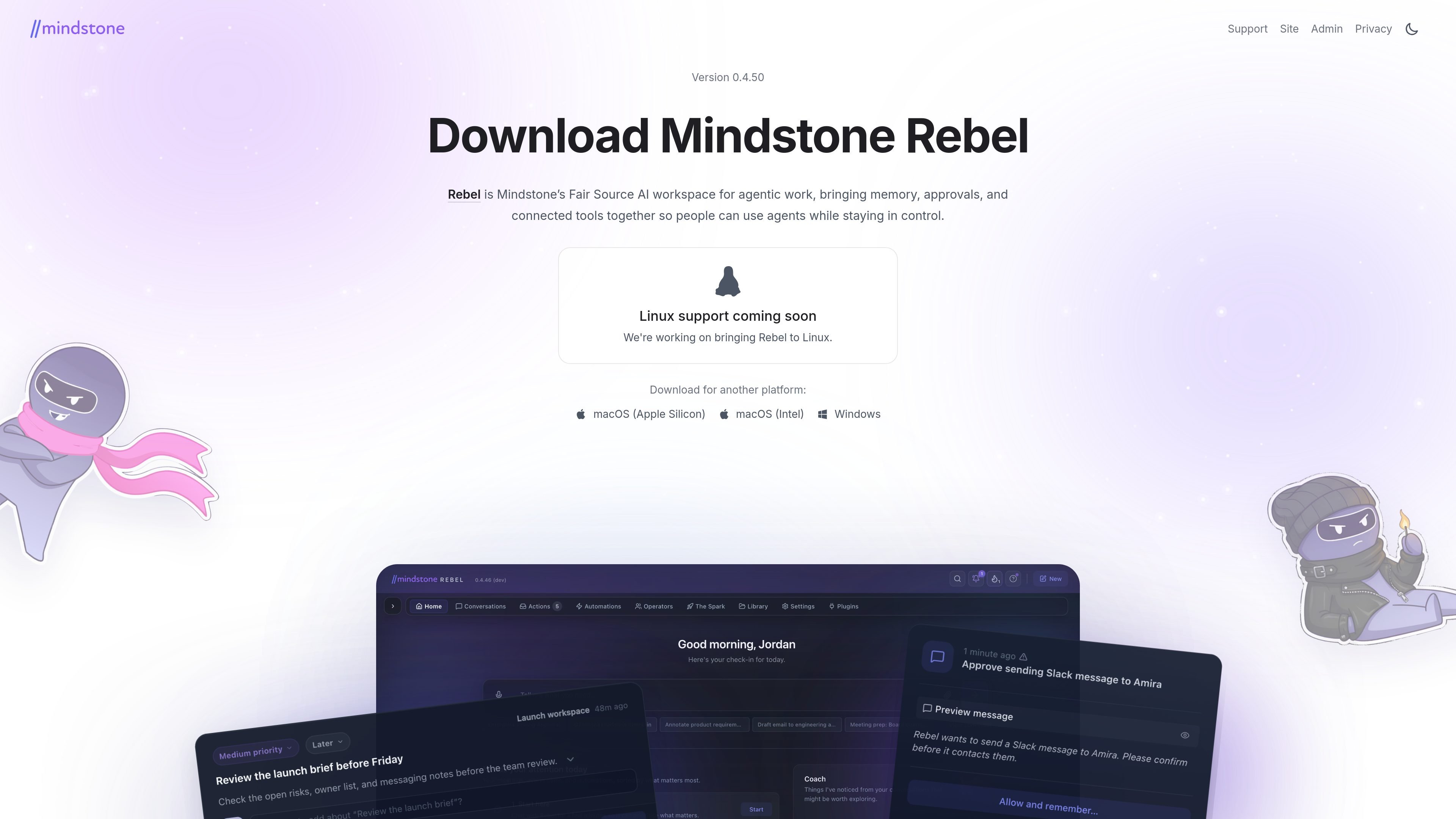
Memory for ongoing work
Rebel includes memory, which suggests it can retain context across steps instead of treating each interaction as isolated.

Mindstone Rebel is a Fair Source AI workspace for agentic work on Mac and Windows, helping people use agents with memory, approvals, and connected tools while staying in control.
Mindstone Rebel is an AI workspace designed for agentic work. It brings memory, approvals, and connected tools into one place so people can work with agents while keeping control over what they do.
The product is available for Mac and Windows, with Linux support coming soon. The website also indicates a sign-in flow for using the workspace, suggesting Rebel is built around an authenticated app experience rather than a standalone public demo.
Rebel includes memory, which suggests it can retain context across steps instead of treating each interaction as isolated.
The product highlights approvals, letting users stay involved in agent actions before they are carried out.
Rebel brings connected tools into the workspace so agentic work can happen alongside the tools people already use.
The site describes Rebel as a Fair Source product, which is relevant for teams evaluating the product’s licensing and openness.
Rebel is offered as downloadable software for Mac and Windows, making it suitable for local desktop workflows.
Use Rebel when you want an AI agent to help with multi-step work but need approvals before actions are taken.
Use it for workflows that benefit from memory, such as returning to a task with prior context preserved.
Use Rebel when the work depends on connected tools rather than isolated chat responses.
Use it if your team prefers a desktop application on Mac or Windows instead of a browser-only workflow.
It is Mindstone’s Fair Source AI workspace for agentic work.
The site lists Mac and Windows downloads, and says Linux support is coming soon.
Yes. The homepage highlights approvals as part of the workspace.
The site says Rebel includes connected tools, but it does not list the specific integrations in the provided source.
A pricing URL is present, but the provided page returns a 404 and does not show pricing details.
Traffic data is for reference only.
www.simular.ai
Simular is an autonomous computer platform that uses AI agents to operate real computers and automate digital workflows. It serves individuals, builders, operators, and businesses that need to automate tasks across desktop applications and websites, including workflows that do not expose traditional APIs.

workato.com
Enterprise integration and orchestration for agentic AI

decisions.com
Decisions orchestrates workflows, integrations, process intelligence, and AI agent governance for enterprise teams.

union.ai
AI runtime for durable workflows and real-time apps in your cloud

octomind.run
Octomind Cloud runs AI agents on persistent cloud machines for research, writing, web work, software development, and scheduled routines. Users give instructions in plain language and can receive results through the web panel, Telegram, WhatsApp, or Slack.

vendo.run
Vendo is an open-source customization layer that embeds an agent inside software products. It lets customers create views, UI changes, micro-apps, and automations through the product’s API and components while retaining the product’s branding and permission rules.