
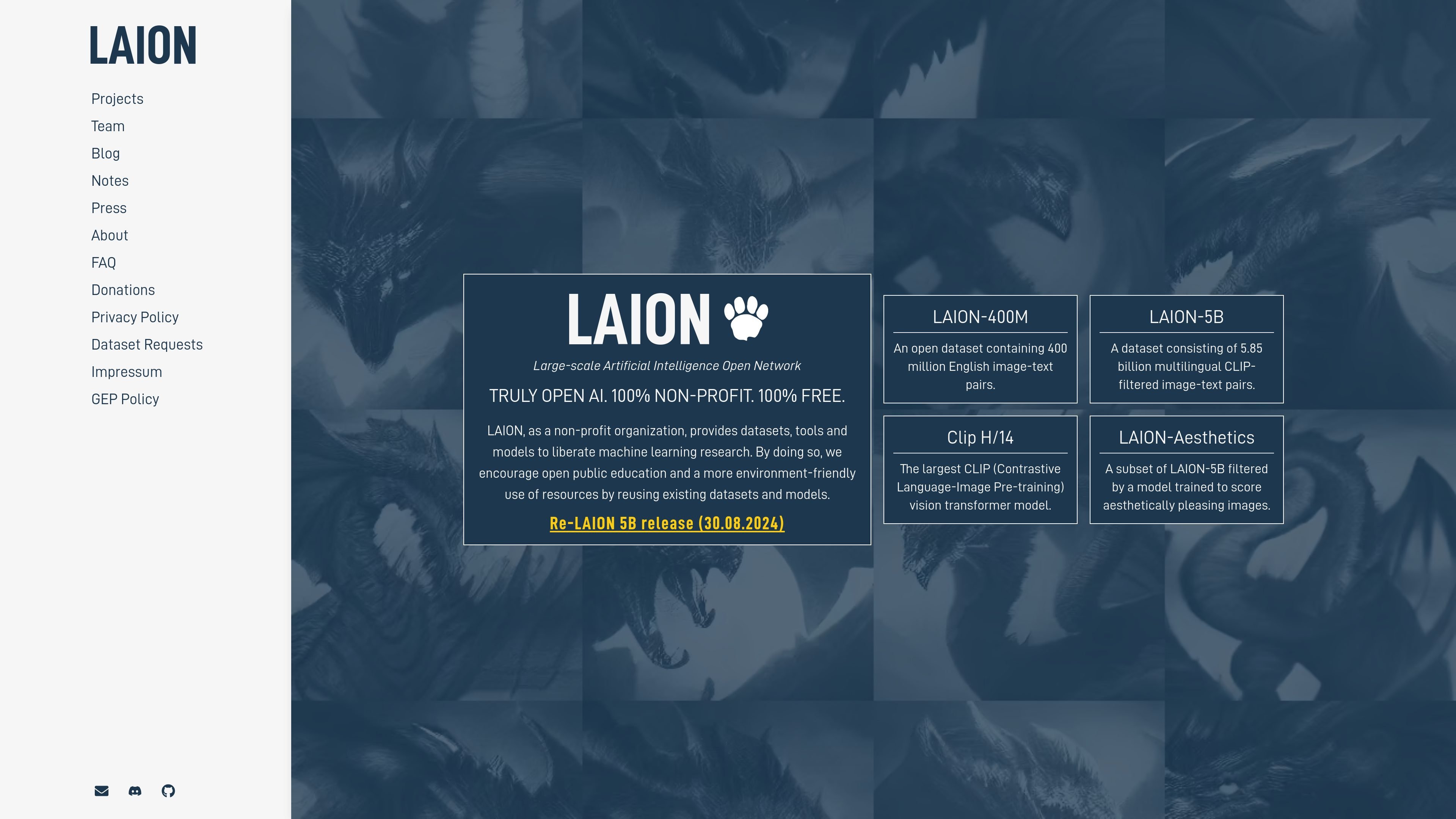
Large public datasets
The site presents LAION as a source of large-scale datasets such as LAION-400M and LAION-5B, which are image-text collections intended for machine learning research.

LAION publishes open ML datasets, models, and tools for research
LAION, the Large-scale Artificial Intelligence Open Network, is a non-profit organization that releases datasets, code, and machine learning models for public use. Its site describes the organization as 100% open, 100% non-profit, and 100% free, with a focus on making machine learning resources available to the general public.
The organization’s projects center on large image-text datasets, open model implementations, and supporting tools for building or analyzing training data. LAION says its work is intended to help researchers reuse existing datasets and models, support education, and reduce duplicated training effort and resource use.
The site presents LAION as a source of large-scale datasets such as LAION-400M and LAION-5B, which are image-text collections intended for machine learning research.
LAION maintains open models including `OpenCLIP`, `ClipCap`, `CLAP`, and `Multilingual-CLIP`, covering contrastive, generative, and multimodal research tasks.
The projects page includes utilities such as `img2dataset` and `Clip Retrieval` for downloading image sources, building datasets, and working with CLIP embeddings.
LAION also lists work on filters and detectors, including watermark detection and NSFW detection, as part of its dataset and model ecosystem.
The FAQ explains that LAION datasets are indexes of URLs and text metadata, and that users reconstruct the data they need rather than receiving original media files from LAION.
The organization says it releases datasets, code, and models to make large-scale machine learning research more reusable and accessible to the public.
Researchers can use LAION’s released datasets and models as starting points for training, benchmarking, or reproducing multimodal machine learning work.
Teams building data pipelines can use `img2dataset` and related project tooling to reconstruct dataset subsets from URL-based sources and package them for experimentation.
Practitioners working on image retrieval or embedding workflows can use `Clip Retrieval` and CLIP-related releases to compute embeddings and explore similarity search.
Organizations or contributors concerned with harmful or unwanted content can review LAION’s detector projects, such as watermark and NSFW detection, as part of dataset filtering work.
Researchers interested in open-source multimodal infrastructure can explore LAION’s mix of datasets, models, and tools as reusable components for public research.
LAION says its datasets are indexes of the web: lists of URLs and associated alt text or captions, not stored copies of the original media. It also says researchers reconstruct the data they need by downloading the subset they are interested in, and suggests `img2dataset` for that workflow.
The FAQ says LAION is a non-profit research organization and that it is permitted to use copyrighted material for research under EU and German TDM exemptions. It also states that LAION does not store original images, audio, or video in its datasets.
According to the FAQ, LAION provides a GDPR takedown process for verifiable requests involving personal data such as a name or image appearing in dataset metadata or linked content. It notes that it can remove entries from data repositories it controls, but not past releases circulating outside its control.
The projects page shows a mix of released, started, planning, and in-progress work. That includes datasets, models, and tools such as `LAION-5B`, `OpenCLIP`, `img2dataset`, and `Clip Retrieval`.
LAION describes itself as a non-profit organization funded by donations and public research grants. The site also presents its work as 100% free and open to the public.
Traffic data is for reference only.
| Jun | 33954 |
|---|---|
| Jul | 29099 |
| Aug | 22281 |
Traffic analytics are not available yet.
Traffic analytics are not available yet.

cradle.bio
Cradle is an AI platform for protein engineering, helping biopharma and industrial biotech teams generate candidates, optimize properties, and learn from experimental data.

voxpopme.com
Voxpopme is a qualitative research platform for video surveys, live interviews, AI-moderated studies, and AI-assisted analysis.

www.useclick.ai
Click MCP gives AI agents specialized external context beyond web search, including people, company, social, travel, financial, and marketplace data. Built for chat-based workflows, it helps agents gather and organize the information needed to complete tasks end to end.

phbench.com
Open benchmark for predicting Series A funding from Product Hunt launch signals

chat.blockscope.co
BlockscopeChat is a web-based AI on-chain investigator that decodes transactions, profiles wallets, and traces funds across 8 EVM chains, helping turn blockchain questions into shareable, evidence-backed case files.

yabble.com
AI research platform for text analysis, summaries, and virtual audience testing