
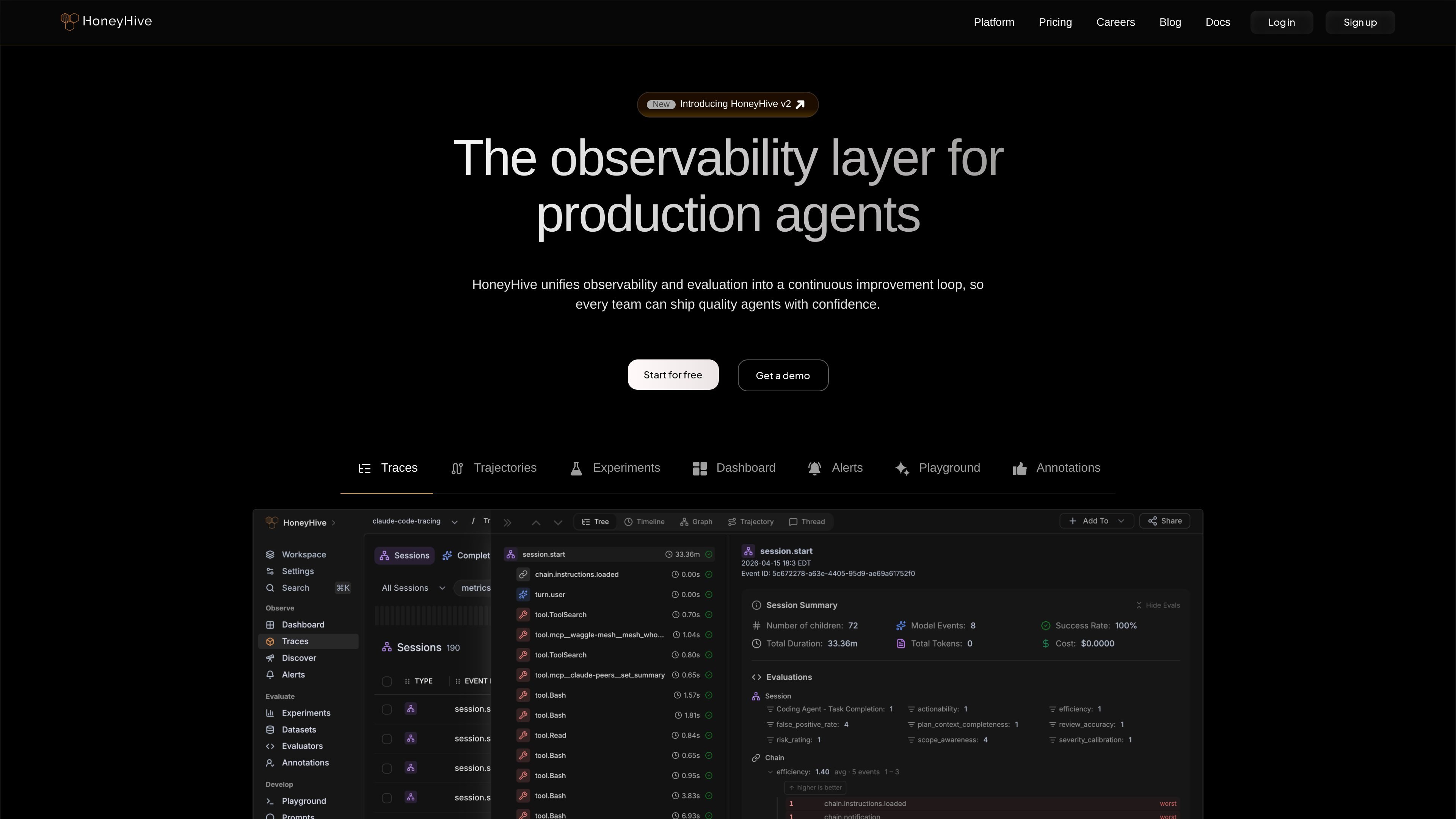
Distributed tracing
Instrument agents with OpenTelemetry to trace behavior across frameworks, models, and runtimes, then use a shared view for debugging and analysis.

Observability and evaluation platform for production AI agents
HoneyHive is an observability and evaluation platform for production AI agents. It combines distributed tracing, live evaluation, experimentation, and review workflows so teams can inspect how agents behave, identify failures, and improve them in a repeatable loop.
The site positions the product as OpenTelemetry-native and framework-agnostic, with support for instrumenting agents on any stack. It is aimed at teams that want one shared source of truth for debugging agent behavior, monitoring live systems, and turning production issues into test cases for the next iteration.
Instrument agents with OpenTelemetry to trace behavior across frameworks, models, and runtimes, then use a shared view for debugging and analysis.
Run live evaluations on traces to detect failures, score outputs, and combine automated checks with human review.
Monitor real-world behavior with alerts, drift detection, and custom dashboards so teams can catch issues before users do.
Replay chat sessions and inspect trajectories, graphs, and timelines to understand how multi-step agent workflows unfold.
Turn production failures into offline test suites, compare against baselines, and detect regressions before release.
Route flagged traces into annotation queues, apply custom rubrics, and use expert feedback to curate datasets and align evaluators.
Instrument production agents to see traces, trajectories, and session replays when debugging unexpected behavior across a live system.
Monitor live traffic with online evaluation, alerts, drift detection, and dashboards to catch quality issues as they emerge.
Build offline regression suites from real failures, compare changes against baselines, and run checks in CI/CD before shipping updates.
Use annotation queues and custom rubrics to let domain experts review edge cases and align evaluators with business standards.
Adopt self-hosted or hybrid deployment when data isolation, governance, or enterprise controls are required.
HoneyHive supports both automated evaluations and human evaluations. Automated evaluations can use code or LLM-as-a-judge scoring, while human evaluations let domain experts review outputs with custom rubrics and annotation queues.
Yes. The Enterprise plan supports self-hosting, and the pricing page also lists hybrid options with a HoneyHive-managed control plane and a self-hosted data plane.
The pricing page says HoneyHive provides Python and TypeScript SDKs with native OpenTelemetry support, plus automatic instrumentation for 50+ libraries such as LangChain, LangGraph, AWS Strands, Google ADK, and OpenAI Agents SDK.
HoneyHive is designed for AI agent observability and evaluation. The site positions it for production agents, distributed tracing, online evaluation, experiments, alerts, annotations, and review workflows.
Traffic data is for reference only.

www.privent.ai
Privent is a runtime security layer for agentic AI, especially n8n workflows. It masks sensitive data before external models see it, logs risk decisions, and monitors organization-wide use of ChatGPT, Claude, and Gemini.

raindrop.ai
Raindrop helps teams monitor AI agents, investigate production failures, and verify fixes with traces, signals, Slack triage, and experiments.

fiddler.ai
Enterprise AI observability and security for production agentic systems, with evaluation, monitoring, guardrails, and governance.

keywordsai.co
LLM engineering platform for observability, evals, prompts, and routing

chirpz.ai
Chirpz AI builds PandaProbe, an open-source platform to trace, evaluate, and monitor AI agents in production for better observability and debugging.

lmnr.ai
Open-source observability for AI agents with tracing, failure detection, evaluations, Slack alerts, and self-hosting.