Faraday logo

Faraday

Claim

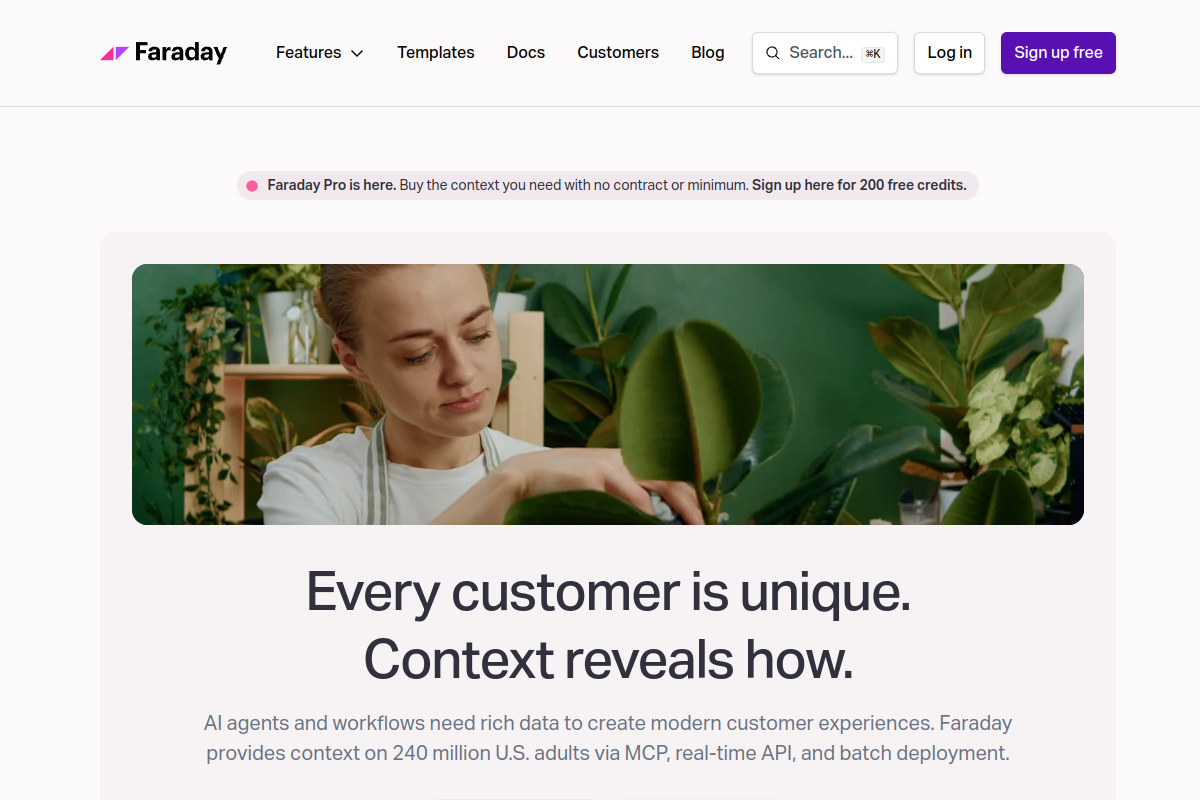
Faraday is a customer context platform that enriches consumer and customer data and delivers it through API, MCP, UI, and batch workflows. It helps teams build predictive models, personas, and enrichment-driven activations inside existing stacks.

Faraday logoFaraday

Customer context for agents and workflows

Faraday is a customer context platform for AI agents and operational teams. It combines third-party consumer data with a client’s first-party data so teams can enrich people and households, create predictive signals, and deliver those results through API, MCP, UI, or batch deployment.

The platform centers on the Faraday Identity Graph, which the site says includes data on approximately 240 million U.S. adults and more than 1,500 consumer and identity data points. It is positioned for enrichment, segmentation, prediction, and repeated activation inside existing stacks rather than as a standalone analytics tool.

Core capabilities

Multiple delivery paths

Faraday exposes customer context through API, MCP, UI, and batch deployment so teams can work with the same underlying data in different operational settings.

Identity and consumer enrichment

The platform starts with Faraday Identity Graph data on about 240 million U.S. adults and more than 1,500 consumer and identity data points, then lets teams choose which elements to include in a payload.

Predictive modeling

Faraday can build custom predictive models from a client’s first-party data and its own consumer data, including propensity, next best offer, churn, and persona clustering use cases.

Developer API surface

The docs include a REST API with authenticated endpoints for datasets, streams, cohorts, outcomes, persona sets, scopes, attributes, feature stores, connections, and targets.

Ongoing stack deployment

The product supports recurring deployment, so context and predictions can be continuously pushed into existing data warehouses, cloud providers, and marketing tools.

Insight and reporting tools

Faraday includes dashboard workflows for comparing segments, building personas, and reviewing reporting around customer context and predictions.

Common workflows

  • Customer and lead enrichment

    Enrich a lead or customer list with identity and consumer attributes such as demographic, financial, lifestyle, and behavioral signals to build a fuller profile before activation.

  • Persona and segment analysis

    Use cluster analysis and persona sets to compare segments, identify core customer groups, and summarize the traits that distinguish one audience from another.

  • Predictive scoring and recommendations

    Build custom propensity or recommender models from first-party data and Faraday context to estimate likelihood to buy, churn, convert, or choose a next best offer.

  • Recurring activation across the stack

    Continuously deploy context into warehouses, cloud tools, marketing systems, and other parts of the stack so campaigns and workflows can use current customer signals.

  • Insight-driven customer operations

    Use the dashboard and reporting outputs to inspect how customer context changes targeting decisions, creative choices, and customer experience workflows.

Pros and Cons

Pros

  • Offers several delivery modes, including API, MCP, UI, and batch deployment.
  • Combines third-party consumer data with first-party data for enrichment and prediction.
  • Supports concrete workflows such as lead enrichment, persona building, propensity scoring, and next best offer modeling.
  • Documents a broad API surface with endpoints for datasets, cohorts, outcomes, persona sets, connections, and targets.
  • Lists many integrations across warehouses, marketing systems, cloud storage, and ad platforms.

Cons

  • The pricing page is not available, so commercial terms and packaging are not visible from the site.
  • The source material is strongest on platform and API capabilities; details on implementation effort, service levels, and limits are sparse.

FAQ

What is Faraday?

Faraday is a customer context platform founded in 2012 and headquartered in Burlington, Vermont. It helps teams enrich identity and consumer data, build predictive models, and deliver outputs through API, MCP, or batch deployment.

How do teams use Faraday?

The source pages show API access, MCP, UI, and batch deployment. The docs also reference a dashboard and developer API reference, so the platform can be used both programmatically and through the product interface.

What can Faraday be used for?

Faraday can be used for customer and lead enrichment, cluster analysis and persona generation, propensity and recommender models, and continuous deployment of customer context into existing tools and workflows.

Does Faraday publish pricing on the website?

The pricing page at faraday.ai/pricing currently returns a 404 and points users to documentation or contact. Based on the available pages, pricing details are not published there.

What systems does Faraday integrate with?

The docs list integrations and connectors for major warehouses, cloud storage, ad platforms, marketing tools, and systems such as HubSpot, Klaviyo, Shopify, Snowflake, Salesforce, Google Ads, Meta Custom Audiences, Stripe, and SFTP.

Quick Facts

Category
Customer context platform
Primary users
AI teams, consumer brands, marketing agencies, and developers
Delivery
API, MCP, UI, and batch deployment
Data scope
Faraday Identity Graph with about 240 million U.S. adults and 1,500+ data points
Company
Founded in 2012; headquartered in Burlington, Vermont
Pricing
Pricing page returns 404; documentation and contact links are available