
Multi-surface product stack
BLACKBOX combines a terminal CLI, an AI-native IDE, and a unified inference API so teams can use the same platform across coding, editing, and model access workflows.

AI-assisted coding platform for terminals, editors, and APIs
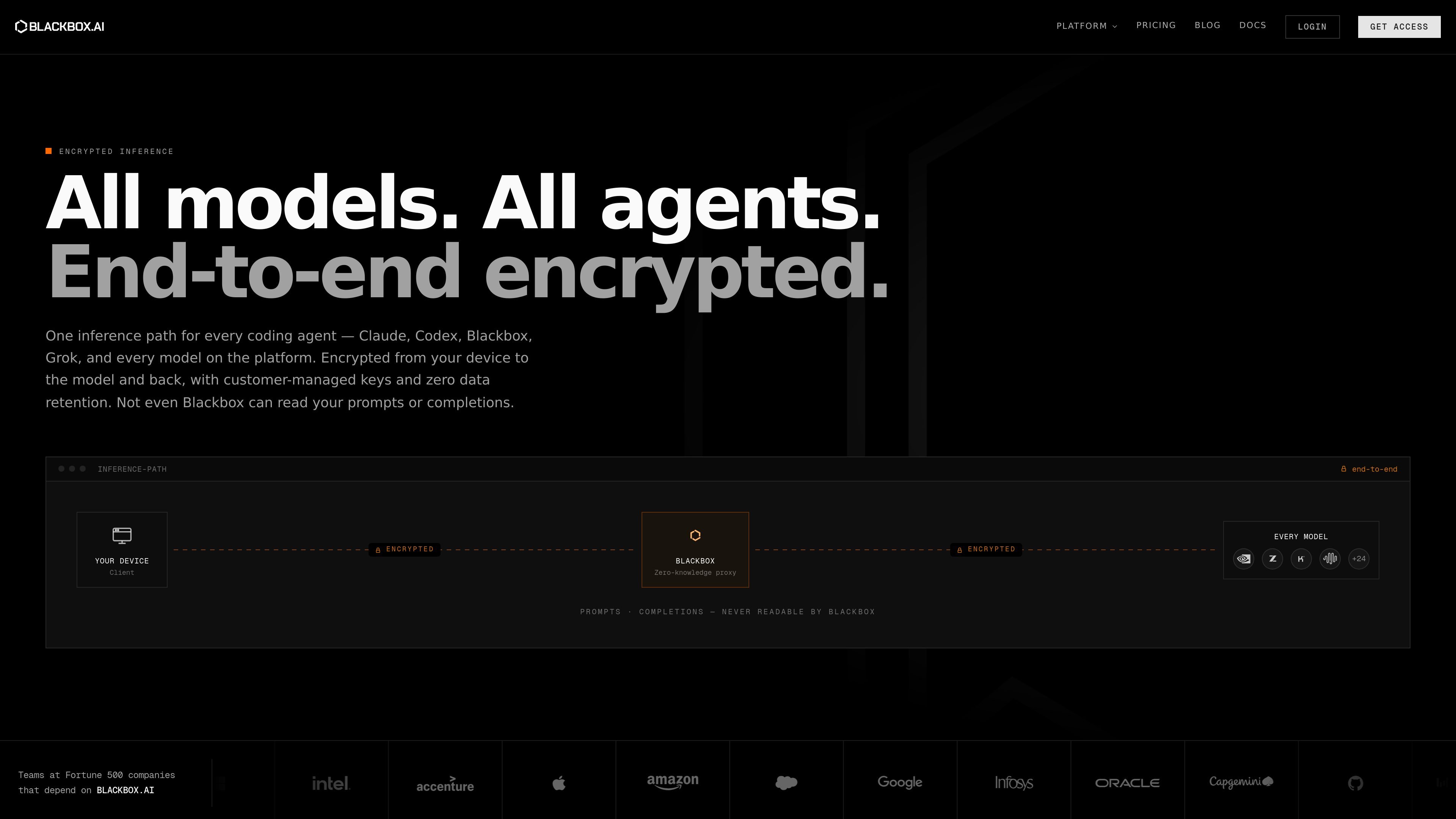
BLACKBOX AI is a developer platform centered on AI-assisted coding across the terminal, editor, and API layers. Its public site presents four main entry points: a multi-agent CLI, an AI-native IDE, a unified Agent API, and an encrypted inference layer that routes requests for models such as Claude, Codex, Blackbox, and Grok.
The product is aimed at teams and individual developers who want to plan changes, generate code, collaborate in an editor, and call frontier or open-source models from one platform. The site also emphasizes enterprise controls such as on-premise deployment, data sovereignty, SSO, audit logging, and support for private infrastructure.
BLACKBOX combines a terminal CLI, an AI-native IDE, and a unified inference API so teams can use the same platform across coding, editing, and model access workflows.
The CLI supports parallel multi-agent workflows, with agents such as Blackbox, Claude Code, Codex, Gemini, Goose, OpenCode, and Qwen working on separate branches before a Chairman LLM evaluates the results.
The IDE provides inline AI chat, multi-file context, real-time code generation, workspace sharing, and collaboration features for editor-based development.
The Agent API exposes major models through a single OpenAI-compatible endpoint and supports chat completions, embeddings, image generation, streaming, function calling, JSON mode, and vision inputs.
Enterprise plans add on-premise deployment options, end-to-end encryption, zero-knowledge architecture, SSO, audit logging, and custom integration support.
The platform advertises integration with 35+ IDEs plus tools such as Slack and Figma, and the CLI supports existing CI/CD tooling and cloud environments.
Use the CLI to plan work, split tasks across multiple agents, and run coding jobs headlessly in scripts or CI pipelines when the work needs automation rather than an interactive editor session.
Use the IDE when developers want inline chat, multi-file refactors, and shared workspace collaboration while staying inside a code editor with repo context.
Use the Agent API when an application or internal tool needs access to frontier or open-source models through a single OpenAI-compatible endpoint.
Use enterprise deployment when an organization needs on-premise operation, private infrastructure, or tighter control over data handling and identity management.
Use the platform across mixed environments when teams want to combine editor workflows, terminal automation, and API calls without switching vendors for each layer.
BLACKBOX CLI is installed with `npm install -g @blackbox/cli` on macOS, Linux, or Windows. On Unix systems, BLACKBOX also provides a shell installer, and Windows users can use the PowerShell installer.
Yes. The CLI supports major languages and frameworks including React, Vue, Angular, Node.js, Python, Java, and Go, and it detects project conventions automatically.
Yes. The CLI supports non-interactive mode for automated workflows such as code generation, test generation, security scanning, and deployment automation, and it can be used in CI/CD pipelines.
Yes. BLACKBOX AI offers enterprise on-premise deployment options, and the pricing page says enterprise plans support full data sovereignty. The CLI FAQ also notes air-gapped environments and encryption at rest for enterprise deployments.
Yes. The Agent API is OpenAI-compatible and supports `/v1/chat/completions`, `/v1/embeddings`, and `/v1/images/generations`, along with streaming, function calling, JSON mode, and vision inputs.
Traffic data is for reference only.

copilot.tencent.com
AI-assisted coding with dialogue, completion, diagnosis, and optimization

penligent.ai
Penligent is an AI-assisted penetration testing platform for security teams, pentesters, and red teams. It automates discovery, validation, exploit reproduction, and evidence-based reporting across web apps, APIs, business logic, and AI agents.