
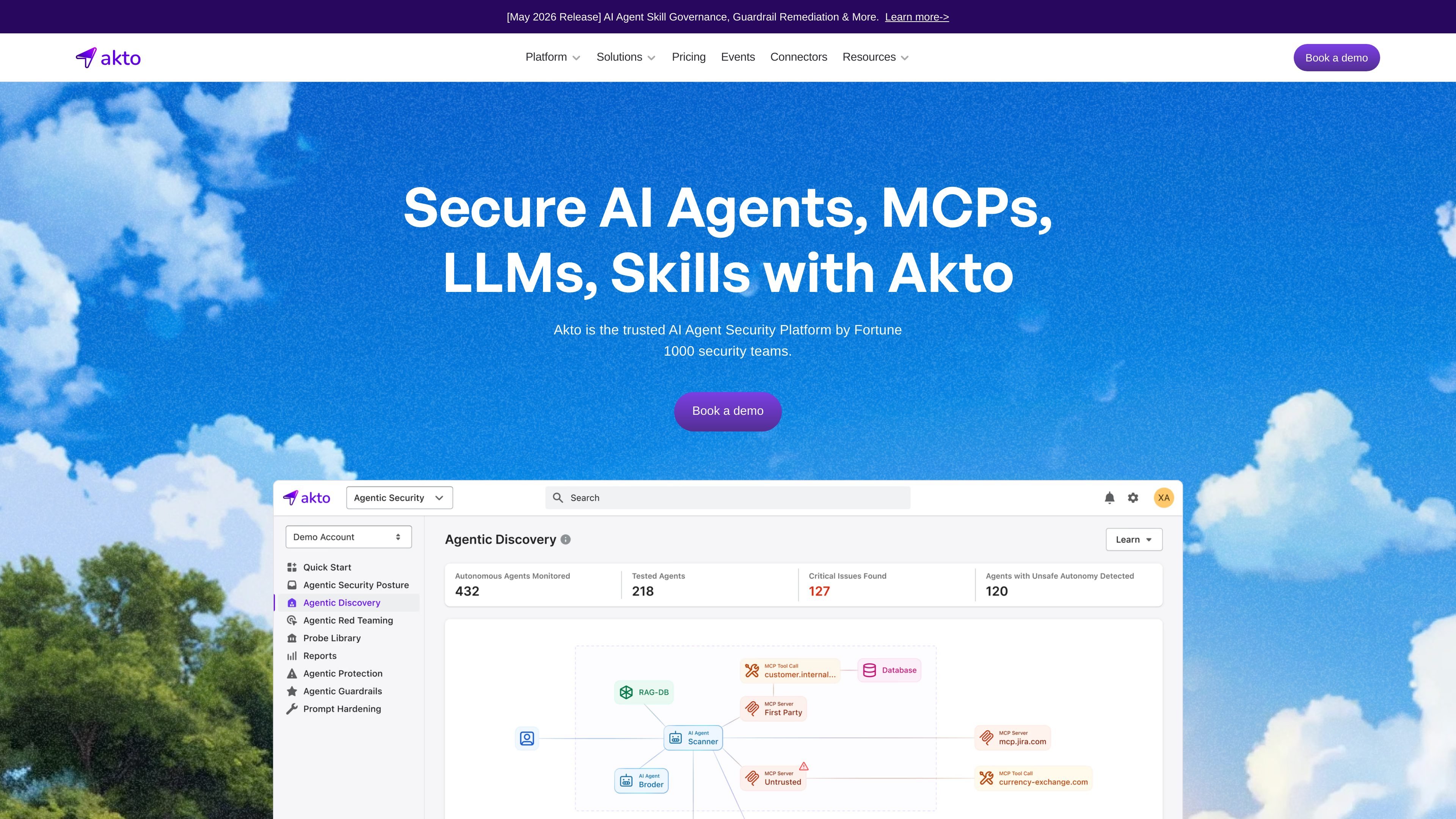
AI asset discovery
Uses traffic and code connectors to identify AI agents, MCP servers, models, and GenAI tools across cloud, on-premises, and employee endpoint environments.

AI security platform for discovering, testing, governing, and protecting LLMs, agents, MCPs, and GenAI applications.
Akto is an AI security platform for LLMs, AI agents, MCP servers, and GenAI applications. It helps security and application security teams discover AI assets, assess their behavior with attack simulations, monitor activity, and apply runtime controls. The platform addresses risks such as prompt injection, data leakage, unauthorized tool use, and unsafe model interactions across cloud, on-premises, and employee endpoint environments.
Akto supports an operating workflow that moves from inventory and risk assessment to testing, governance, and enforcement. Teams can map agents and their dependencies, run continuous security tests, review audit records, and configure policies that block, mask, redact, or escalate risky actions.
Uses traffic and code connectors to identify AI agents, MCP servers, models, and GenAI tools across cloud, on-premises, and employee endpoint environments.
Runs more than 4,000 probes for risks including prompt injection, tool poisoning, data exfiltration, unauthorized access, memory manipulation, and cascading failures across multi-agent systems.
Evaluates prompts, responses, tool calls, and MCP requests before execution, with policies that can block, mask, redact, or escalate actions.
Provides access governance by user, team, and tool, and records prompts, responses, violations, and skill calls for audit and investigation.
Maps agents to the MCP servers, tools, databases, and third-party dependencies they use, while supporting continuous risk assessment per asset.
Maps AI activity and enforcement evidence to frameworks and references including OWASP Top 10 for LLMs, OWASP Top 10 for Agentic AI, NIST AI RMF, ISO 42001, SOC 2, GDPR, HIPAA, PCI DSS, and MITRE ATLAS.
SaaS teams can inventory LLMs, MCP servers, and integrations across tenants, test for prompt leaks, privilege escalation, and tenant-jumping risks, and enforce contextual boundaries.
E-commerce teams can monitor agents used for search, recommendations, and order management, then test for prompt exploitation, product data scraping, transaction fraud, and unsafe output.
Security teams can discover web and local AI usage, including agents, coding assistants, MCP servers, and agent skills, while identifying personal accounts and maintaining an interaction audit trail.
Application security teams can use red-team simulations to validate agent behavior and integration security in CI/CD, then apply guardrails as systems move toward production.
Akto uses traffic and code connectors to find AI agents, MCP servers, models, and GenAI tools across cloud, on-premises, and employee endpoint environments. The resulting inventory is continuously updated.
Its probes cover prompt injection, tool poisoning, data exfiltration, unauthorized access, memory manipulation, and cascading failures across multi-agent systems, among other AI-specific risks.
Akto evaluates prompts, responses, tool calls, and MCP requests before execution. Based on configured policies, an action can be blocked, masked, redacted, or escalated.
The platform records AI interactions such as prompts, responses, violations, and skill calls. It also provides access governance by user, team, and tool and maps activity to listed security and compliance frameworks.
The pricing page describes usage-based, enterprise-grade pricing and presents cloud and self-hosted plans. The listed AI security capabilities use a contact-sales or demo-led evaluation process.
Traffic data is for reference only.

evidentlyai.com
Open-source framework for evaluating and monitoring LLM applications, AI agents, and ML models.

salt.security
API and agentic AI security for teams that need visibility into agents, MCP servers, APIs, and runtime activity.

hamming.ai
Testing, red teaming, and production monitoring for teams building voice and chat agents.

www.galileo.ai
Galileo is an AI observability and evaluation platform for testing, debugging, and governing LLM and agent systems across development and production. It helps teams turn evaluation results into production guardrails and monitor AI behavior at scale.

langfuse.com
Langfuse is an open-source AI platform for tracing, evaluating, and improving LLM applications and agents with observability, prompts, experiments, and human review.