
AI SDK Core
Provides a unified TypeScript API for text generation, structured objects, tool calls, and agent workflows so apps can use one interface across model providers.

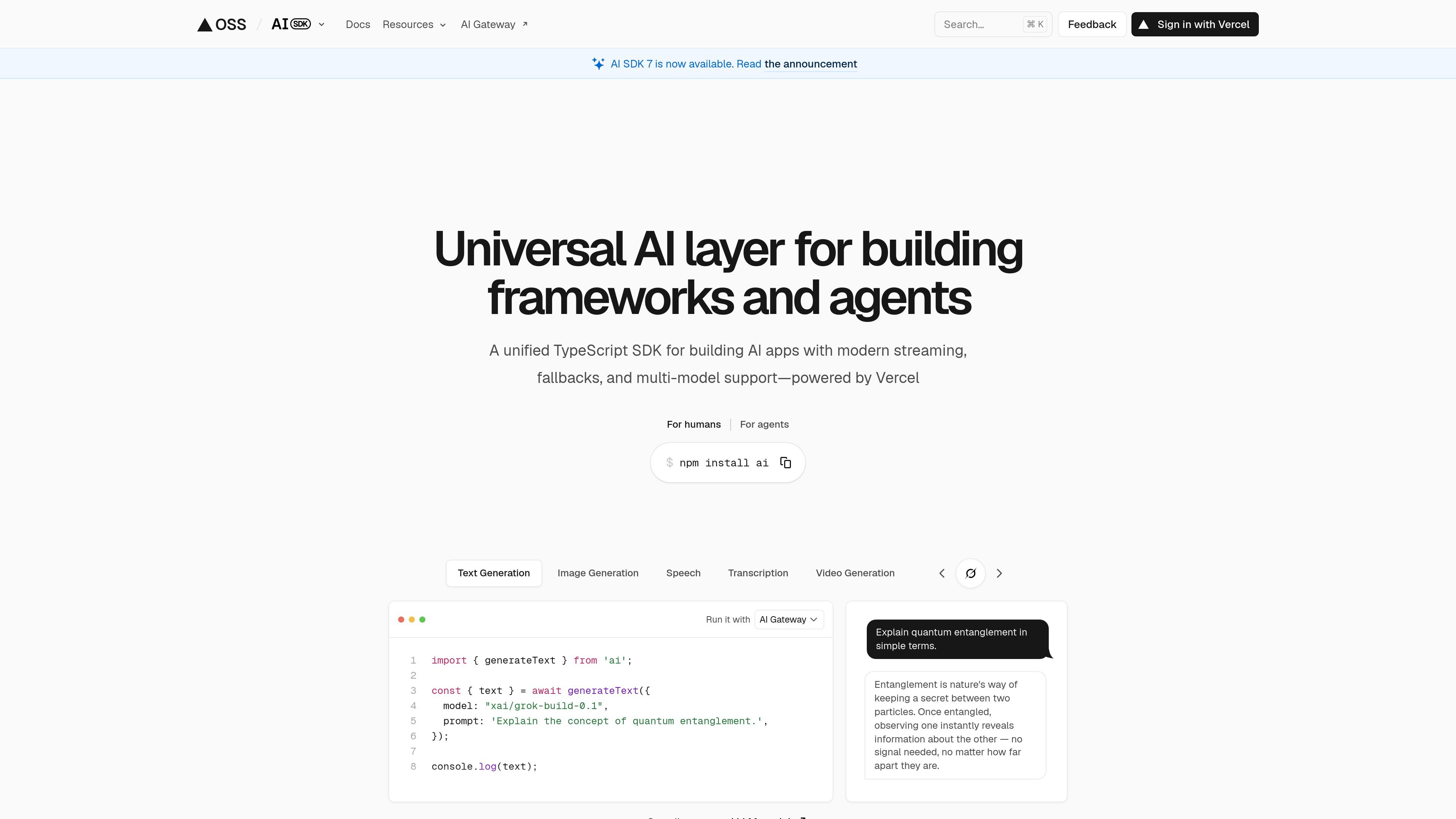
AI SDK is a TypeScript toolkit for AI apps and agents across frameworks and model providers.
AI SDK is a TypeScript toolkit for building AI applications and agents. It is positioned as a framework-agnostic layer for developers who want to integrate large language models without wiring each provider separately.
The site highlights support for modern streaming, fallbacks, and multi-model workflows, along with surfaces for core generation APIs and UI hooks. It also shows an ecosystem of templates and adjacent tools for common AI app patterns, including chat, retrieval, tool use, and agent workflows.
Provides a unified TypeScript API for text generation, structured objects, tool calls, and agent workflows so apps can use one interface across model providers.
Offers framework-agnostic hooks for chat and generative interfaces, which helps teams build UI without tying the product to one frontend stack.
Supports switching between multiple providers and models with one line of code, reducing provider-specific branching in application logic.
Includes streaming and fallback behavior for production use, allowing applications to deliver real-time responses and handle model interruptions more gracefully.
Documents support for a broad provider ecosystem, including major vendors such as OpenAI, Anthropic, Google, xAI, Azure, Bedrock, Groq, and more.
Surfaces templates and recipes for common builds such as chatbots, Slackbots, SQL agents, retrieval apps, and multi-modal experiences.
Build chat products that need streaming responses, persistence, or multi-modal interactions using the provided SDK surfaces and templates.
Create agents that call tools, return structured objects, and handle multi-step workflows with the core generation APIs.
Switch between model providers or route requests through Vercel AI Gateway when you want provider flexibility without rewriting application logic.
Build framework-specific AI experiences in React, Next.js, Vue, Svelte, or Node.js while keeping the SDK layer consistent.
Use the playground and templates to compare models and start from common patterns such as Slackbots, SQL agents, and retrieval apps.
Yes. The docs describe the AI SDK as a TypeScript toolkit for building AI applications and agents with React, Next.js, Vue, Svelte, Node.js, and more.
The docs present AI SDK Core for generating text, structured objects, tool calls, and agents, and AI SDK UI for framework-agnostic chat and generative interfaces.
The source shows support for multiple providers, including Vercel AI Gateway, OpenAI, Anthropic, Google Generative AI, xAI Grok, Azure, Amazon Bedrock, Groq, Fal AI, DeepInfra, Google Vertex AI, Mistral, Together.ai, Cohere, Fireworks, DeepSeek, Cerebras, Perplexity, Luma AI, and Baseten.
No pricing details were available from the pricing page because it returned a server error in the collected sources.
Traffic data is for reference only.
| Jun | 0 |
|---|---|
| Jul | 0 |
| Aug | 0 |
Traffic analytics are not available yet.
Traffic analytics are not available yet.

aakar-ai.dev
Manage AI providers, project setups, logs, and analytics in one dashboard with BYOK support.

harnessrouter.ai
HarnessRouter is an agent backend layer that lets teams connect Codex, Claude Code, and Hermes to their product through a single API on their own infrastructure. A managed cloud option is also available for teams that prefer not to operate the agent runtime themselves.

hunyuan.tencent.com
Tencent Hy is Tencent’s branded hub for Hy AI products, models, and studios.

tongyi.aliyun.com
通义实验室 is Alibaba Cloud’s hub for AI models and apps, featuring Qwen, Wan, updates, and developer access paths.

humanornot.ai
AI21 is an enterprise AI platform for foundation models and AI systems, designed to help teams run AI agents and workflows with a focus on quality, cost, and reliability.

ludwig.ai
Open-source declarative deep learning framework for training, fine-tuning, and deploying models from one YAML config.