
Traceable scientific workflows
Ressearch AI links research steps together so users can review the evidence, code, and outputs behind a result. This is meant to support reproducibility and make the final work easier to audit.

Ressearch AI는 재현 가능한 과학 연구를 위한 AI 워크스페이스로, 문헌 검색, 데이터 수집, Python/R 분석, 시각화, 과학적 글쓰기를 하나의 환경에서 지원하며 생명과학, 보건, 생태학 및 관련 기술 연구에 활용할 수 있습니다.
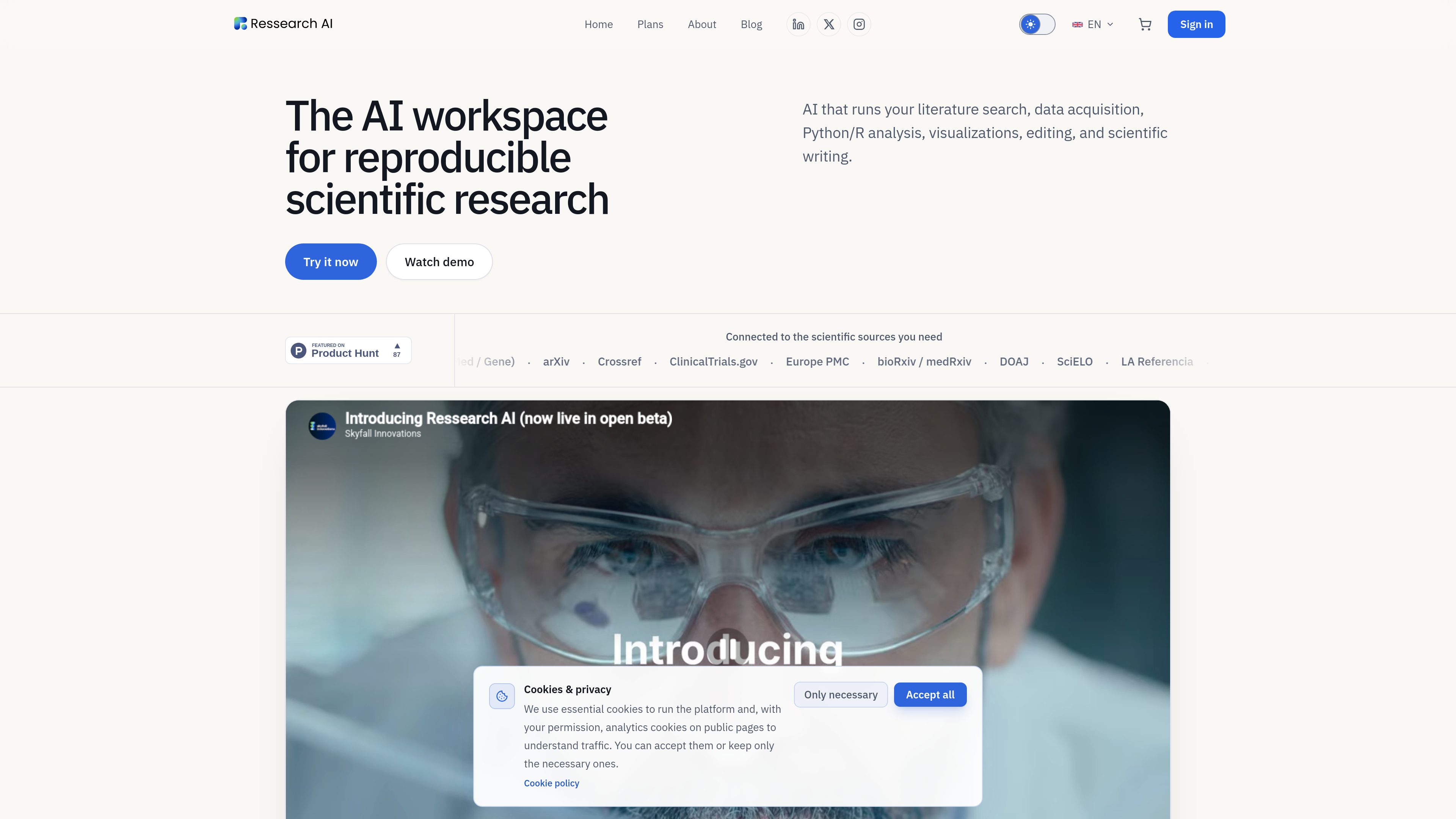
Ressearch AI is an AI workspace for scientific research that combines literature search, data acquisition, analysis, visualization, editing, and writing in a single environment. The product is designed around traceable workflows so researchers can review sources, code, results, and decisions rather than moving between disconnected tools.
It runs AI-assisted research tasks in isolated cloud sandboxes, with Python and R execution built into the workflow. The site positions the product for biosciences, health sciences, ecology, environmental research, and other technical analysis work where reproducibility and human review matter.
Ressearch AI links research steps together so users can review the evidence, code, and outputs behind a result. This is meant to support reproducibility and make the final work easier to audit.
The platform connects to scientific sources such as Semantic Scholar, OpenAlex, PubMed, arXiv, Crossref, Europe PMC, DOAJ, SciELO, and other domain databases, giving users a way to gather papers and supporting evidence from within the workspace.
Users can run code in isolated cloud environments instead of setting up local tooling. The product also lists specialized sandbox types for areas such as biostatistics, geospatial analysis, omics, molecular modeling, and long-running tasks.
The system includes scientific writing support, assisted figure and table editing, and export options such as Word, PDF, and LaTeX with references, which helps move from analysis to a shareable document.
Pricing and legal pages indicate project-based workflows with code execution, knowledge graph and Zotero/reference integration, chat access, and collaboration features for teams and workgroups.
The legal page states that results are reviewable proposals and that users can correct, reject, stop, or repeat workflows, keeping final judgment with the researcher.
A researcher can search across connected scholarly sources, gather papers, and use the workspace to organize evidence before starting analysis or writing.
A bioscience, health, or ecology team can bring in datasets, run Python or R analysis in an isolated environment, and keep the steps connected for later review.
After computing results, users can refine text, figures, and tables in the same workspace and export a document suitable for further editing or submission preparation.
The pricing page lists specialized sandboxes for areas such as biostatistics, bio ML, geospatial biology, species distribution, microbiome, cheminformatics, bioimaging, omics, single-cell analysis, docking, and molecular modeling.
The product supports shared projects and organization-level administration on higher tiers, making it suitable for labs or technical teams that need a common workspace and usage control.
Ressearch AI is a scientific research support environment that uses AI agents, search tools, and code execution to help users move from a question or dataset to a reproducible result.
The site says the product works without installing software, because code runs in isolated cloud environments.
The site highlights biosciences, health sciences, biology, ecology, environmental sciences, and related analytical work.
Yes. The product says results are reviewable, and it includes an editor plus export options for formatted documents.
The pricing page shows a Free plan with 100 welcome credits and paid plans above it, along with business and enterprise contact-sales options.
트래픽 데이터는 참고용으로만 확인하세요.