
Intercepts tool calls at the boundary
Phinq observes agent tool calls before execution rather than relying on prompts or instructions the agent could ignore.

Phinq는 AI 에이전트를 위한 오픈 소스 런타임 거버넌스 계층입니다. 에이전트의 도구 호출을 가로채 위험도를 분류하고, 고위험 작업은 실행 전에 일시 중지해 사람의 승인을 받습니다.
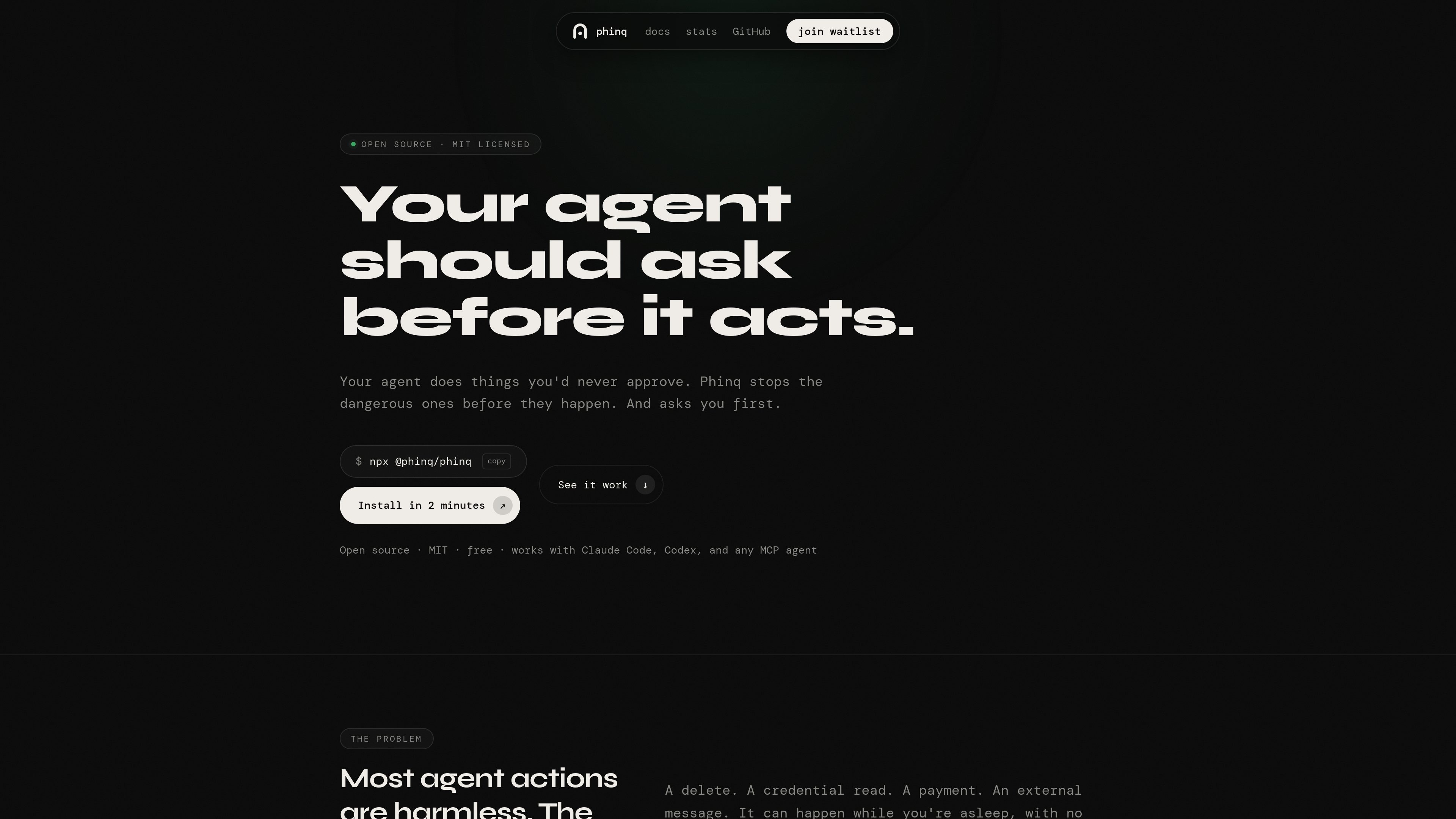
Phinq is an open source runtime governance layer for AI agents. It sits between an agent’s proposed tool call and the execution boundary, classifies the request by risk, and either allows it to pass or holds it for approval.
The product is meant to reduce damage from irreversible agent actions such as deletes, credential reads, payments, or external messages. It records each decision in an append-only, hash-chained audit log so teams can review what the agent attempted and how the request was resolved.
Phinq observes agent tool calls before execution rather than relying on prompts or instructions the agent could ignore.
The system evaluates the proposed action using the tool name, arguments, and session velocity, then returns an allow or hold decision.
Higher-risk actions are paused instead of forwarded until a human approves them through the configured channel.
If a held action is denied or times out, the action is blocked and never reaches the tool.
Every decision is written to an append-only JSONL log with SHA-256 chaining so later edits, reordering, or deletion can be detected.
Phinq can run as a proxy, an in-process SDK, or a plain HTTP gate, and the docs list compatibility with OpenAI-style, Anthropic Messages, Gemini, and MCP-based clients.
Use Phinq when an assistant may need to delete records, read credentials, send payments, or dispatch messages, but you want a human decision point before the action reaches the tool.
Teams can place Phinq at the proxy, SDK, or HTTP boundary instead of rewriting the agent workflow, which makes it suitable for systems already using compatible clients or MCP.
Phinq is useful when you need to review what an agent attempted, how it was classified, and whether it passed, held, approved, denied, or timed out.
The docs say the proxy starts in shadow mode by default, which lets teams classify and log traffic before enforcing holds in production.
Phinq is a runtime governance layer for AI agents that intercepts tool calls, classifies them by risk, and holds higher-risk actions for human approval before execution.
The docs say it evaluates the proposed tool call using the tool name, arguments, and session velocity, then returns allow or hold.
No. The documentation says the proxy starts in shadow mode by default, meaning it classifies and logs traffic first and only enforces HOLD decisions when enforcement is enabled.
The action becomes a pending approval instead of being forwarded. It can then be resolved through the configured channel; denied or timed-out holds are blocked.
Yes. The audit log is append-only JSONL and each entry is chained with SHA-256, so changing, reordering, or deleting entries breaks verification.
트래픽 데이터는 참고용으로만 확인하세요.