
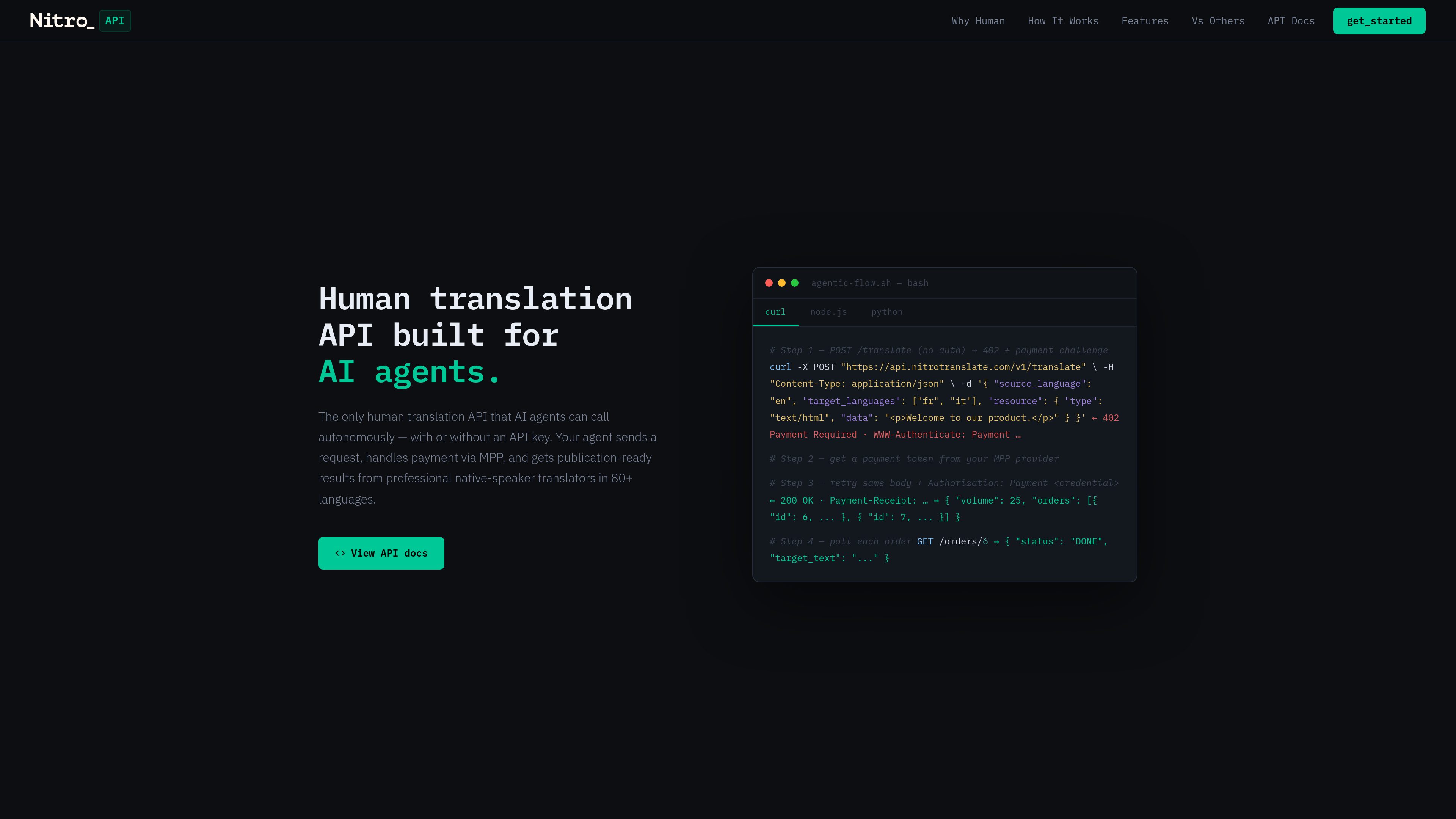
No-key and authenticated request paths
The API can be called without pre-registration or an API key, while still supporting authenticated requests for callers that already have credentials.

Nitro API는 AI 에이전트와 개발자를 위한 사람 번역 API로, API 키가 있어도 없어도 사용할 수 있습니다. 번역 작업을 제출하고 MPP 기반 흐름으로 결제를 처리하며, 전문 원어민 번역가가 번역한 80개 이상의 언어 결과를 제공합니다.
Nitro API lets software submit translation requests for professional human review and then retrieve the finished result through an API workflow. It is designed so AI agents can use the service autonomously, with support for no-auth requests and an optional API key path.
The site describes a payment-challenge flow based on MPP, where a request can return a 402 response before being retried with a payment credential. It also provides endpoints for rate checks, price estimates, translation orders, and order status polling, making the service usable as a developer-facing translation backend.
The API can be called without pre-registration or an API key, while still supporting authenticated requests for callers that already have credentials.
Documentation shows a payment challenge flow where the initial translation request returns 402 Payment Required, then the caller retries with a payment credential from an MPP-compatible provider.
Translation jobs are created as orders that can be polled by ID until they move from queueing to in progress and then to done.
The API includes endpoints to get current rates per 1,000 characters and to estimate price before placing an order.
Source pages describe professional native-speaker translators working across more than 80 languages, with separate language listings for many regions.
The product supports complex content types such as HTML, JSON, XML, and iOS strings, with a focus on preserving tags, keys, and structure during translation.
An agent can submit text, handle the payment challenge, and poll for results without a manual dashboard step, which fits autonomous workflows.
The service is suited to marketing copy, product pages, and other content that needs human translation rather than machine-only output.
Teams working with HTML, JSON, XML, or app string files can translate content while preserving the underlying structure.
The language catalog and sector examples point to use across e-commerce, software, apps, games, e-learning, travel, and other multi-language publishing needs.
Teams can check rates and calculate an estimated cost before placing orders, which helps plan translation work inside a build or publishing pipeline.
No. The site says the translation API can be called with or without an API key, and the no-auth flow is designed for AI agents.
The documented flow starts with a POST /translate request, returns a 402 Payment Required challenge, and then the caller retries with a payment credential from an MPP-compatible provider.
The service is positioned around human translation by professional native-speaker translators rather than machine-only output.
Yes. The source pages mention support for complex formats including HTML, JSON, XML, and iOS strings, with preservation of tags and structure.
The translation API page says there is no charge for API services and that customers pay for the translation itself. The site also describes the pricing model as pay-as-you-go with no minimum order.
트래픽 데이터는 참고용으로만 확인하세요.