
Real-time environment generation
Generates embodied environments from prompts and predicts how they change as a person or agent moves, acts, or introduces events.

A foundation world model for simulating physical and virtual environments and adapting AI to physical systems.
Odyssey-3 is a foundation world model for physical and virtual systems. It is implemented as an autoregressive diffusion transformer that predicts how objects move and interact through space and how situations evolve over time. The model learns representations of physics, dynamics, cause and effect, and human behavior from visual observations.
Developers can use Odyssey-3 to generate and inspect interactive environments, simulate scenarios, and train policies for specific machines or tasks. Adaptation is described through an action decoder or policy trained on paired observations and actions, allowing the model’s learned representations to connect with the controls of a robot, humanoid, vehicle, or other system.
The published work presents Odyssey-3 as a research preview. Reported applications include robot-arm manipulation, humanoid autonomy, closed-loop vehicle driving, and multi-camera observation generation. The site invites physical-AI developers interested in building with the model to get in touch.
Generates embodied environments from prompts and predicts how they change as a person or agent moves, acts, or introduces events.
The preview supports first-person and third-person navigation together with independent camera movement for inspecting model predictions.
Odyssey-3 is trained to model physical behavior. Odyssey-3 Pro reported a 66.1 score on Physics-IQ Verified’s video-to-video benchmark, covering areas such as fluid dynamics, optics, solid mechanics, magnetism, and thermodynamics.
An action decoder or policy can be trained on paired observations and actions to translate the foundation model’s representations into controls for a particular physical system.
An early driving experiment generated three camera views together for an autonomous-driving dataset after 100 training steps, demonstrating adaptation to a specified sensor arrangement.
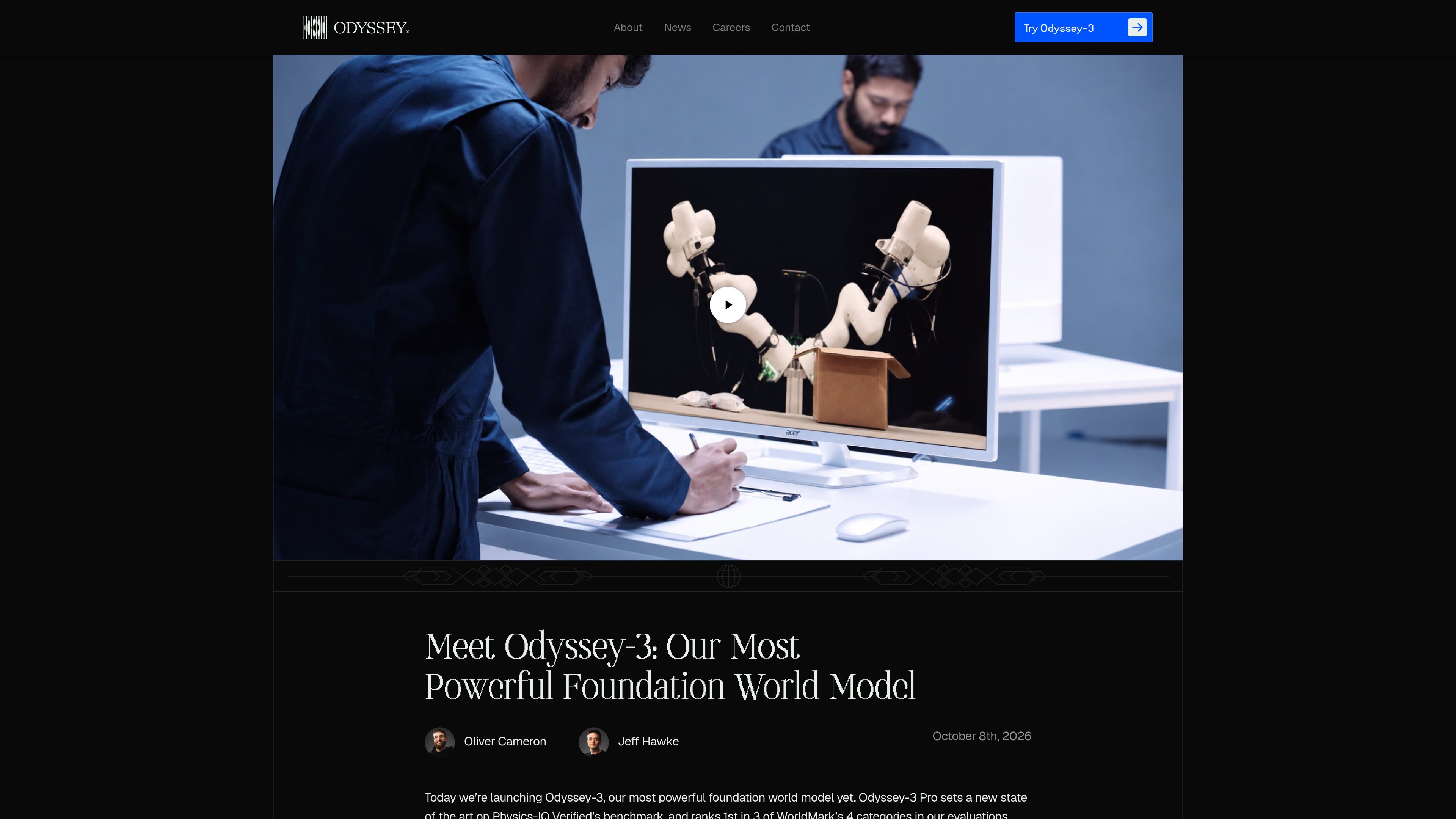
Developers can train robot-arm policies from demonstrations for tasks such as pouring cereal, closing a screwbox, or handling objects. Reported tests included recovery after a missed grasp and retrieval of a dropped object.
Odyssey-3 has been used as a base for humanoid control policies developed with Flexion. Demonstrated tasks include opening a container, removing a box, and placing a mug on a table, including tests under changed lighting and other environmental conditions.
A driving policy used Odyssey-3’s visual representations to predict waypoints ahead of a car and drive in closed loop on roads in India. The reported experiment trained with 20 hours of driving data while keeping the backbone frozen.
The model can generate interactive environments and predict their evolution, providing a way to inspect physical scenarios or create simulated experience for training agents and policies.
Odyssey-3 is a foundation world model that predicts how objects and situations evolve over time. It uses visual observations to learn representations of physics, dynamics, and cause and effect for physical and virtual systems.
The published approach trains an action decoder or policy on paired observations and actions from the target system. That component translates Odyssey-3’s learned representations into the controls required by the machine or task.
The reported examples include robot arms, humanoid systems, and vehicles. The research also describes generating synchronized observations for a three-camera autonomous-driving setup.
The supplied site content describes Odyssey-3 as a research preview and invites physical-AI developers to get in touch. It does not provide usable pricing, a detailed setup workflow, API or SDK documentation, or a list of supported integrations.