
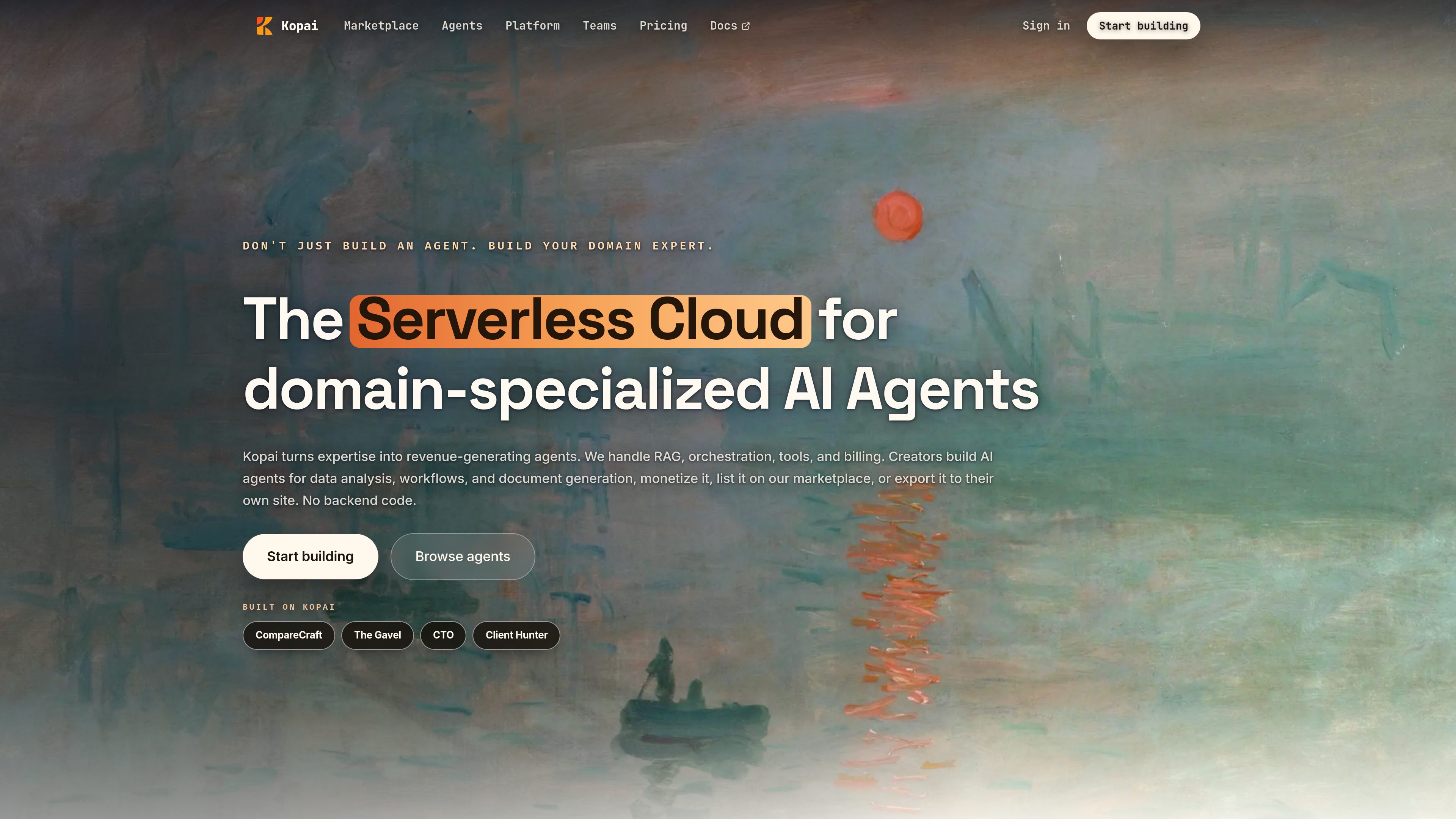
Prompt-based agent builder
Create an agent by writing plain-language instructions, selecting a model, connecting knowledge, previewing behavior, comparing models, and running evaluations before publishing.

Kopai is a hosted platform for building, running, publishing, and monetizing domain-specific AI agents. It supports internal team agents, marketplace listings, and deployment to a creator’s own site through live APIs.
Kopai is a serverless cloud and marketplace for domain-specialized AI agents. It lets creators build agents from prompts, connect documents or organizational data, test models, evaluate responses, and publish the result for private team use or public marketplace access. Kopai handles the underlying retrieval, orchestration, model routing, storage, streaming, infrastructure, and message billing.
An agent can stay inside an organization or be submitted for marketplace evaluation. Team workspaces provide role-based access, shared knowledge libraries, project separation, and usage and cost reporting. Public agents can charge a publisher-set markup, while the platform itemizes runtime and publisher charges. Kopai also offers live APIs for running an agent in another product or site; its SDK is described as forthcoming.
Create an agent by writing plain-language instructions, selecting a model, connecting knowledge, previewing behavior, comparing models, and running evaluations before publishing.
Kopai operates retrieval, model routing, file storage, streaming, vector-database infrastructure, and provider credentials so teams do not need to deploy or maintain those components.
Responses can be checked against the sources they cite. Evaluation results are associated with the version that earned them, so editing a prompt requires another pass.
Invite team members with owner, admin, or developer permissions. Organizations can share a knowledge library across agents, isolate projects, and keep agents private by default.
Approved agents can be listed with a publisher markup. Kopai records message charges, runtime usage, payouts, and earnings in an itemized ledger, with creators receiving 70% of their markup.
Conversations can resume after a dropped connection, and live APIs allow an agent to be used in another product or on the creator’s own site. The site says an SDK is shipping next.
A company can attach handbooks, policies, or other internal documents to a private agent so employees can query shared organizational knowledge without making the agent public.
Creators can build agents for tasks such as checking supplier invoices against payment terms, analyzing data, supporting workflows, or generating documents from connected knowledge.
CompareCraft demonstrates a research workflow that gathers evidence from official documentation, GitHub, Reddit, and independent reviews, then presents comparisons as tables, charts, and sentiment breakdowns.
A creator can evaluate a domain-specific agent, submit it to the marketplace, set a markup, and let users try its initial free messages before paid credit usage begins.
Teams or product builders can use Kopai’s live APIs to place an agent in their own product or website while keeping hosting, model access, billing, and measurement managed by Kopai.
Kopai says it manages retrieval, orchestration, model routing, file storage, streaming, infrastructure, provider keys, and billing. The creator supplies the instructions, knowledge, and intended use of the agent.
Yes. Organization agents are private by default and do not need to be listed, priced, or evaluated for public marketplace access. Teams can invite members and assign owner, admin, or developer roles.
Users spend credits per message. The charge reflects the runtime used plus any publisher markup, and both parts are itemized. Kopai offers monthly credit plans, one-time wallet top-ups, and auto-reload; unused monthly credits roll over.
Marketplace agents must pass Kopai’s evaluation before they can be listed. The site states that an evaluation pass belongs to the version that earned it, so changing the prompt requires the agent to be evaluated again.
The site says live APIs support running an agent on a creator’s own domain or inside another product, including streaming chat and native agent APIs. An SDK is described as forthcoming.
トラフィックデータは参考情報としてご利用ください。

www.zoho.com
Zoho Creator is an AI-assisted low-code application development platform for building custom business apps, workflows, agents, and portals. It supports internal operations, external-user services, and integrations with existing business systems.

www.stagehand.dev
Stagehand is an SDK for building browser agents with Playwright-style APIs, natural-language actions, structured extraction, and self-healing behavior. It supports TypeScript, Python, and Go for agents that need to operate web pages with browser-level control.
adk.dev
Agent Development Kit (ADK) is an open-source framework for building, evaluating, and deploying conversational and non-conversational AI agents. It supports multi-agent systems, tools, structured workflows, and production runtimes across Python, TypeScript, Go, Java, and Kotlin.

learn.microsoft.com
Microsoft Agent Framework is a developer framework for building, orchestrating, and deploying AI agents and multi-agent workflows. It supports implementations in Python and .NET.

aistudio.google.com
Google AI Studio is a browser-based development environment for experimenting with Google’s generative models and moving prompts into applications through the Gemini API. It supports developers building text, image, video, audio, and agent experiences.

superblocks.com
Superblocks is an enterprise platform for building and deploying AI-powered internal applications on private company data. Business teams can use natural-language prompts with Clark AI, while IT manages integrations, permissions, authentication, deployment, and auditing.