
Multilingual handwriting recognition
Supports more than 300 languages and mixed-language documents without language-specific setup. The service reports its best performance on widely spoken languages.

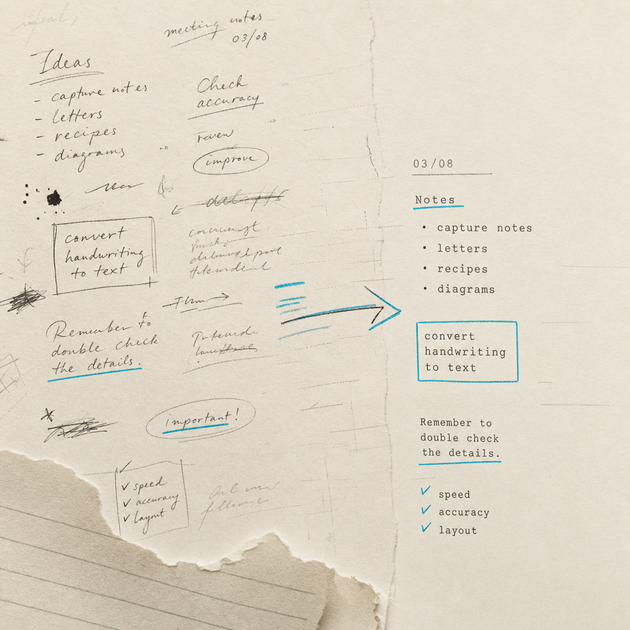
Convert handwritten documents into editable text and structured data for work and archives.
Handwriting OCR is a cloud service that converts handwritten and printed documents into editable text and structured data. Users upload photos, scans, or PDFs through the web interface, or submit documents through its REST API.
Designed for handwriting that conventional OCR struggles to read, it handles cursive writing, faded ink, and pages containing both printed and handwritten text. Transcription preserves the original layout, helping users turn paper records into searchable documents without retyping each page. Results can be downloaded for editing, recordkeeping, or further processing.
Supports more than 300 languages and mixed-language documents without language-specific setup. The service reports its best performance on widely spoken languages.
Export transcriptions as TXT, DOCX, PDF, or JSON. Original document images can optionally be embedded in exports to retain visual context alongside the text.
Detect table structure and extract tabular data into XLSX or JSON for spreadsheet analysis. Available on Pro and Business plans.
Define fields to capture from forms using a sample document, then test and refine the extractor. Results are available as XLSX, CSV, or JSON. Available on Pro and Business plans.
Translate transcribed text into a target language and download it using the same export formats offered for transcription.
The REST API supports transcription, table extraction, and custom extractors. Webhooks deliver completed results as JSON, with HMAC-SHA256 signatures for verification.
Digitize old letters, diaries, and census records into searchable text so archivists and family historians can locate names and passages across collections.
Extract information from handwritten lead forms into spreadsheets and CRM workflows, reducing repeated manual entry of contact and lead details.
Convert handwritten intake forms into structured reporting data. Confirm the required storage and processing region before uploading documents subject to location restrictions.
Convert student essays, exam scripts, and classroom notebooks into digital documents that teachers can review and use during grading.
Turn journals, notebooks, and handwritten drafts into editable records for searching, organizing, and revising personal writing.
The API supports PDFs and common image formats, including JPG, PNG, and TIFF. The web workflow accepts document photos and PDFs, including batches of scans.
Standard transcription requires no setup or training: upload the document, wait for processing, and export the result. Custom extractors require you to define fields and test them against a sample first.
Accuracy depends on the original handwriting, language, and scan quality. Very faded pages, poor scans, or rare scripts may need closer review. Check the transcription and extracted fields against the original document before using them.
Documents are used for requested processing, not to train the service’s own AI models. Uploads are encrypted in transit, with access controls for stored files. Necessary hosting and operational providers can receive data, and optional connectors return results to the connected service, which may keep its own copy. Documents and results are deleted after seven days by default; settings allow ten minutes to fourteen days. Account, billing, and security records have separate retention.
A free trial is available without a credit card. API access is included on all plans, including the trial.
Each page or image costs one credit. Pay-as-you-go is $15 for 100 pages, valid for one year. Monthly subscriptions include Starter at $19 for 250 pages, Pro at $59 for 1,000 pages, and Business at $499 for 10,000 pages. Table extraction and custom extractors are included on Pro and Business. Subscription credits remain valid while the subscription is active.
The current API limit is two requests per second per account, shared across all endpoints. Webhooks can deliver results without repeated polling. Higher throughput is available to Enterprise customers by agreement.
トラフィックデータは参考情報としてご利用ください。
| 4月 | 35236 |
|---|---|
| 5月 | 32333 |
| 6月 | 30207 |
