
Agent observability
Provides observability for AI agents and LLM applications so developers can inspect system behavior while building and deploying them.

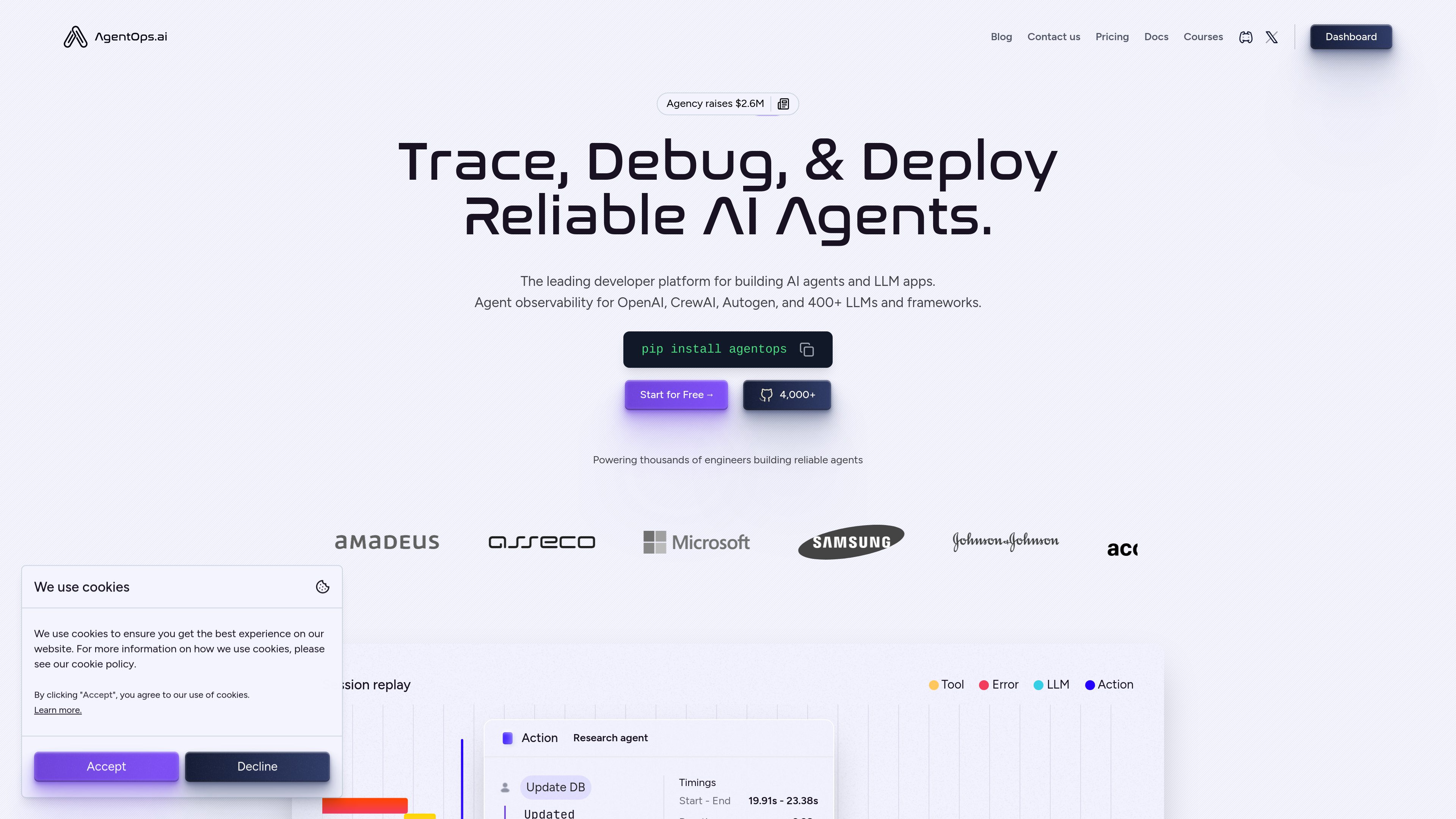
AgentOps is a developer platform for building, tracing, debugging, and deploying AI agents and LLM applications. It provides observability for agents built with OpenAI, CrewAI, AutoGen, and more than 400 LLMs and frameworks.
AgentOps is a developer platform for building AI agents and LLM applications. Its core purpose is to help developers trace, debug, and deploy these systems with agent observability. The site presents AgentOps as a tool for understanding agent behavior during development and deployment rather than as an end-user chatbot or standalone model.
The platform supports observability for OpenAI, CrewAI, AutoGen, and more than 400 LLMs and frameworks, giving teams a way to work with agent stacks that use different model and framework combinations. The documented installation cue is pip install agentops, indicating a Python package-based setup path.
AgentOps also provides educational material for AI agent development and evaluation through courses. The listed course topics include agent fundamentals, evaluation, and RAG chatbot development, making the product site relevant both to teams instrumenting agent applications and developers learning how to build and assess them.
The available source does not establish pricing, plan limits, detailed outputs, or specific collaboration controls. The pricing URL returned a 404, so those details should be confirmed directly with AgentOps before purchase or deployment decisions.
Provides observability for AI agents and LLM applications so developers can inspect system behavior while building and deploying them.
The platform is positioned for tracing and debugging agent workflows, helping developers investigate how an application operates rather than treating the agent as a black box.
The site states support for OpenAI, CrewAI, AutoGen, and more than 400 LLMs and frameworks.
The site provides `pip install agentops` as the installation cue, indicating a package-based path for adding AgentOps to a development environment.
AgentOps offers courses covering AI agent fundamentals, evaluation, and RAG chatbot development.
Use AgentOps while building agent applications to add an observability layer around development and deployment work.
Use tracing and debugging capabilities to examine an agent or LLM application when its behavior needs to be understood during development.
Use the platform when an application uses supported technologies such as OpenAI, CrewAI, or AutoGen, or when a team works with multiple LLMs and frameworks.
Use the AgentOps course material to study how AI agents are built and how their performance can be evaluated.
Use the listed Chatbots 101 course as an educational starting point for building and deploying RAG chatbots with modern AI techniques.
The website shows `pip install agentops` as the installation command, indicating a Python package-based setup path. The available source does not provide further setup steps.
The site names OpenAI, CrewAI, and AutoGen, and states that AgentOps supports more than 400 LLMs and frameworks. The complete compatibility list is not provided in the available source.
AgentOps is presented as a platform for tracing, debugging, and deploying reliable AI agents and LLM applications through agent observability.
No. The supplied pricing URL returned a 404, and the available page text does not provide verified prices, plan limits, or billing details.
Yes. Its courses page lists courses on AI agent fundamentals, agent evaluation, and RAG chatbot development. The listed sessions are described as coming soon and use Zoom.

ai-sdk.dev
AI SDK is a TypeScript toolkit for building AI-powered applications and agents across supported model providers and web frameworks. It provides shared APIs for model generation, tool use, streaming, structured output, and AI user interfaces.

developers.openai.com
Agents API gives applications access to an OpenAI-managed Codex harness for building durable cloud agents. It manages sessions, orchestration, context compaction, and recovery while the application supplies tools and selects the execution environment.

azure.microsoft.com
Microsoft Foundry is an enterprise AI platform for building, grounding, deploying, and governing AI applications and agents. It helps development and data teams connect models, organizational knowledge, business tools, and lifecycle controls in Azure.

www.trulens.org
TruLens is an open-source library for tracing and evaluating AI agents and other LLM applications. It helps development teams inspect agent steps, score quality with configurable metrics, and compare application versions using OpenTelemetry-based instrumentation.

powabase.ai
A Postgres backend for AI applications with built-in retrieval, agents, auth, and storage.

autoloops.ai
Autoloops provides speech infrastructure for voice agents, combining streaming speech-to-text with realtime serving for open-weight language models. It offers serverless APIs and on-demand clusters for teams building or testing realtime voice and agent workloads.