
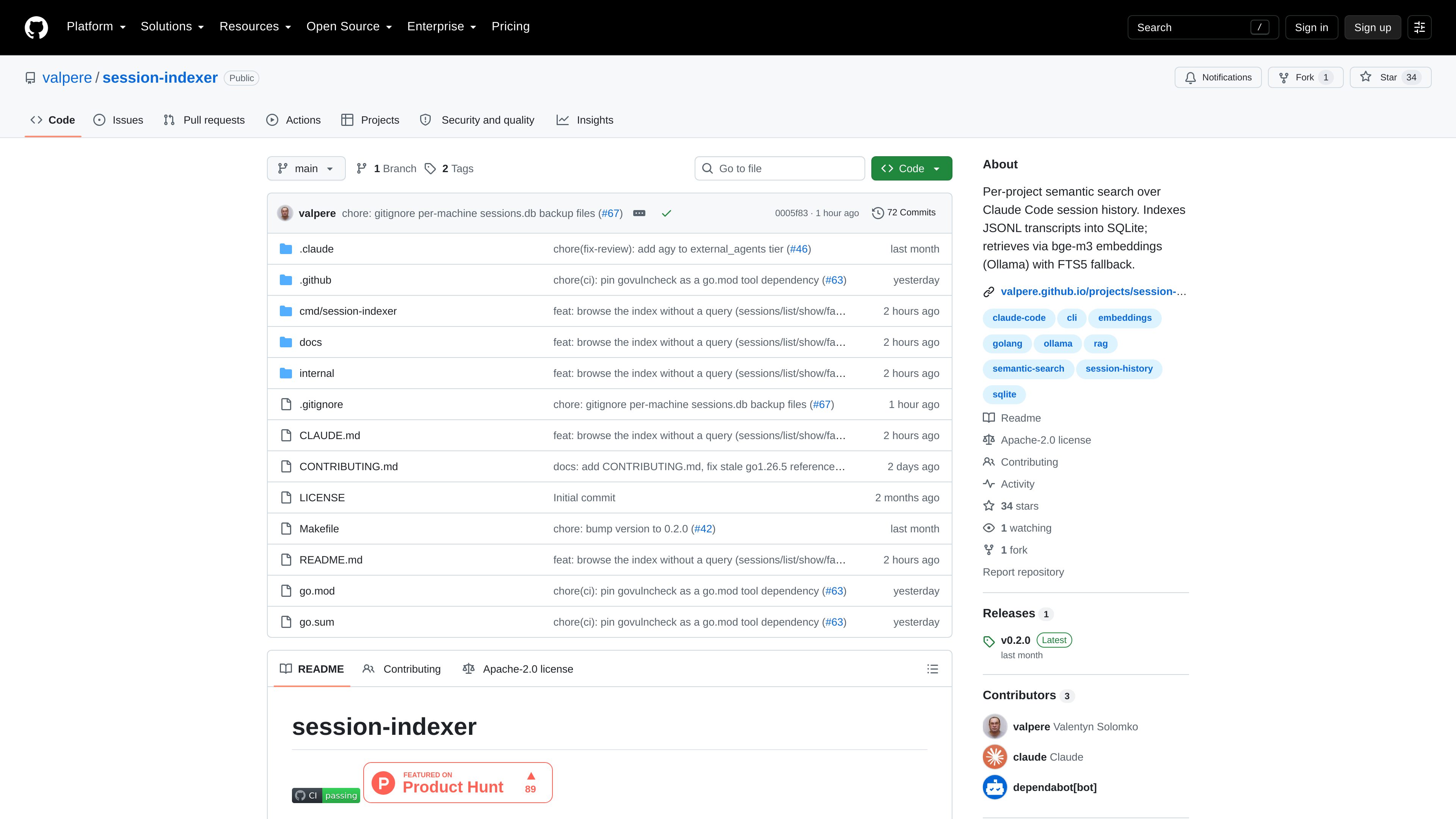
Indexes JSONL transcripts into SQLite
The project stores session history in SQLite, which makes the transcript data queryable in a structured local database instead of leaving it only as raw files.

session-indexerは、Claude Codeのセッション記録をSQLiteにインデックス化し、意味検索できるGitHubホスト型の開発者ツールです。プロジェクトごとにJSONLのセッション履歴を検索でき、埋め込みベースの検索が使えない場合はFTS5にフォールバックします。
Session-indexer is a developer tool for searching Claude Code session history on a per-project basis. It indexes JSONL transcripts into SQLite and then lets users retrieve past sessions with semantic search powered by bge-m3 embeddings through Ollama, with FTS5 available as a fallback.
The project is presented as a GitHub repository and appears to be aimed at developers who want a local, queryable record of Claude Code sessions rather than a generic note-taking or search app. Its core purpose is to make past sessions easier to find by turning transcript files into a searchable index.
The project stores session history in SQLite, which makes the transcript data queryable in a structured local database instead of leaving it only as raw files.
The page description states that search is performed using bge-m3 embeddings via Ollama, which indicates embedding-based matching for searching by meaning rather than exact text alone.
When semantic retrieval is not used or not available, the project can fall back to SQLite FTS5, providing a text-search path over indexed transcript content.
The product is described as per-project search over Claude Code history, suggesting the index is organized around individual project contexts rather than one global transcript pool.
The repository contains a docs directory and a .claude directory, indicating that usage and project-specific configuration/documentation are part of the codebase.
A developer can search session history for a specific project when they need to recover a decision, command, or troubleshooting thread from earlier Claude Code work.
Semantic search is useful when the user remembers the topic of a session but not the exact phrase used in the transcript.
If the embedding path is not in use, FTS5 provides a fallback for users who still need text-based retrieval over the indexed transcripts.
Developers can keep JSONL transcripts in SQLite so session history is easier to inspect and reuse later.
It indexes JSONL transcripts from Claude Code session history into SQLite.
The project uses bge-m3 embeddings through Ollama for semantic retrieval, with FTS5 as a fallback.
The source describes a repository that indexes data into SQLite and does not indicate a hosted SaaS product.
Yes. The page explicitly mentions FTS5 fallback.
The repository includes docs and project files, but the provided page text does not show a full usage guide.
トラフィックデータは参考情報としてご利用ください。
| 7月 | 0 |
|---|---|
| 8月 | 0 |
| 9月 | 0 |
トラフィック分析データはまだありません。
トラフィック分析データはまだありません。

skillsmp.com
SkillsMPは公開GitHubリポジトリからオープンソースのエージェントスキルを探せる無料マーケットプレイスです。検索、閲覧、REST API、MCPに対応し、Claude Code、Codex CLI、ChatGPTで利用できます。

algolia.com
パーソナライズされた検索・発見・レコメンドを実現するAI検索基盤

tablo-cat.netlify.app
tabloは、画面の隅からClaude CodeとOpenAI Codexのセッションを見守る、デスクトップ用の猫ウィジェットです。コンテキスト使用量、権限リクエスト、通知、セッションごとのアクティビティをリアルタイムで確認できます。

sourcegraph.com
Search and navigate code across repositories with Sourcegraph, investigate questions with cited AI answers and coordinate reviewed changes at scale.