
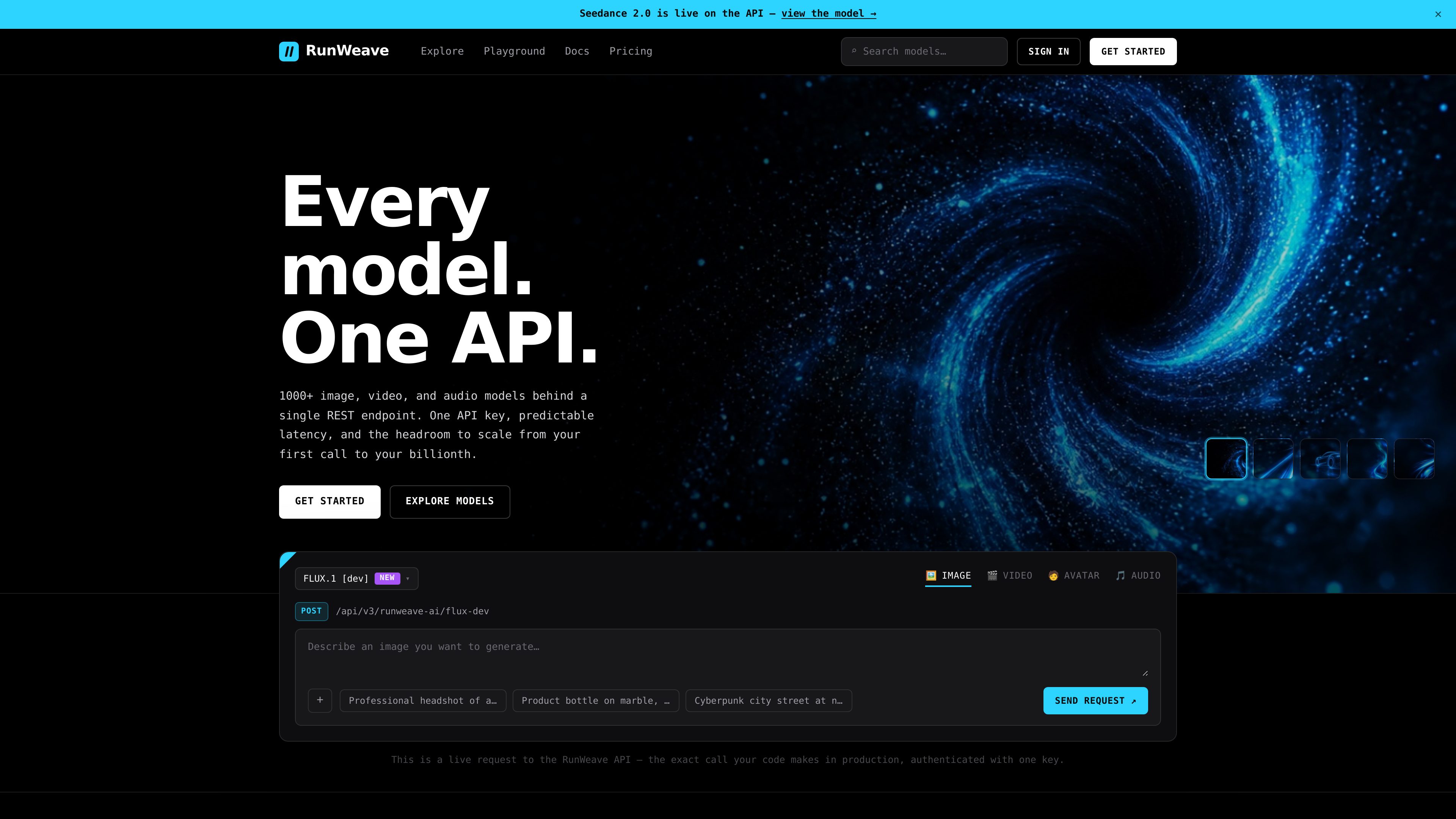
Unified multimodal catalog
Access more than 1,000 models through one API, covering image and video generation, audio and speech, 3D creation, avatars, editing, upscaling, and other model categories.

RunWeave is a unified inference API for developers building with image, video, audio, 3D, and related AI models. It provides access to 1,000+ models through one REST endpoint and one API key.
RunWeave is a unified AI inference API that exposes 1,000+ image, video, audio, 3D, avatar, and related models through one REST endpoint. Developers use one API key and base URL to browse models, test them in the browser playground, and integrate selected models into applications.
The platform supports both asynchronous task-based generation and synchronous mode for fast models. A typical asynchronous request returns a task ID, which the application polls until completion; completed responses can include output URLs. Requests can be sent with cURL, JavaScript, Python, or another HTTP client using Bearer authentication.
Model access is usage-based. Each model has a listed per-request price, and account credits are charged when requests run. Users can add funds through the service’s checkout flow, while the playground states that new accounts receive $1 in free credits.
Access more than 1,000 models through one API, covering image and video generation, audio and speech, 3D creation, avatars, editing, upscaling, and other model categories.
Use the documented base URL and Bearer API-key authentication across models instead of implementing a separate API connection for each provider or model.
Submit generation tasks and poll their status until completion, or enable synchronous mode for supported fast models when an inline result is preferable.
Select a model, provide its inputs, and run it from the browser before writing an integration. The playground exposes model-specific controls such as prompts, images, masks, output formats, and generation settings where available.
Browse the model directory and filter listings by type, provider, or free-text search, with pagination available through the API.
Models display per-request pricing, and requests draw from an account balance. Users can top up through the documented checkout flow rather than subscribing to a recurring plan.
Product teams can connect image, video, audio, or 3D generation to an existing backend using standard HTTP requests, then retrieve completed outputs from task results.
Developers can compare models in the browser playground, inspect available inputs and pricing, and use the model catalog to narrow the options before building a production workflow.
Applications that combine generation and transformation steps—such as image creation, background removal, upscaling, or video processing—can call different model types through the same API surface.
Individual developers can test requests with cURL, Python, or JavaScript and start with the documented submit-and-poll pattern before embedding the workflow in a larger service.
Requests use a Bearer API key in the Authorization header. The documentation recommends keeping the key secret and making API calls from a backend rather than exposing it in client-side code.
By default, a POST request creates a task and returns an identifier and result URL information. The application polls the prediction endpoint until the task is completed or failed, then reads the outputs. Fast models may support synchronous mode through the enable_sync_mode option.
The catalog includes image, video, audio, speech, 3D, avatar, editing, upscaling, training, and language-related model types. The exact inputs and outputs depend on the selected model.
RunWeave describes its pricing as usage-based. Models show a price per request, account credits are charged when requests run, and users can add funds through the account purchase flow. The pricing page says there are no subscriptions.
Yes. The browser playground lets users select a model, enter its inputs, and run it. The playground states that new accounts receive $1 in free credits.
トラフィックデータは参考情報としてご利用ください。

lumalabs.ai
Luma APIs provide image and video generation models for creative products, workflows, and production pipelines. They expose Uni-1.1 for image generation and Ray3.2 for controllable video generation, including editing and reframing workflows.

seeapi.com
SEEAPI is a unified platform for creating and integrating image, video, and other multimodal AI workflows across leading models. It supports browser-based experimentation and a public API for developers building creative tools, automations, and content systems.

modelslab.com
ModelsLab is a developer platform that provides APIs for image, video, audio, 3D, and LLM generation through a unified service. It supports teams building generative media features without integrating each model provider separately.

apiframe.ai
Apiframe is a unified REST API for generating AI images, videos, and music. It helps developers and automation teams add media generation through one API, with asynchronous jobs, webhooks, SDKs, and CDN-hosted outputs.
runwayml.com
Runway Dev is an API platform for adding AI-generated video, images, and audio to products and production workflows. It provides access to Runway and other providers' models, along with model routing, workflows, recipes, and team controls.

www.imejis.io
Imejis.io is an image generation platform with a remote MCP server and REST API for creating, editing, and rendering structured designs. It helps AI-agent users, developers, and automation workflows turn templates or structured data into PNG, JPEG, WebP, and single-page PDF outputs.