
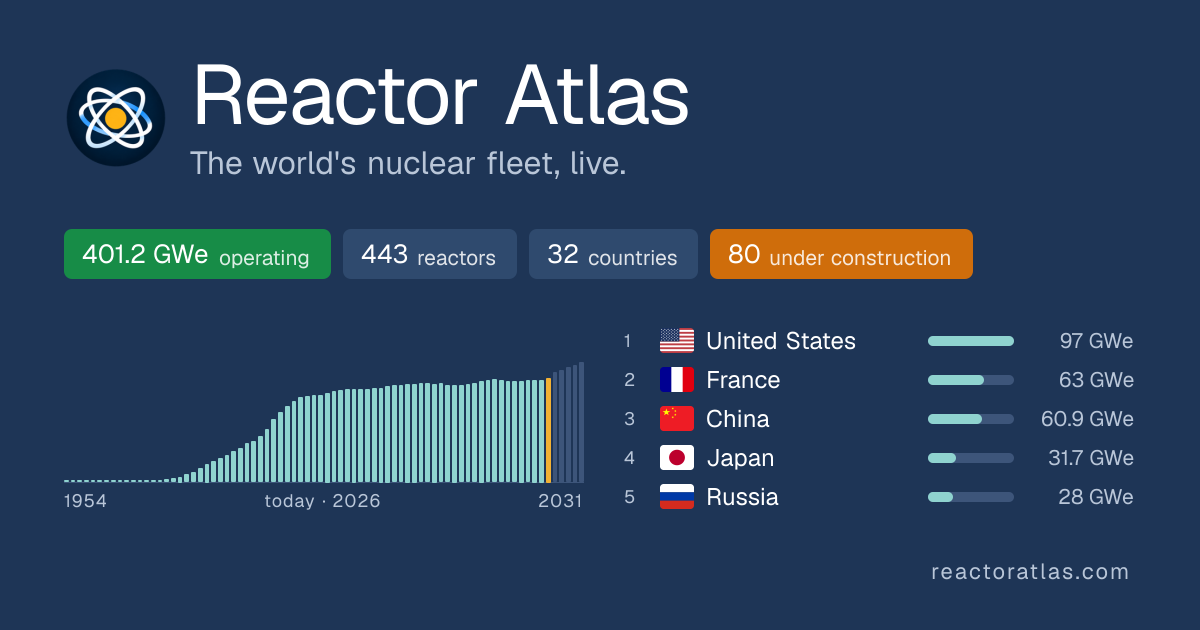
Global reactor map
Explore nuclear reactors and plants on an interactive world map, with records covering reactors dating back to 1954.

Reactor Atlas is an interactive map and reference service for nuclear reactors, power plants, research facilities, and fusion devices. It combines historical and technical reactor records with plant visualization and monitored operational signals.
Reactor Atlas is an interactive map and reference service for nuclear reactors and related facilities worldwide. It combines location-based exploration with technical reactor records, plant histories, 3D plant views, and live operational signals.
The service covers power reactors, research reactors, and fusion devices. Its reference content explains reactor designs and fundamental nuclear-energy concepts, while its research-reactor directory provides facility-level records grouped by country. A monitoring section adds recent operational and energy-system events, including outages, derates, generation changes, demand deviations, and earthquakes near plants.
Explore nuclear reactors and plants on an interactive world map, with records covering reactors dating back to 1954.
Review reactor families, designs, operating concepts, and technical context for types such as PWR, BWR, PHWR, gas-cooled, fast, high-temperature gas, SMR, research, and fusion systems.
Use plant-focused technical sheets and 3D plant presentations to inspect facilities beyond their map locations.
Browse research reactors and critical or subcritical assemblies by country, with facility names, locations, reactor types, and status labels. The directory identifies the IAEA Research Reactor Database as its survey source.
Follow recent nuclear and related energy events, including outages, derates, returns to service, generation swings, demand deviations, and earthquakes near plants.
Review selected events in a recent timeline, including dates and sources where available, and inspect events with locations on a map.
Use the reactor-type guides and design references to distinguish how different reactor families moderate neutrons, manage coolant, generate steam, or confine fusion plasmas.
Start with the map or a facility record, then use technical sheets, status information, and the site's historical explanations to place a reactor in its operating or development context.
Browse the research-reactor directory to identify facilities in a selected country and compare their names, locations, types, and current status labels.
Use the monitoring timeline and event map to review recent outages, derates, returns to service, generation changes, and other signals associated with nuclear or energy-system activity.
Consult the wiki explanations for concepts such as fission, power ratings, capacity factor, safety barriers, decay heat, fuel enrichment, radioactive waste, and decommissioning.
It covers nuclear power reactors, research reactors, critical and subcritical assemblies, and fusion devices. The product description also states that its reactor records extend back to 1954.
Yes. A dedicated research-reactor section lists facilities by country and includes names, locations, reactor types, and status labels such as operating, shut down, under construction, and decommissioned.
The monitoring section includes nuclear-unit outages, derates, returns to service, generation swings, demand deviations, and earthquakes near plants, along with related energy and contextual signals.
The product description says live signals are updated hourly. The monitoring page also displays a last-checked time and recent event windows, so the page should be treated as a time-stamped monitoring view rather than a static archive.
Yes. Its wiki includes guides to reactor designs and concepts covering reactor physics, plant operation, safety, fuel and waste, decommissioning, and fusion.