
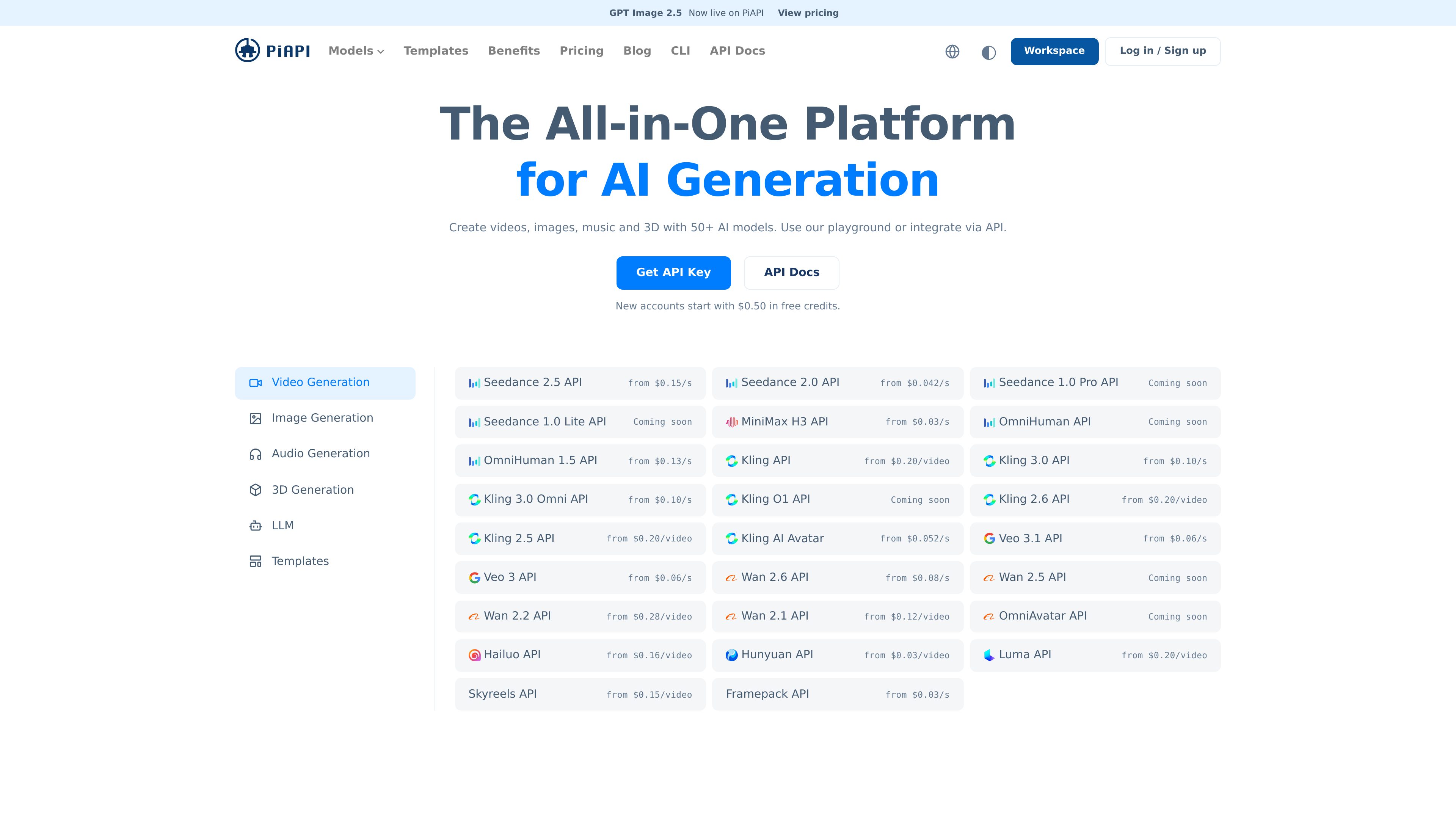
Multi-category model catalog
Browse models for video, images, audio, 3D, and LLM tasks from one catalog. Listed task types include text-to-video, image-to-video, text-to-image, image editing, music, text-to-speech, and image-to-3D.

PiAPI is a unified platform for generating video, images, audio, 3D assets, and LLM outputs through a model catalog, playground, APIs, CLI, and MCP server. It is designed for developers, AI agents, and automation workflows that need access to multiple generative models.
PiAPI is a generative AI platform that brings video, image, audio, 3D, and LLM models behind a common interface. Its catalog lists 88 models across six categories, with capabilities including text-to-video, image-to-video, text-to-image, image editing, music generation, text-to-speech, image-to-3D, and chat or research tasks.
Users can access models through the PiAPI playground or integrate them into applications with the platform's unified API. The documented workflow centers on task creation and task retrieval, with webhooks available for status updates. The site also provides a CLI, MCP server, and no-code workflow options for developers, AI agents, and automation users.
PiAPI supports pay-as-you-go model usage from a credit balance, with rates set by model and version. Subscription plans provide account features and, on some tiers, bonus credits; API usage is billed separately from the subscription plan.
Browse models for video, images, audio, 3D, and LLM tasks from one catalog. Listed task types include text-to-video, image-to-video, text-to-image, image editing, music, text-to-speech, and image-to-3D.
PiAPI's unified API architecture uses task-creation and task-retrieval operations across supported models, reducing the need to learn a separate basic workflow for every model.
Webhook fields and webhook services support task update notifications. The documentation also covers task responses, output storage, task history, billing, and account information.
The PiAPI CLI lets users run multimodal models from a terminal, list available models, and submit asynchronous tasks. The MCP server exposes models to coding agents and MCP-compatible assistants using structured inputs and results.
PiAPI describes connections to Make, n8n, and Zapier through HTTP modules and webhooks, allowing automation workflows to call model APIs without writing an application integration.
The Free, Creator, Pro, and Enterprise plans offer different account features. Enterprise includes higher task concurrency, up to 100 sub-accounts, unified billing, and balance management; model API usage remains separately metered.
A developer can use the playground and trial access to test image, video, audio, 3D, or LLM generation before connecting a model to a personal application.
An application can submit generation tasks through the unified API, retrieve task results, and use webhooks for status updates instead of implementing a separate basic integration for each supported model.
Developers and AI agents can install the PiAPI CLI, select a model, submit synchronous or asynchronous jobs, and receive generated results or task identifiers from command-line workflows.
Teams can place PiAPI calls inside Make, n8n, or Zapier workflows using HTTP modules and webhooks for processes that generate media or text as part of a larger automation.
Organizations using the Enterprise plan can organize up to 100 sub-accounts, consolidate billing into one invoice, and manage sub-account balances while using the platform's model APIs.
PiAPI lists models for video generation, image generation and editing, audio and music, 3D generation, and LLM tasks. The catalog includes tasks such as text-to-video, image-to-video, text-to-image, text-to-speech, image-to-3D, and chat or research.
The documented unified workflow uses an API request to create a task and a retrieval request to get its result. Webhooks can be supplied or configured for task updates. The site shows API-key authentication and JSON request parameters in a Python example.
Model API usage is pay-as-you-go from a PiAPI credit balance, and each model or version has its own rate. Subscription plans provide account features and, on selected tiers, bonus credits; subscription fees and API usage are billed separately. New accounts start with $0.50 in free credits according to the pricing page.
Yes. The playground provides an interactive way to try models, the CLI supports terminal workflows, and the site describes no-code connections to Make, n8n, and Zapier through HTTP modules and webhooks.
The Enterprise plan includes higher task concurrency, up to 100 sub-accounts, unified billing with a single invoice, and balance management for sub-accounts. The source does not specify broader team permissions or workspace limits.
トラフィックデータは参考情報としてご利用ください。

eachlabs.ai
each::labs provides a single API for orchestrating more than 600 AI models, with routing, fallback handling, observability, and usage-based pricing. It is designed for teams building and operating production AI applications across video, image, audio, and text workflows.

huggingface.co
Hugging Face Inference Providers gives developers a way to compare supported models across infrastructure providers using model availability, pricing, context limits, latency, throughput, and capability indicators.

wiro.ai
Wiro AI is a unified API and model marketplace for running image, video, audio, language, and other AI models. Developers can use one API key to test models, execute tasks, and build workflows and agents.

gmicloud.ai
NVIDIA GPUで本番推論・学習・ファインチューニングを行うAI基盤。
aimlapi.com
AIMLAPI provides one API and billing key for accessing a catalog of AI models for chat, reasoning, image, video, audio, voice, search, embeddings, code, and related tasks. It is intended for developers and teams that want to compare and use models from multiple providers through a common platform.

chat100.ai
Chat100.aiは、ChatGPT、Grok、Geminiに一か所でアクセスし、切り替えや出力比較ができるWeb AIチャット platformです。