
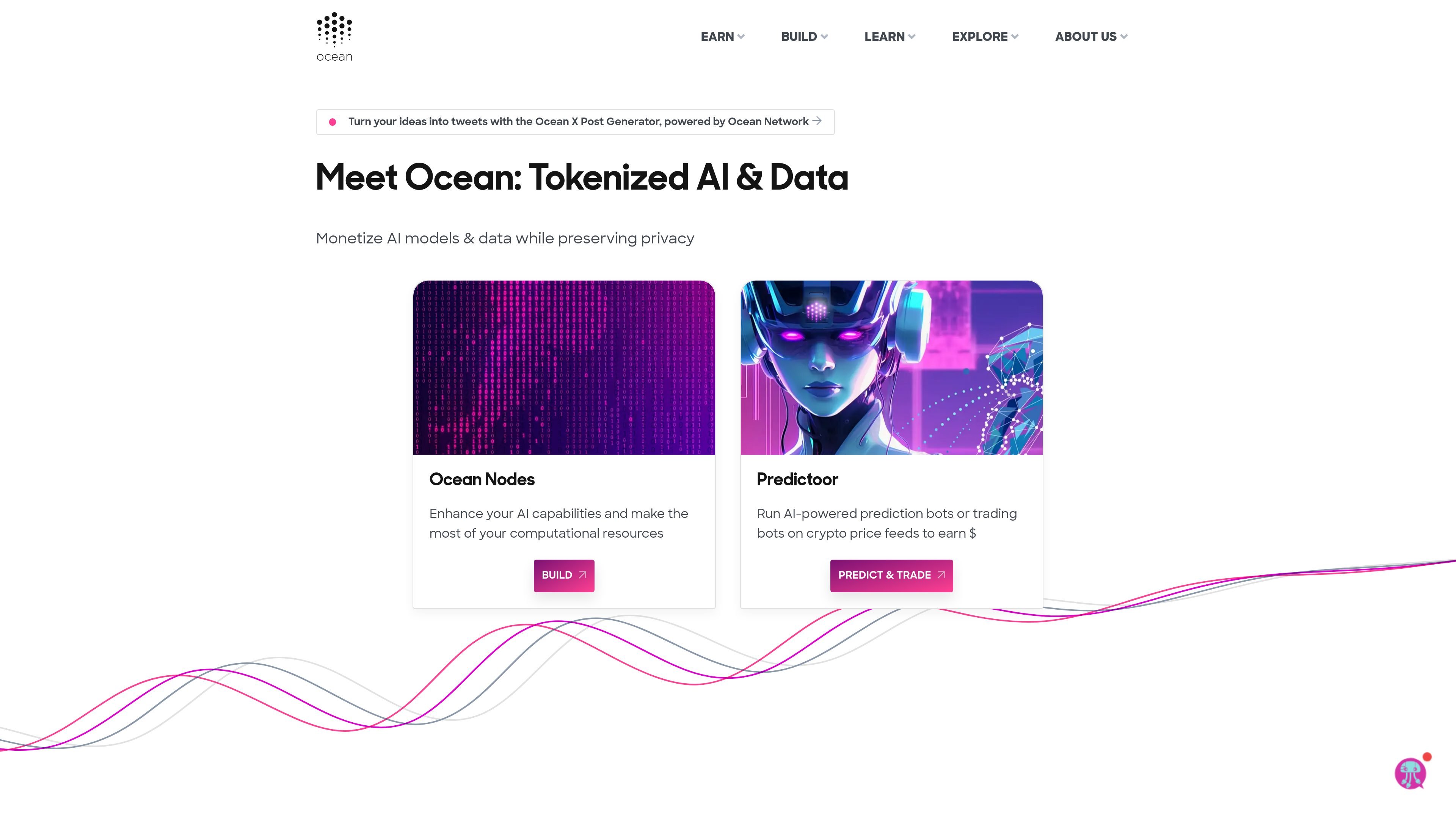
Ocean Nodes
Run decentralized, peer-to-peer compute clusters with a modular architecture. Nodes support CPU and GPU resources for developing, training, and monetizing AI models.

Open-source infrastructure for developers to monetize AI models and data with privacy controls.
Ocean Protocol is open-source infrastructure for building applications that control and monetize access to data and AI models. Its stack combines Ocean Nodes for computation, Data NFTs to represent assets, datatokens for access permissions, and Compute-to-Data for running algorithms where data resides.
Developers can assemble data-driven applications and APIs with configurable access licenses, payment routing, and team permissions. The core purpose is to let asset owners offer access or computation while retaining control over their underlying data.
Run decentralized, peer-to-peer compute clusters with a modular architecture. Nodes support CPU and GPU resources for developing, training, and monetizing AI models.
Represent assets and their provenance using ERC721 technology with ERC725y features. Configure access to data environments, web services, and digital assets with storage encryption and access controls.
Create one or more ERC20 datatokens for each Data NFT to define access permissions. Configure whitelists, pricing, promotions, and expiration for asset access.
Move computation to the data so algorithms can run remotely without relocating the underlying assets. Support algorithm allowlists, encryption and decryption, and royalty distribution.
Manage roles that control who can edit Data NFTs and datatokens. Use ERC20 templates to route payments automatically to different stakeholders.
Build with Ocean.js and open-source application templates. An uploader interface supports sending files to decentralized storage and retrieving their decentralized data object (DDO).
Data owners can make datasets available for remote machine learning tasks, permit selected algorithms, and earn revenue while keeping the source assets in place.
Developers can create data-driven dApps or APIs that grant access through datatokens, with wallet whitelists and time limits suited to their distribution workflow.
Compute operators can run Ocean Nodes using CPU or GPU infrastructure to support model development and training within decentralized clusters.
Teams can assign asset editing permissions and distribute payments among stakeholders when commercializing data, models, or access to web services.
A Data NFT represents the underlying asset and its provenance. It can produce one or more datatokens, which define token-based permissions for accessing that asset.
Ocean's developer hub describes building token-gated AI applications and APIs in JavaScript or Python. It also provides Ocean.js and prebuilt open-source templates.
Yes. Developers can set credentials in an asset's DDO to whitelist wallets and restrict who can buy access.
Yes. Setting a timeout greater than zero limits how long a user can access files after consumption.
トラフィックデータは参考情報としてご利用ください。

www.tinyfish.ai
TinyFish is web infrastructure for AI agents that searches, fetches, browses, and completes tasks on live websites. It helps developers and enterprise teams gather current web data, use authenticated portals, and automate browser-based workflows.

superlinked.com
Open-source inference for agents, serving embeddings, rerankers, extractors, and open LLMs on your infrastructure.

happy.engineering
An open-source desktop app for developers to orchestrate Claude, Codex, and Grok.

getbb.app
bb is a local-first, open-source IDE for running coding agents in parallel, organizing their work in threads, and extending the workspace with plugins. It is designed for developers and teams that want to coordinate provider-based agents and customize their software workflow.

opengeni.ai
Open-source infrastructure for building agent experiences into products.

busabase.com
An open-source database and workspace for connecting AI agents with reusable data, documents, skills, and apps.