

Knowledge extraction and contextualisation
Ingests structured and unstructured enterprise content and maps relationships and dependencies so the system can build deeper context than simple retrieval.
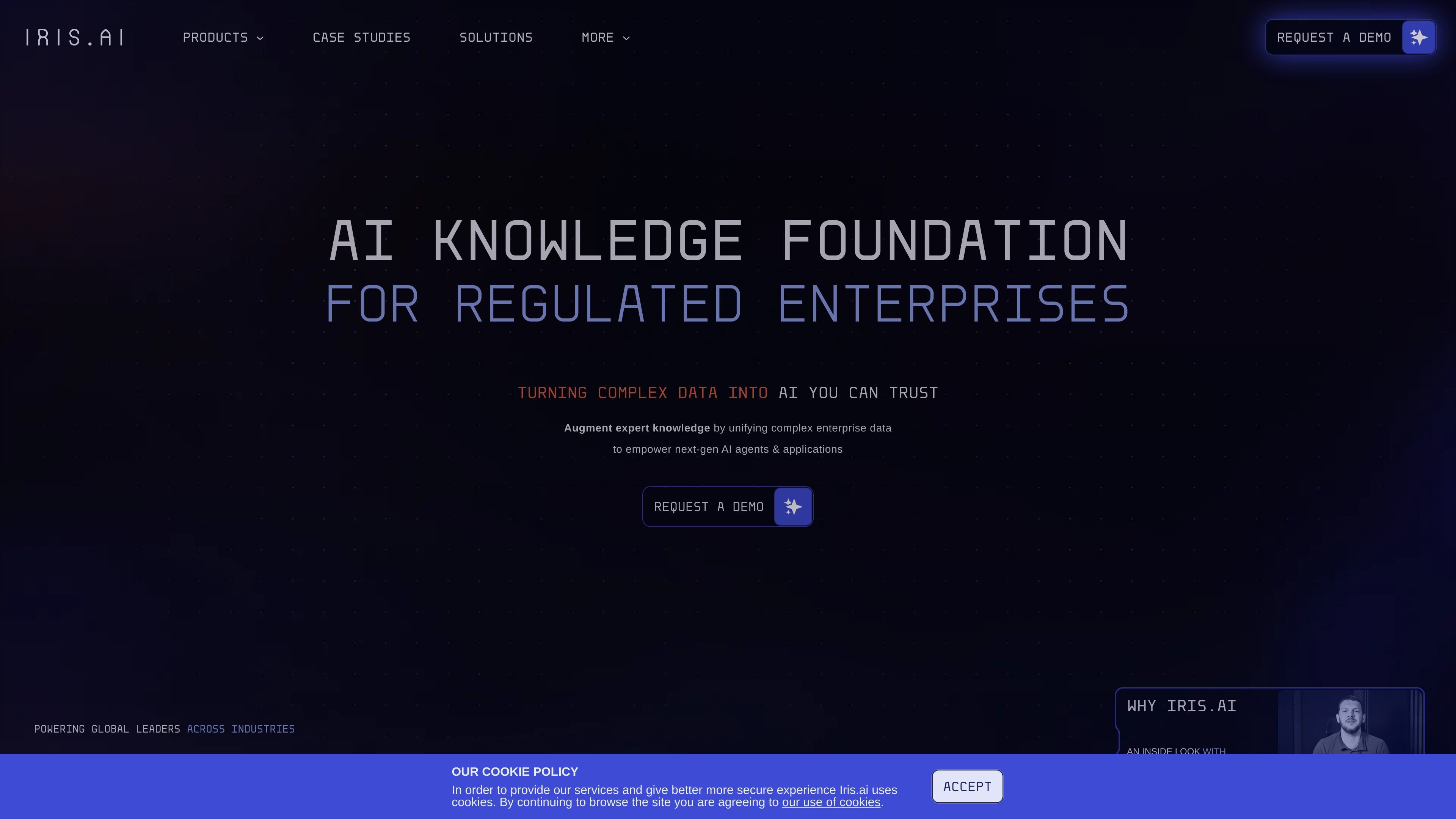
Iris.ai is an AI knowledge foundation for regulated enterprises. It is designed to turn fragmented enterprise data into a structured knowledge layer that can support AI agents, copilots, and other domain-aware applications.
The site describes the platform as a “missing middle layer” between raw enterprise data and AI outputs. It combines knowledge extraction, contextual grounding, expert validation, and output controls so organizations can produce responses that are more auditable, explainable, and aligned with internal standards.
Ingests structured and unstructured enterprise content and maps relationships and dependencies so the system can build deeper context than simple retrieval.
Aggregates enterprise data across systems into a coherent knowledge graph, giving the platform a semantic layer for reasoning and analysis.
Grounds AI models in trusted sources and domain semantics to reduce hallucination and keep responses tied to business context.
Uses SME and architect feedback to refine accuracy, relevance, and completeness, with knowledge that is versioned and auditable.
Tests outputs against accuracy and compliance criteria and applies guardrails so responses stay consistent with expert benchmarks.
Provides full source traceability and explainable reasoning paths, which supports auditability in regulated deployments.
Helps research and development teams review papers and patents more efficiently, especially when they need to keep up with ongoing literature and competitor monitoring.
Turns internal documents, policies, and historical knowledge into a searchable and reasoned knowledge layer for teams that need to preserve institutional expertise.
Supports regulated workflows that need traceable, explainable outputs rather than ungrounded model responses.
Helps teams narrow down relevant research faster when working across disciplines or responding to time-sensitive topics.
Provides a foundation for agents and copilots that need domain context, controlled outputs, and consistent responses at scale.
Iris.ai positions itself as an AI knowledge foundation for regulated enterprises. Its source material says it ingests structured and unstructured enterprise data, validates and refines knowledge with SME feedback, and uses that foundation to support AI agents and applications.
The source describes an intelligence pipeline with four stages: extract and contextualise, validate and refine, control output, and deliver enterprise AI responses. It also references knowledge synthesis, contextual grounding, and governance and trust as core functions.
The website says Iris.ai is built for regulated enterprises and for teams in energy and industrials, life sciences, and professional services. The solution pages point to research and development teams, enterprise knowledge management, and other expertise-led workflows.
The pages highlight knowledge graph-based reasoning, source traceability, explainable reasoning paths, and measurable accuracy. The platform also emphasizes support for governance and compliance requirements in regulated environments.
The pricing page is present, but the collected source text does not expose pricing numbers, plan names, or a published pricing model. A demo request flow is visible from the site content.
トラフィックデータは参考情報としてご利用ください。

graphlit.com
AIエージェント向けのコンテキストレイヤーで、根拠ある検索と対話を実現

enterpret.com
フィードバックを行動につなげる顧客インテリジェンス基盤

getzep.com
時間的コンテキストグラフで情報を保存・検索するAIエージェント記憶基盤

pulsehq.tech
Pulseは、権限を考慮した社内ナレッジ製品です。チームのツールをひとつのグラフにつなぎ、出典を添えて平易な英語で質問に回答します。5〜500人のチーム向けで、創業者によるライブデモを通じて評価できます。

www.cognee.ai
Cognee is an open-source memory platform for AI agents and applications. It connects data across sources, builds connected memory using vector, graph, and relational storage, and makes that context available through SDK, cloud, or self-hosted deployments.

structify.ai
接続されたデータのマッピング・整理・検索を支援するAIデータ基盤