
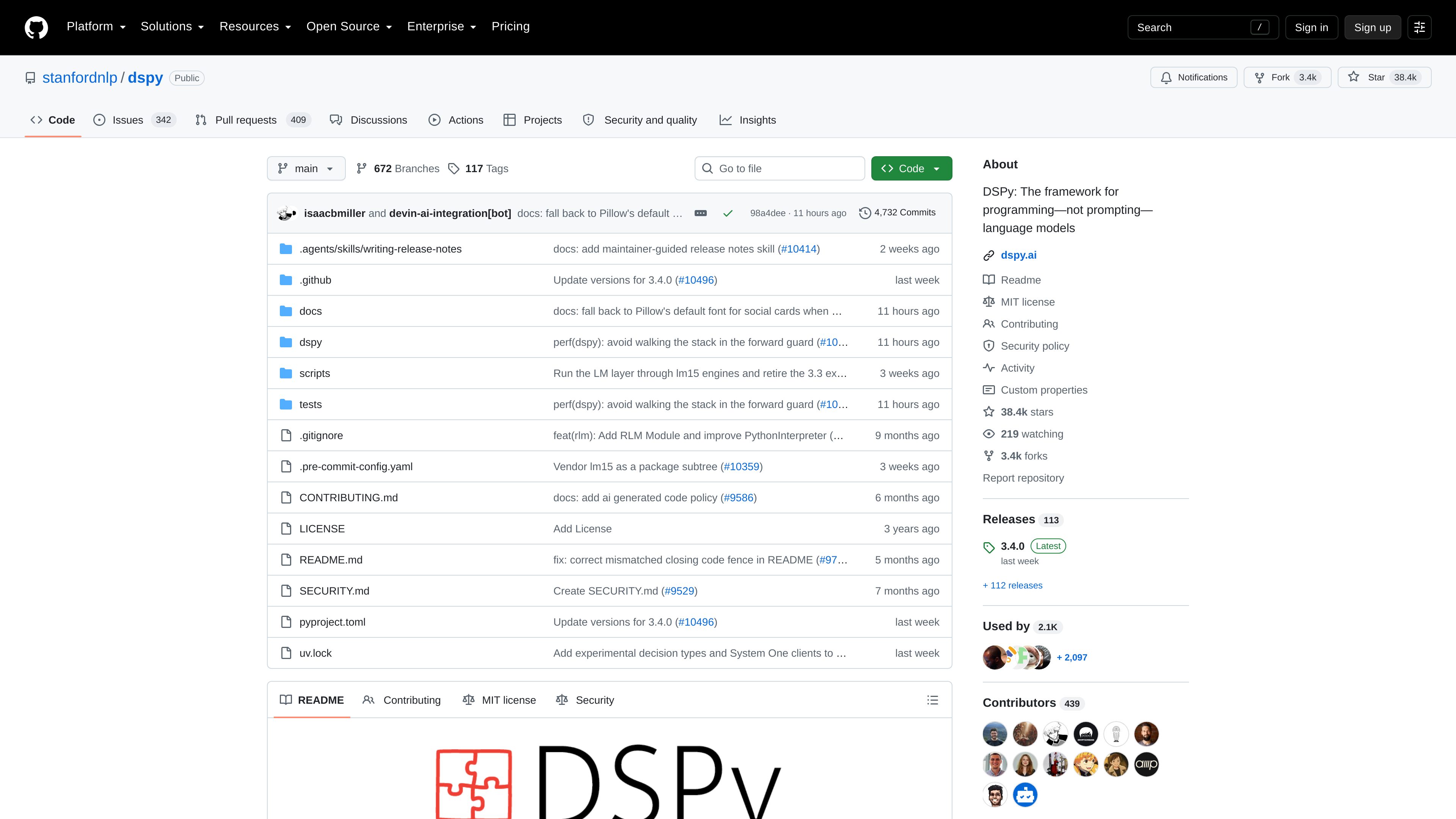
Programming-oriented language-model framework
DSPy is presented as a framework for programming—not prompting—language models, giving the project a code-centered approach to language-model application development.

DSPy is an open-source framework for programming language-model applications instead of manually prompting them. Its public repository provides the project code, documentation, tests, issue tracking, and contribution workflow.
DSPy is an open-source framework from the Stanford NLP organization for programming language-model applications rather than manually writing prompts. Its public GitHub repository contains the project source, documentation, tests, scripts, configuration, and community development workflow. The available page evidence identifies DSPy’s core positioning, but does not provide enough detail to document specific integrations, installation commands, deployment environments, or model-provider support.
DSPy is presented as a framework for programming—not prompting—language models, giving the project a code-centered approach to language-model application development.
The repository is public and includes the main `dspy` source directory, allowing users and contributors to inspect the implementation.
A dedicated `docs` directory and README are included in the repository, providing the project’s documented entry points.
The repository includes a `tests` directory, which provides a visible place for project validation and regression coverage.
CONTRIBUTING.md and SECURITY.md are present, giving the project documented locations for contribution guidance and security reporting information.
GitHub Issues, pull requests, Discussions, Actions, Projects, and the repository’s branch and tag history support public software development around DSPy.
Developers can review the README, documentation, source tree, and tests to determine whether DSPy fits a language-model application project.
Teams that prefer to assess dependencies and implementation details directly can examine the public repository before building on the framework.
Engineers can use the repository’s contribution guidance, issues, pull requests, and discussions to propose or review changes.
Researchers and developers can inspect commits, branches, tags, documentation, and tests to follow how the framework changes over time.
DSPy is an open-source framework from the Stanford NLP organization whose stated focus is programming—not prompting—language models.
DSPy is developed in the public `stanfordnlp/dspy` repository on GitHub, which contains its source, documentation, tests, and project-management workflow.
Yes. The repository includes contribution guidance and exposes issues, pull requests, and discussions for public project participation.
No. The supplied page evidence does not establish a supported-provider list, integration catalog, installation procedure, or deployment requirements; those details should be verified in the project documentation.

www.getzep.com
Graphiti is an open-source GitHub project for building real-time knowledge graphs for AI agents. It provides a codebase that developers can inspect, extend, and contribute to through the repository’s development workflow.

opentrade.io
OpenTrade is an open-source trading harness for Claude Code and Codex agents. It provides a repository-based app, agent templates, and scheduling-oriented run management for automated trading workflows.
gitmcp.io
GitMCP creates a remote Model Context Protocol (MCP) server for public GitHub repositories and GitHub Pages sites. It helps MCP-compatible AI assistants access repository documentation and code context for more relevant coding responses.

modelcontextprotocol.io
The official TypeScript SDK for building Model Context Protocol servers and clients. It provides a repository-organized foundation for MCP development, with separate client, server, core, middleware, documentation, and example areas.

www.pipecat.ai
Pipecat is an open-source Python framework and ecosystem for building real-time voice and multimodal AI agents. It helps developers compose pipelines that coordinate speech, language, vision, video, text, tools, and telephony transports.

relace.ai
コーディングエージェント向けに、コード検索・ファイルマージ・ソース管理ワークフローを支援するAIモデルおよびインフラストラクチャプラットフォーム