
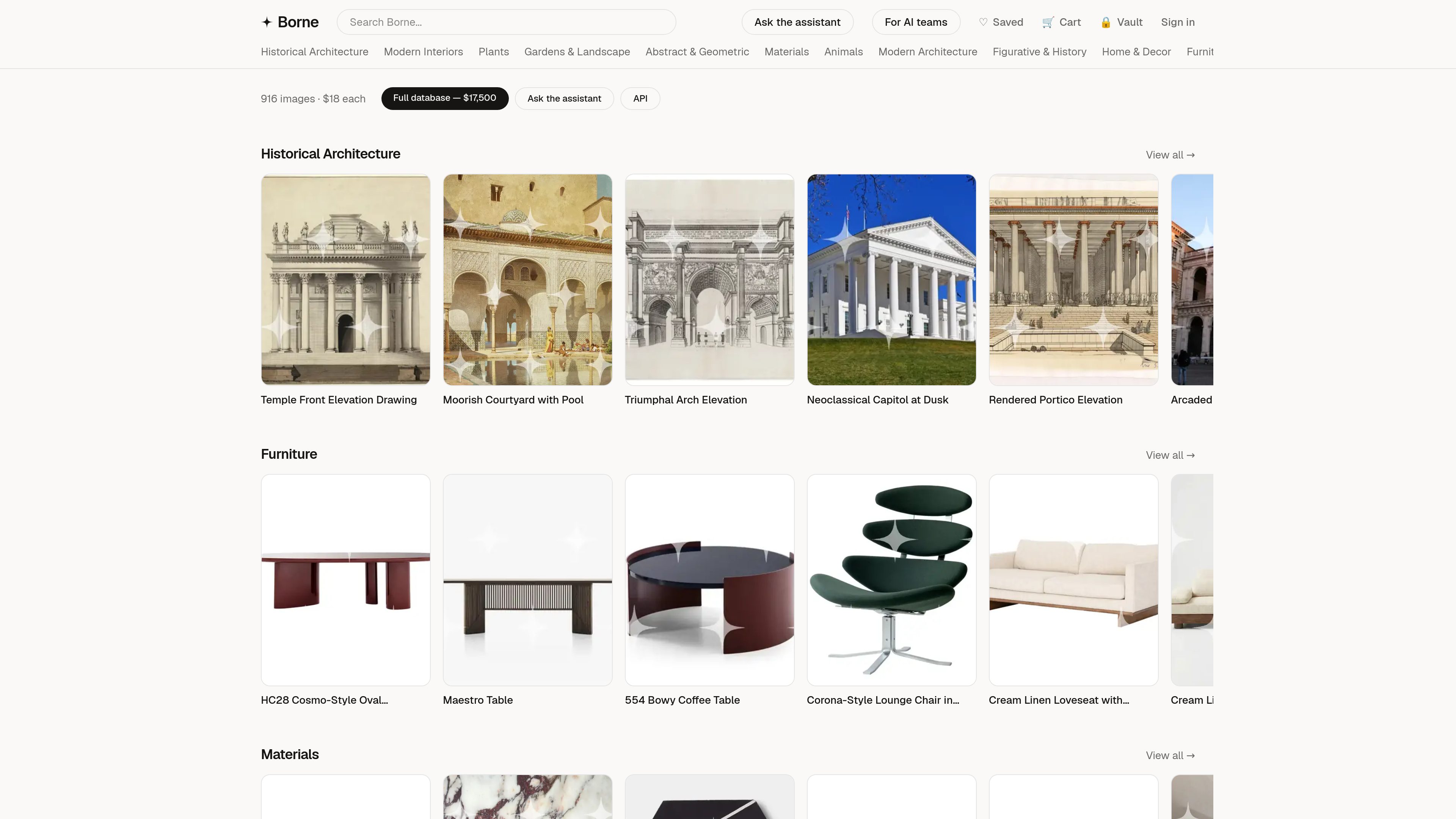
Curated visual catalog
The catalog contains 916 images across 41 categories, including historical and modern architecture, interiors, landscapes, art, furniture, materials, plants, animals, fashion, and design-related subjects.

Borne is a hand-curated visual database of public-domain imagery across architecture, interiors, landscapes, art, materials, and design objects. It supports visual research, individual image licensing, and bulk dataset licensing for AI training and related machine-learning work.
Borne is a hand-curated visual database of public-domain imagery for visual research, image licensing, and AI dataset use. Its catalog covers architecture, interiors, landscapes, art, furniture, materials, fashion, plants, animals, and other subjects, organized into categories and eras and accompanied by human-written captions and keywords.
The database contains 916 images across 41 categories. Users can license individual images for $18 or license the full Borne Visual Database v1 for $17,500. The full licence includes the complete image set, full-resolution unwatermarked originals, JSON metadata sidecars, and a bulk download, with stated permission for training, fine-tuning, and synthetic derivation.
Borne also includes a natural-language assistant for catalog discovery. For dataset buyers, the site documents endpoints for inspecting the manifest and sample records and for initiating a programmatic purchase.
The catalog contains 916 images across 41 categories, including historical and modern architecture, interiors, landscapes, art, furniture, materials, plants, animals, fashion, and design-related subjects.
The full dataset describes each asset with a title, caption, category, and keyword list, helping users search and organize imagery by subject and visual attributes.
Dataset records can include orientation, colors, materials, era, people indicators, image dimensions, megapixels, aspect ratio, format, and color space in JSON metadata.
The Borne Visual Database v1 licence provides all 916 assets as full-resolution, unwatermarked originals in a single bulk download rather than requiring per-file negotiation.
The stated full-database terms permit training, fine-tuning, and synthetic derivation; the licence is described as one-time, perpetual, non-exclusive, and worldwide.
The assistant accepts natural-language shopping or catalog requests, while documented API endpoints provide a manifest, representative sample records, and a purchase route for the dataset.
Designers, art directors, and researchers can browse curated groupings such as modern interiors, historical architecture, materials, gardens, and landscape painting to assemble visual references.
A user who needs one public-domain image for a project can select an individual catalog asset and license it for the listed $18 price.
AI and machine-learning teams can acquire the complete database, download the image files and JSON sidecars, and use the stated permissions for training and fine-tuning workflows.
Technical buyers can request the dataset manifest and a free representative sample through the documented endpoints to review terms, size, category breakdown, and record structure before purchasing.
A shopper can describe a category, style, or budget to the Borne assistant—for example, minimalist furniture under a specified budget or available art prints—and receive catalog results.
Borne Visual Database v1 contains 916 images across 41 categories. The site states that every asset is captioned and keyworded.
The $17,500 full-database licence includes all 916 assets, full-resolution unwatermarked originals, complete JSON metadata sidecars, and one bulk download. The stated terms are one-time, perpetual, non-exclusive, and worldwide.
Yes. The dataset page explicitly permits training, fine-tuning, and synthetic derivation under the full-database licence.
Yes. Borne documents a manifest endpoint that returns terms, size, and category breakdown, plus a sample endpoint offering free representative records. Purchase is initiated through a documented POST endpoint and Stripe checkout.
Users describe what they are shopping for using a category, style, or budget. The assistant then pulls from the catalog; examples on the site include minimalist furniture, watches, art prints, and leather goods.
トラフィックデータは参考情報としてご利用ください。