
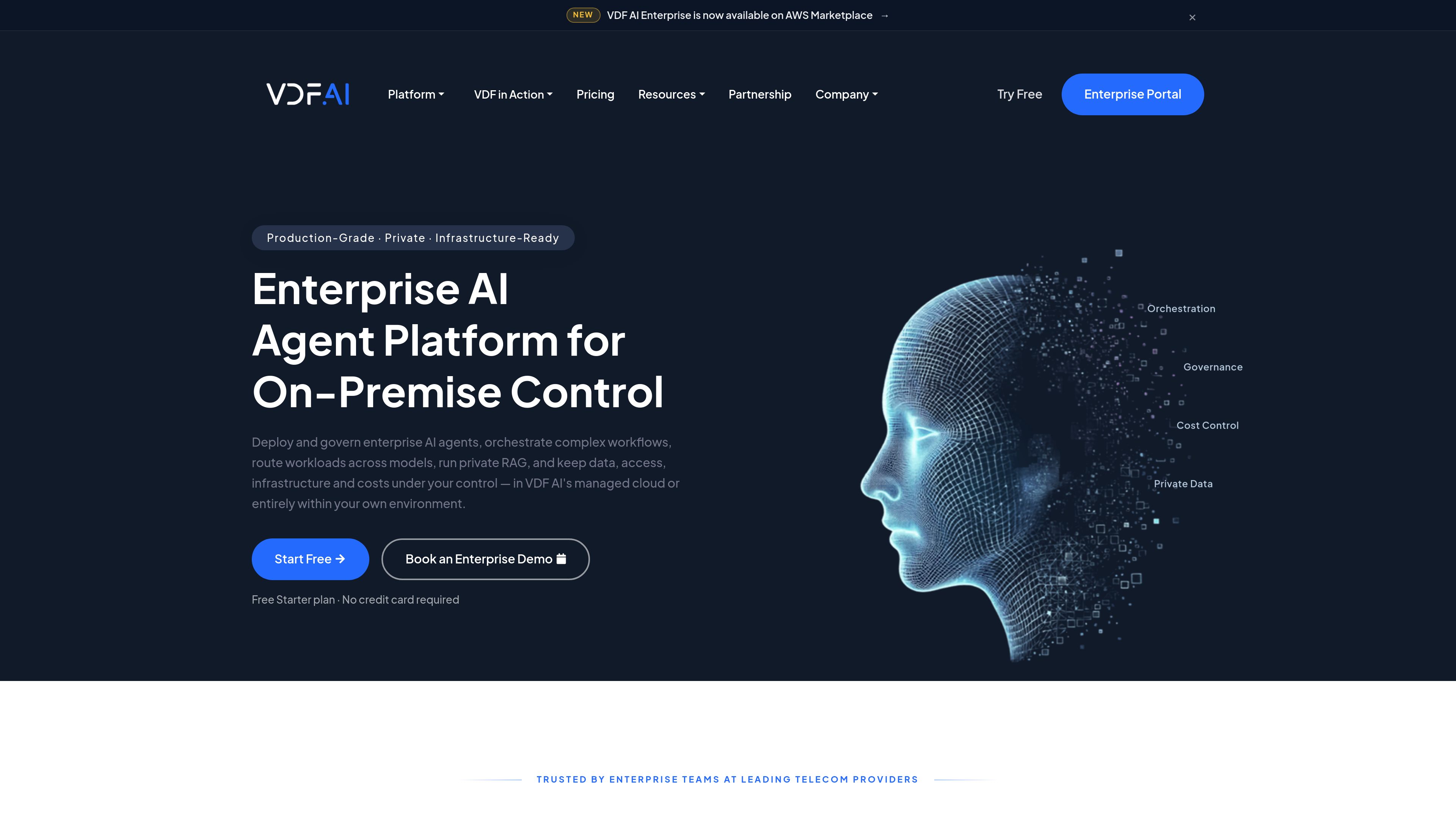
Governed multi-agent Networks
Decompose a request into typed sub-tasks, map dependencies, select agents, tools, and models at runtime, and validate the result before returning it. Execution paths are recorded.

VDF AI è una piattaforma enterprise di orchestrazione degli agenti AI che coordina agenti, modelli, strumenti, retrieval e flussi di lavoro con una governance centralizzata. Può essere usata come servizio cloud gestito o distribuita in un cloud privato, data center, ambiente sovrano, account AWS o infrastruttura air-gapped.
VDF AI is an enterprise AI orchestration platform for turning AI agents and models into governed workflows. It coordinates multi-agent execution, retrieval from enterprise knowledge sources, model selection, tool calls, approvals, and result validation while recording the execution path for review.
The platform is available as a managed cloud service or as a self-deployed installation in a data centre, private cloud, sovereign environment, AWS account, or air-gapped setting. Its product suite includes VDF AI Networks for multi-agent orchestration, VDF AI Agents for deployable agent workflows, VDF AI Chat for private-RAG conversations, and VDF AI Data for data preparation and model validation.
Decompose a request into typed sub-tasks, map dependencies, select agents, tools, and models at runtime, and validate the result before returning it. Execution paths are recorded.
Use private RAG and knowledge-graph capabilities to ground responses in connected enterprise information rather than relying only on pasted context.
Select models against task complexity, cost, latency, and capability. Routing decisions are logged for operational review.
Apply centralized controls for access, permissions, policies, retrieval, tool calls, and execution logging so decisions can be reconstructed later.
Run the platform in VDF AI’s managed cloud or deploy it on private infrastructure, including on-premises, private-cloud, sovereign, and air-gapped environments.
Monitor cost and energy metrics, usage, execution activity, and governance data. Capacity licensing includes dashboards, monthly consumption statements, and usage alerts.
Build chat or agent experiences that retrieve information from private enterprise sources while keeping the data and deployment under the organization’s control.
Coordinate multiple agents, models, tools, APIs, databases, business systems, decisions, and approval steps as one repeatable workflow.
Route different tasks to suitable models based on complexity, latency, capability, and cost, then review the routing and usage records.
Operate agents and retrieval inside a company data centre, private or sovereign environment, or disconnected infrastructure where external API dependencies are not acceptable.
Move a validated use case from a pilot into a controlled production workflow with defined inputs, owners, access controls, monitoring, and auditable execution records.
VDF AI can run as a managed cloud service or be deployed on an organization’s infrastructure, including a data centre, private cloud, sovereign environment, AWS account, or air-gapped environment. The on-premises platform uses container deployment.
VDF AI parses intent, breaks the request into typed sub-tasks, maps dependencies, selects agents, tools, and models, coordinates work that may run in parallel, validates the result, and records the execution path and outcome.
Yes. The platform provides enterprise RAG and knowledge-graph grounding, and its deployment options are intended for organizations that need to keep data, models, agents, and infrastructure within their own perimeter.
On-premises capacity licensing uses an annual organization-wide pool with separate token and platform-transaction meters. Capacity is shared across included environments, while human users are unlimited. VDF AI provides a usage dashboard, monthly consumption statements, and alerts.
The managed cloud version has a free Starter plan with no credit card required. VDF AI also describes a controlled 90-day pilot for on-premises evaluation, with a defined allowance, throughput ceiling, and one non-production environment; the pilot fee is credited toward an annual Capacity Bundle ordered shortly afterward.
I dati sul traffico sono solo a scopo di riferimento.

www.dograh.com
Dograh è una piattaforma open source e self-hostable per creare e distribuire agenti vocali in produzione. Collega telefonia, voce, modelli linguistici, sintesi vocale, flussi di lavoro e osservabilità sulla tua infrastruttura o nel suo cloud gestito.

usejango.com
Jango è uno strumento desktop per macOS che consente di testare applicazioni web multiutente con partecipanti AI in sessioni browser separate. Gli sviluppatori possono assegnare ai partecipanti account di test e obiettivi, osservarne o guidarne le azioni e provare flussi di lavoro come interazioni sociali, messaggistica, collaborazione, marketplace e registri degli ordini in sandbox.
thunderphone.com
ThunderPhone è una piattaforma di agenti telefonici AI per creare, testare e distribuire agenti vocali per chiamate in entrata, in uscita e via web o app. È pensata per i team che necessitano di gestire chiamate in produzione con telefonia, supporto linguistico e integrazioni dei flussi di lavoro in un unico stack.
kelam.sh
Kelam assegna un numero di telefono agli assistenti AI, così possono effettuare e ricevere chiamate. Supporta agenti basati su browser e flussi di lavoro degli agenti di programmazione, con trascrizioni in tempo reale, registrazioni, informazioni estratte dalle chiamate e conversazioni vocali in inglese, spagnolo e francese.

www.cadenya.com
Cadenya è un runtime per agenti pensato per gli sviluppatori che creano, testano e migliorano agenti AI basati su API esistenti. Riunisce strumenti, modelli, obiettivi, webhook, feedback e widget integrabili in un’unica piattaforma.

ycode.com
Ycode è un website builder e CMS open source per progettare, ospitare e aggiornare siti personalizzati, con self-hosting, Ycode Cloud e flussi di lavoro per agenzie.