
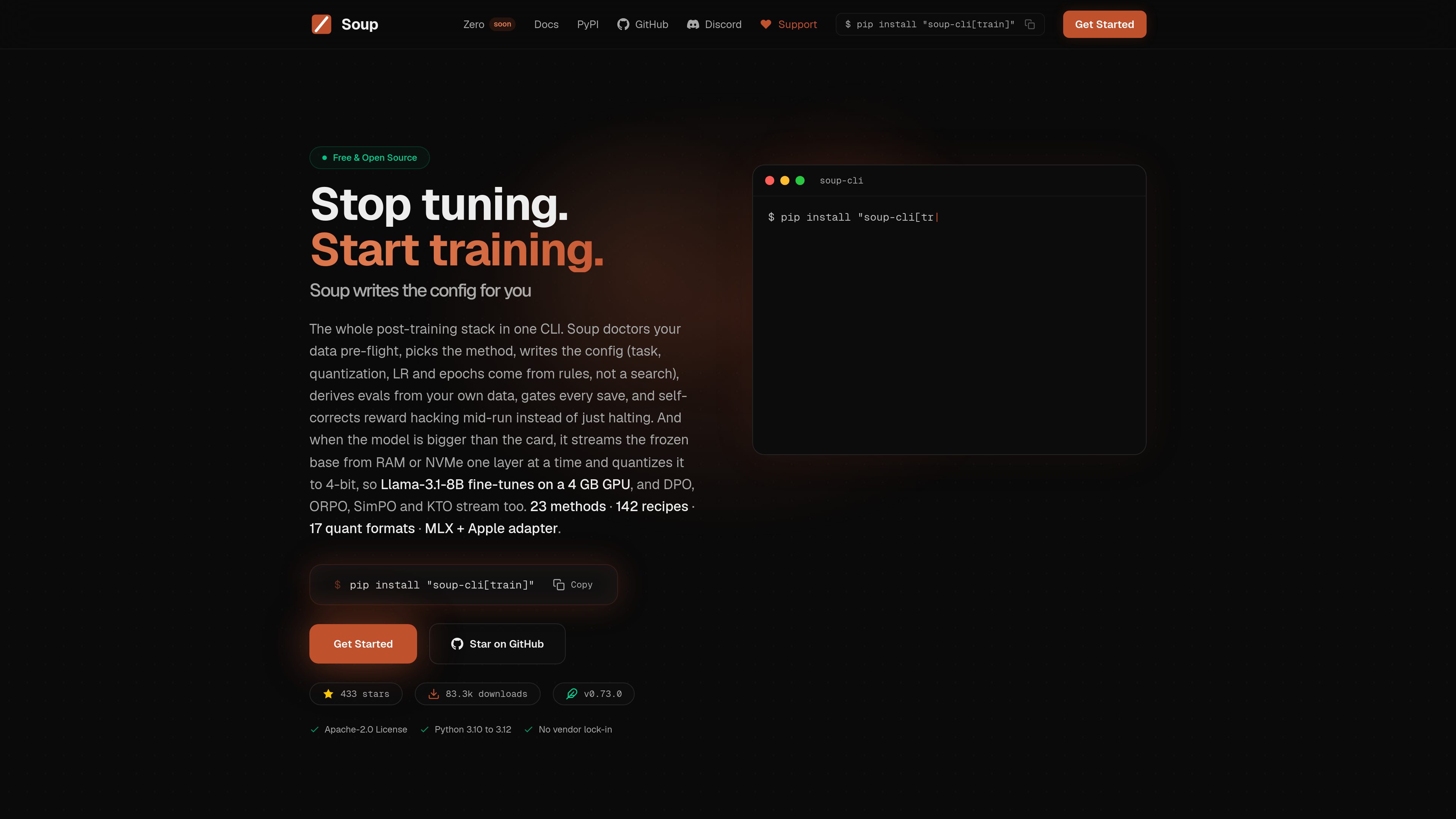
Config-driven training setup
`soup init` creates a `soup.yaml`, and the site states that Soup writes much of the training configuration automatically, including task, quantization, learning rate, and epochs when rules determine them.

Soup CLI è uno strumento open source a riga di comando per il post-training e i flussi di lavoro correlati ai modelli, tra cui fine-tuning, addestramento basato sulle preferenze, valutazione, unione, distribuzione e preparazione dei dati. È pensato per chi desidera gestire l’addestramento e la messa in produzione dei modelli con un’unica CLI offline, su hardware proprio o preso in prestito.
Soup CLI is an offline, CLI-first toolkit for post-training language models and related workflows. It combines training setup, data preparation, evaluation, model merging, inference serving, export, and deployment commands in one interface.
Its core training workflow is designed to work from a config file generated by the tool, with rules that set many defaults automatically. The site emphasizes methods such as supervised fine-tuning and preference training, plus layer streaming so the frozen base model can stay in CPU RAM or NVMe instead of occupying full VRAM.
The product is positioned for users training on limited hardware, including cases where a model is too large to fit resident in GPU memory. The docs also show commands for migrating configs from other tools, browsing recipes, running eval gates, and pushing or deploying models to external runtimes.
`soup init` creates a `soup.yaml`, and the site states that Soup writes much of the training configuration automatically, including task, quantization, learning rate, and epochs when rules determine them.
Soup can stream the frozen base layer-by-layer from CPU RAM or NVMe into VRAM so only one layer is resident at a time, which the site says supports training models that do not fit on the card.
The training docs and home page mention support for supervised fine-tuning and preference methods including DPO, ORPO, SimPO, and KTO, with the training page stating 23 task values in the schema.
`soup train` supports `--gate` to run evaluation suites at epoch boundaries and halt on regression, and the home page says Soup derives evals from the user’s own data and gates saves on a ship/don’t-ship verdict.
`soup migrate` imports configs from tools like LLaMA-Factory, Axolotl, and Unsloth, while `soup recipes` lets users list, inspect, search, and copy from 142 ready-made recipes.
The reference includes commands for chat, serving, export, merge, push, evaluation, data validation, deduplication, generation, and dataset publishing, making the tool a broader model ops CLI rather than a training-only utility.
Use Soup when a base model is too large to load fully into VRAM and you need a streaming approach that keeps the frozen base in RAM or on NVMe.
Use it for DPO, ORPO, SimPO, or KTO runs where you want the reference model to come from the same streamed base rather than loading a second resident copy.
Use `soup migrate` to convert existing setups from LLaMA-Factory, Axolotl, or Unsloth into Soup YAML with minimal manual rewriting.
Use gating and checkpoint-related flags when you want runs to stop on eval regressions or automatically resume and push checkpoints during training.
Use Soup when you want a single workflow for data review, training, evaluation, adapter merging, deployment, and export to serving formats.
Soup CLI is a command-line tool for post-training workflows such as training, evaluation, merging, deployment, data preparation, and dataset handling.
Yes. The site says Soup can stream the frozen base from CPU RAM or NVMe layer by layer so the model does not have to stay resident in VRAM.
The site explicitly mentions SFT, DPO, ORPO, SimPO, and KTO, and the training docs describe 23 task values in the schema.
Yes. `soup migrate` is documented for importing configs from LLaMA-Factory, Axolotl, and Unsloth.
No. The CLI reference also documents chat, serving, export, merge, push, eval, and data commands.
I dati sul traffico sono solo a scopo di riferimento.
| mag | 0 |
|---|---|
| giu | 0 |
| lug | 0 |
Le analisi del traffico non sono ancora disponibili.
Le analisi del traffico non sono ancora disponibili.

www.coldtea.ai
Coldtea è un ambiente di distribuzione del software basato sull’IA per i team che vogliono gestire in un unico posto QA, monitoraggio della produzione, rilevamento dei bug, creazione delle attività e correzioni. Funziona sul tuo computer e aiuta a individuare regressioni e problemi di produzione dopo la scrittura del codice.

nuphos.ai
Nuphos è uno spazio di lavoro DevOps nativo dell’IA per i team di ingegneria. Offre un ambiente condiviso in cui gli agenti IA possono apprendere l’infrastruttura, analizzare i problemi e gestire i sistemi di produzione con approvazione umana e audit trail.

canyontechs.ai
CanyonTechs AI è un prodotto di correzione automatica basato su LLM che analizza i log di produzione, rileva gli incidenti e invia le correzioni tramite pull request firmate. Offre un servizio basato su workspace con registrazione e accesso per utenti individuali e aziende.