
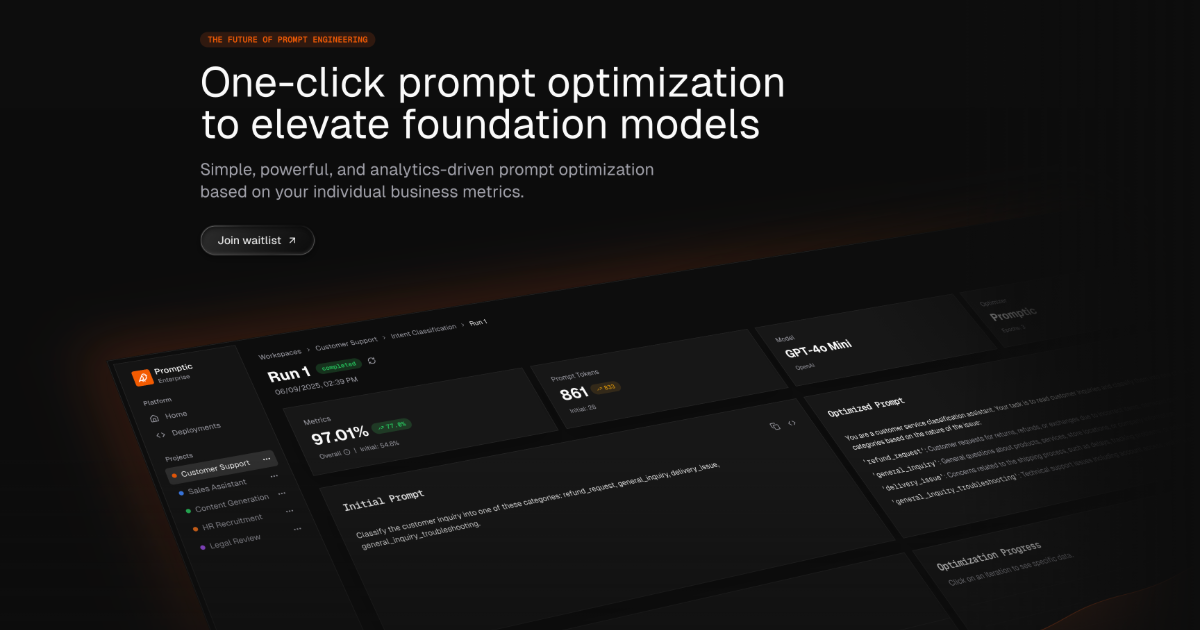
Prompt optimization
Optimize prompts against labeled examples, evaluators, and business metrics. Promptic supports multi-variable prompts and structured chat-message templates so experiments can match the format used in an application.

Promptic è una piattaforma di ottimizzazione GenAI per valutare modelli, migliorare prompt e agenti e scegliere configurazioni in base alle metriche aziendali. Combina il tracing basato su OpenTelemetry con dataset, benchmark e flussi di lavoro di ottimizzazione per i team che sviluppano applicazioni di IA.
Promptic helps teams evaluate and improve AI applications using representative data, expected outputs, and business metrics. It covers model comparison, prompt tuning, agent evaluation, information extraction, and tool-selection workflows.
Users can benchmark candidate configurations for quality, cost, and latency, inspect production behavior through OpenTelemetry traces, and retrieve or deploy a validated configuration from application workflows.
Optimize prompts against labeled examples, evaluators, and business metrics. Promptic supports multi-variable prompts and structured chat-message templates so experiments can match the format used in an application.
Benchmark different foundation models on the same task and compare quality, inference cost, and latency to identify a configuration that fits the project’s priorities.
Evaluate complete agents and compare their outputs, artifacts, trajectories, and architectures, including workflows that use routing, retrieval, or tools.
Capture LLM calls, tool calls, and workflow steps with provider-agnostic spans. Traces can include request and response payloads, token counts, cost, and latency for debugging and optimization.
Score only the output fields that matter, with per-field inclusion, weighting, required-field handling, strategy overrides, and configurable LLM-judge behavior.
Use the Python SDK, REST API, CLI, or documented dashboard workflows to instrument applications, manage experiments, and retrieve optimized prompts or configurations. The SDK supports first-class tracing for OpenAI, Anthropic, Google, LangChain, and Cohere.
Run the same evaluation dataset across candidate models and weigh output quality against inference cost and latency before choosing what to deploy.
Compare complete agent architectures, inspect failing traces and spans, and validate a revised implementation against fixed cases before shipping it.
Optimize prompts for documents or other structured tasks, then evaluate important output fields individually so optional or noisy fields do not obscure meaningful regressions.
Evaluate how reliably a model selects tools from an MCP server and use trace evidence to investigate incorrect routing, retries, or other tool-use failures.
Promptic can optimize prompts, compare models, evaluate agent architectures, improve information-extraction workflows, and optimize model tool selection. The documentation also describes support for multi-variable prompts, chat-message prompts, and structured-output evaluation.
Users provide representative inputs and expected outputs, define the metrics that matter, and benchmark candidate prompts, models, or architectures against the same dataset. Promptic surfaces differences in the results and helps select a configuration based on the chosen trade-offs.
Promptic uses OpenTelemetry-based instrumentation to capture LLM calls, tool calls, and workflow steps. Trace data can include payloads, token counts, cost, and latency, and can then be used for debugging, dataset creation, and optimization.
Yes. Promptic documents a Python SDK, REST API, CLI workflows, and dashboard-based workflows. The Python SDK provides drop-in initialization for tracing and supports OpenAI, Anthropic, Google, LangChain, and Cohere integrations.
The pricing page distinguishes Promptic Credits from model or token usage. Users can bring their own model keys, while managed model usage is optional on applicable plans and billed separately; enterprise terms are customized.
I dati sul traffico sono solo a scopo di riferimento.

www.cybedefend.com
CybeDefend è una piattaforma di sicurezza del codice progettata per i flussi di lavoro di programmazione con l’IA. Il livello VibeDefend esamina i prompt degli agenti e i diff, applica le regole del progetto e aziendali, protegge dalle azioni rischiose e riunisce le scansioni di codice, dipendenze, segreti, infrastruttura e CI/CD prima di una pull request.

sapling.ai
Sapling è un toolkit e assistente basato su modelli linguistici per sviluppatori e aziende, con accesso API/SDK e integrazioni per supporto alla scrittura, analisi del testo e flussi di lavoro aziendali.

deepchecks.com
Piattaforma per valutare, testare e monitorare LLM, prompt, modelli, pipeline RAG e agenti

pangea.cloud
Pangea è una piattaforma di sicurezza per applicazioni di IA che aggiunge controlli di protezione a prompt, output, accesso ai dati e logging. Protegge i flussi di lavoro LLM tramite API, SDK, strumenti di IA o gateway API.

omlx.ai
oMLX è un server di inferenza LLM nativo per macOS basato su MLX, che esegue localmente su Apple Silicon modelli compatibili linguistici, visione-linguaggio, embedding e reranker. Progettato per i flussi di lavoro con agenti di programmazione, funziona con Claude Code, OpenClaw, Cursor e client compatibili con OpenAI.

www.cosmicjs.com
Un marketplace per installare plugin dei fornitori sull’agente Cosmic responsabile di un’attività. È pensato per i team che utilizzano agenti Cosmic, strumenti MCP e flussi di lavoro correlati a contenuti o operazioni.