
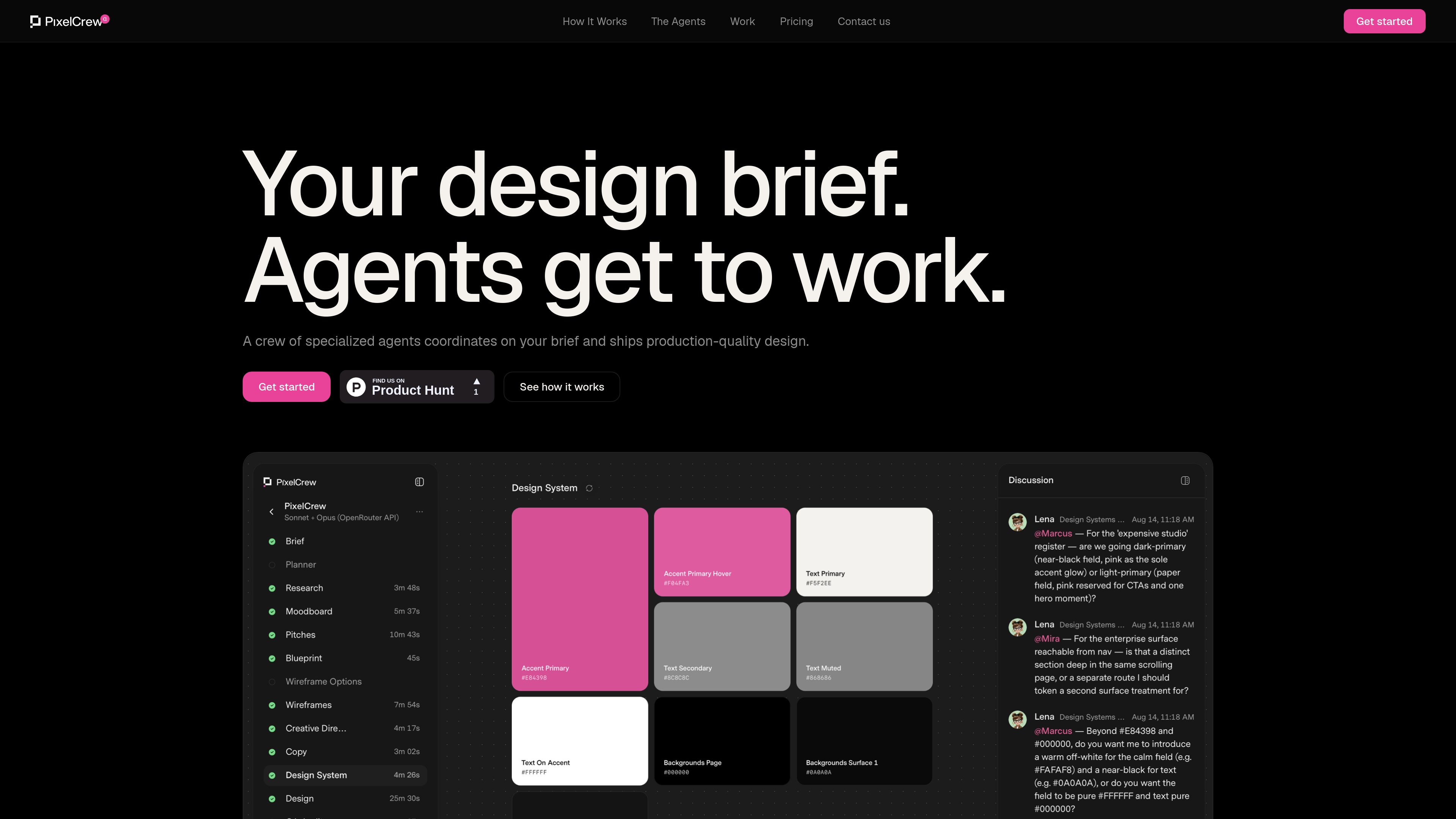
Sequential specialist agents
Elena handles research and strategy, Marcus develops creative direction, and Mira defines UX architecture before the build crew produces the final materials.

PixelCrew è un workflow di design con AI che coordina agenti specializzati per trasformare un brief scritto in ricerca, direzione creativa, wireframe UX, testi, risorse per il design system, documentazione QA e HTML/Tailwind pronto per la produzione. È pensato per persone e team che hanno bisogno di siti web, dashboard, landing page o design system senza partire da un modello rigido.
PixelCrew is an AI-assisted design production workflow built around a crew of specialized agents. A user submits a free-form brief, and the agents work sequentially: research establishes audience and information architecture, art direction defines the visual approach, and UX architecture turns that direction into flows, wireframes, and screen specifications.
The workflow continues through copy, design-system assembly, QA, and final review. The stated outputs include production HTML and Tailwind, design-system files, documentation, and supporting artifacts that can be shipped directly or handed to a developer. PixelCrew reports an average delivery time of 25–45 minutes, although the site does not define how that average varies by brief complexity.
Elena handles research and strategy, Marcus develops creative direction, and Mira defines UX architecture before the build crew produces the final materials.
Users describe needs in free text rather than completing a predefined template. The site lists landing pages, product dashboards, design systems, and pitch decks as examples.
The research stage can cover audience personas, competitive analysis, jobs-to-be-done mapping, and information architecture recommendations.
The workflow produces three visual pitches, a moodboard, a creative brief, wireframes, user flows, navigation specifications, and section-by-section composition guidance.
Later stages assemble copy, tokens, type scale, colors, components, production HTML, Tailwind output, and documentation.
Screens go through a QA audit and final review, with issues flagged, revised, and rechecked before delivery.
A founder or marketing team can submit a brief for a new landing page and receive a researched structure, visual direction, wireframes, copy, and production HTML.
A product team can use the workflow to develop dashboard architecture, navigation, interaction states, and a component set before engineering implementation.
Teams starting a new interface can request tokens, type scale, colors, components, and documentation as part of a broader design deliverable.
A business with a specific atmosphere or content structure can describe that intent in a brief and receive a tailored site concept with production-oriented outputs.
A team that already knows what it wants but lacks design-production capacity can use the generated HTML, Tailwind, documentation, and design-system files as implementation material.
The site describes outputs including research briefs, personas, information-architecture specifications, moodboards, creative briefs, wireframes, UX flows, navigation specifications, copy, design tokens, components, QA reports, production HTML, Tailwind, design-system files, and documentation.
Users submit a free-text description of what they need. The agents then work in sequence, beginning with research and strategy, followed by creative direction, UX architecture, build work, copy and design-system assembly, QA, and final review.
The site names landing pages, product dashboards, design systems, and pitch decks as examples. Demonstration projects also include a coffee-shop website, an automotive landing page, a task manager web app, and a retail coffee-roastery site.
During alpha, users bring their own key. The site recommends OpenRouter and says Anthropic and Google Gemini keys also work. It states that users paste the key into PixelCrew once and set their own spend limit.
PixelCrew states that it charges nothing during alpha, with no subscription, markup, or card on file. Users are responsible for model costs billed by their key provider; the site says a typical brief costs a few dollars in model usage, without defining a fixed price.
I dati sul traffico sono solo a scopo di riferimento.

tastemaker-skill.online
Tastemaker è una skill di workflow per agenti di programmazione che trasforma il contesto del prodotto e i riferimenti visivi in schermate UI, risorse, sistemi di colori con contrasto verificato e decisioni di design locali. È pensata per agenti come Claude Code, Windsurf e Gemini CLI.

uxpin.com
UXPin è uno strumento per UI design e prototipazione con librerie React, layout assistiti dall’AI e passaggio a codice pronto per la produzione.

magicpath.ai
Canvas di design condiviso per persone e agenti AI

ludo.ai
Piattaforma AI per ricerca, design e pre-produzione di giochi

uxmagic.ai
UXMagic è un generatore di UI con IA che trasforma testi, schizzi, screenshot e URL in design pronti per Figma, con esportazione in HTML o React e importazione di sistemi Figma.

trybloom.ai
Livello di brand per agenti e team, per creare risorse riutilizzabili e coerenti via web app, API o MCP.