
Local, offline inference
Runs LLMs without API keys or hidden usage fees, which makes it suitable for private or network-limited workflows.

NobodyWho è un motore di inferenza per eseguire LLM in locale e in modo efficiente sui dispositivi supportati. È pensato per gli sviluppatori che vogliono eseguire inferenze offline, gestire input multimodali e creare flussi di lavoro locali per voce e testo senza chiavi API.
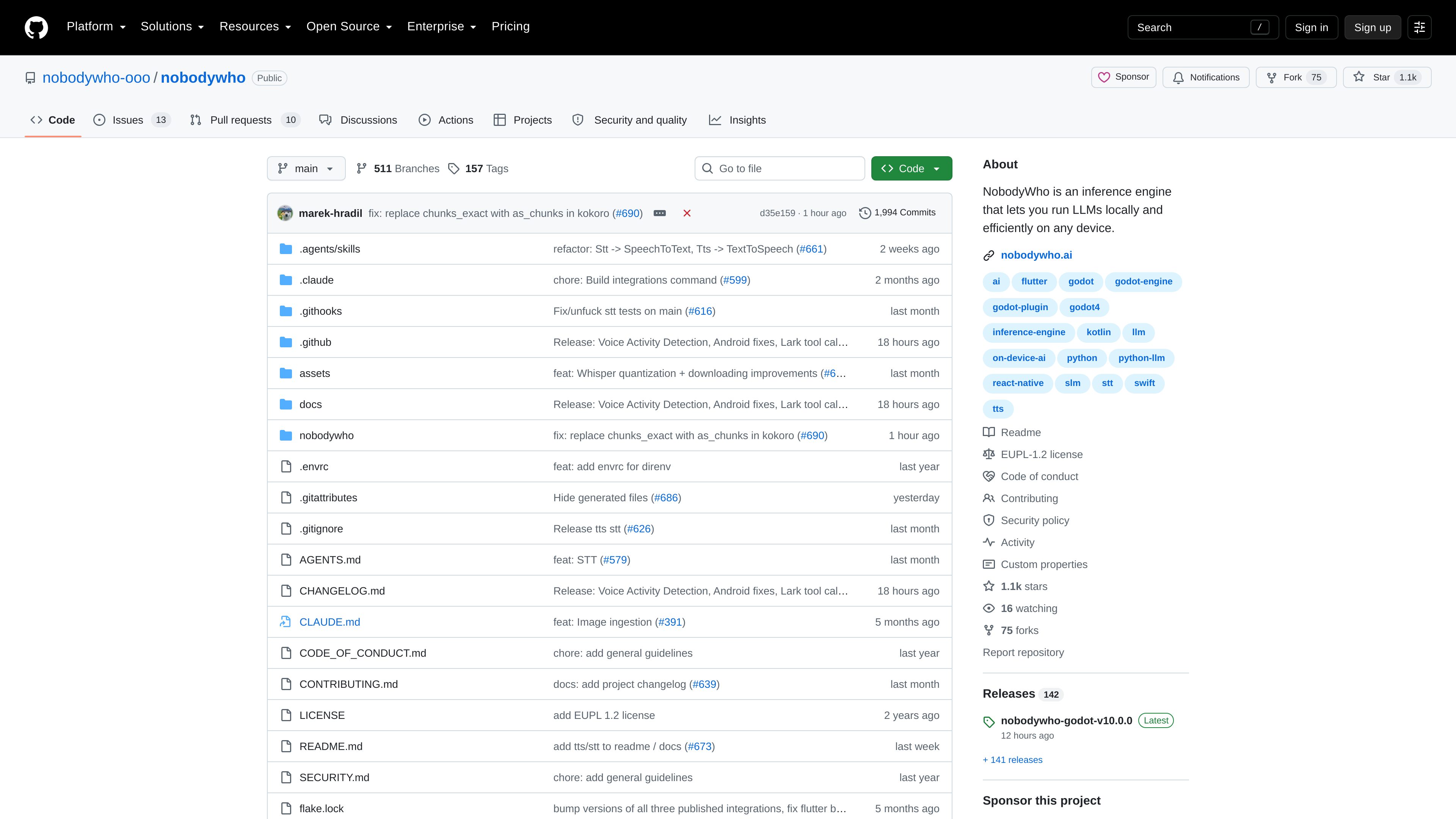
NobodyWho is an on-device inference engine for running large language models locally. The project describes itself as a way to use LLMs efficiently on any device, with an emphasis on offline operation and local execution rather than hosted API calls.
The repository README highlights support for chat models, structured tool calling, multimodal input, text-to-speech, speech-to-text, and model downloading from Hugging Face or any direct URL. It also points to GPU-accelerated inference through Vulkan or Metal, conversation-aware context shifting, and compatibility with GGUF models powered by llama.cpp.
Runs LLMs without API keys or hidden usage fees, which makes it suitable for private or network-limited workflows.
Works with chat LLMs such as Gemma, Qwen, and Mistral, with the broader claim of compatibility with many GGUF-format models.
Generates structured grammars from function signatures, reducing the need to write schemas manually.
Accepts image and audio information as part of LLM interactions.
Includes text-to-speech backends such as Kokoro, Pocket TTS, and Supertonic, plus speech-to-text via Whisper.
Can load models directly from Hugging Face or from any URL, which simplifies distribution and testing.
Build local chat experiences that do not depend on external model APIs.
Add LLM capabilities to Kotlin, Swift, Python, Flutter, React Native, or Godot projects using the documented platform packages.
Combine Whisper transcription with local text-to-speech for voice-enabled workflows.
Use type-safe function calling when you want the model to trigger structured actions from application code.
Load GGUF models from Hugging Face URLs and experiment with local inference across supported runtimes.
No. The README states that it runs locally and offline, with no API keys needed.
The repository says it can run chat LLMs such as Gemma, Qwen, and Mistral, and that it is compatible with thousands of pretrained LLMs in GGUF format.
Yes. The README mentions text-to-speech and speech-to-text support, including Kokoro, Pocket TTS, Supertonic, and Whisper.
The project lists Kotlin, Swift, Python, Flutter, React Native, and Godot.
The README says models can be loaded from Hugging Face or any URL.
I dati sul traffico sono solo a scopo di riferimento.
| giu | 0 |
|---|---|
| lug | 0 |
| ago | 0 |
Le analisi del traffico non sono ancora disponibili.
Le analisi del traffico non sono ancora disponibili.

www.betterclaw.io
BetterClaw è uno strumento no-code per creare, distribuire e gestire agenti AI tramite un’interfaccia visiva, con supporto BYOK e controlli di sicurezza integrati. È pensato per i team che vogliono eseguire flussi di lavoro pianificati tra strumenti collegati senza dover mantenere un’infrastruttura.

cosyra.com
Cosyra è un terminale cloud mobile per sviluppatori che vogliono eseguire agenti di programmazione AI da iPhone o Android senza gestire un VPS personale. Offre uno spazio di lavoro Ubuntu isolato, archiviazione persistente e fatturazione con la propria chiave API.

opencodesuper.app
OpenCode Superapp è uno spazio di lavoro nativo per Mac che consente di usare modelli AI locali, self-hosted o cloud insieme a programmazione, automazione del browser, voce, estensioni, widget e accesso remoto sicuro. È pensato per chi desidera un ambiente OpenCode local-first senza bisogno di un account.

www.coolplugz.com
CoolPlugz è un livello di orchestrazione per Claude Code che raccoglie il contesto, esegue flussi di lavoro strutturati e aiuta a completare attività di programmazione con meno supervisione costante. È pensato per gli sviluppatori che vogliono ridurre i cambi di contesto tra Jira, GitHub, Slack, Notion e CI.

kilo.ai
Kilo Code è un plugin di programmazione AI multi-agente per JetBrains IDE. Aiuta gli sviluppatori a eseguire e gestire agenti di programmazione AI, esaminare le modifiche in worktree isolati e scegliere da un ampio catalogo di modelli senza uscire dall’IDE.

sim.ai
Sim è uno spazio di lavoro AI open source per creare, distribuire e gestire agenti AI, con flussi visivi, Chat, accesso API, integrazioni e strumenti di collaborazione.