
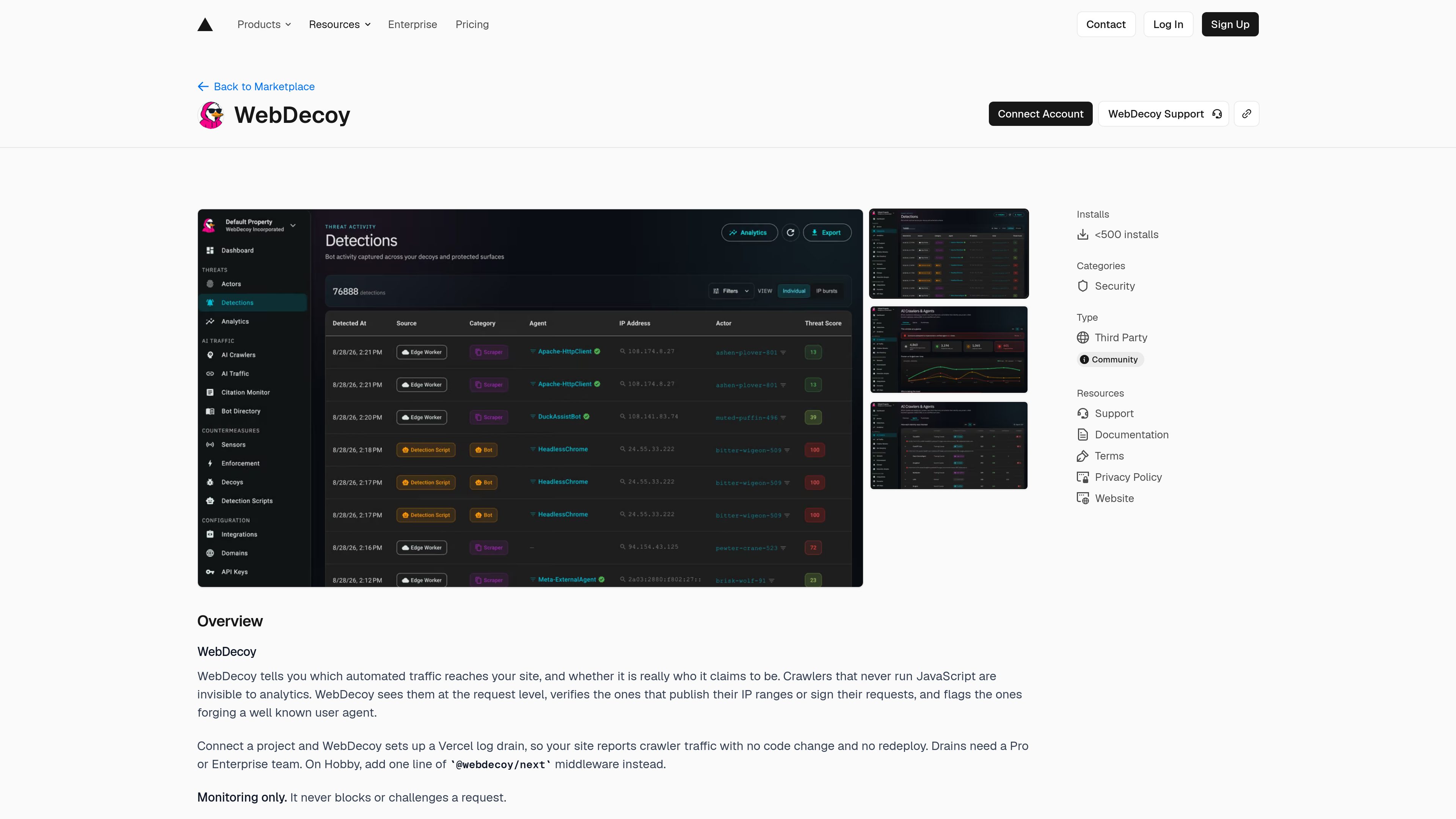
Request-level crawler visibility
Reports crawlers, tools, and requests with no user agent based on traffic received by the site, including automated visitors that browser-based analytics may not capture.

WebDecoy surveille le trafic automatisé qui atteint un site ou une application Vercel et identifie les robots d’exploration, les bots IA, les outils et les requêtes sans user agent. Il vérifie les plages d’adresses IP publiées ou les requêtes signées, signale les user agents connus falsifiés et rend compte de l’activité sans modifier le code de l’application avec les forfaits Vercel compatibles.
WebDecoy is a monitoring tool for identifying automated traffic that reaches a Vercel site or application. It observes requests that conventional analytics may miss, including crawlers that do not execute JavaScript, and distinguishes reported crawler identities from requests that may be spoofing a known user agent.
For Vercel projects, connecting WebDecoy creates a log drain so the service can analyze request-level data without a code change or redeploy. On Vercel Hobby teams, the alternative is a line of @webdecoy/next middleware. WebDecoy is monitoring-only: it does not block or challenge requests.
Reports crawlers, tools, and requests with no user agent based on traffic received by the site, including automated visitors that browser-based analytics may not capture.
Verifies crawlers that publish IP ranges or sign their requests, helping distinguish claimed identities from observed request characteristics.
Flags requests that appear to forge a well-known user agent rather than treating every matching user-agent string as verified.
Connecting a project creates a Vercel log drain and sends request data such as user agent, path, status, client IP, and TLS fingerprint to WebDecoy.
The Vercel connection does not require an application code change or redeploy. It also creates three environment variables used by the optional Next.js middleware.
Disconnecting a project removes its WebDecoy log drain and the three variables created by the integration; disconnecting the integration removes everything it set up.
Site owners can see which automated agents are reaching their Vercel site, including agents invisible to JavaScript analytics.
Teams can review verification results and spoofing flags when a request claims to be a recognized crawler or bot.
Vercel Pro or Enterprise teams can connect a project and use the log-drain workflow without modifying application code or redeploying.
Hobby users can use the documented `@webdecoy/next` middleware path when a Vercel log drain is unavailable to their team plan.
It reports crawlers, tools, and requests with no user agent. Human visitors are not reported.
It verifies crawlers that publish their IP ranges or sign their requests, and flags requests that appear to forge a well-known user agent.
For projects using the Vercel log-drain connection, WebDecoy sets up the drain without a code change or redeploy. On Hobby, the documented alternative is to add one line of `@webdecoy/next` middleware.
The listing states that drains require a Pro or Enterprise team. Vercel’s pricing page lists Hobby as a free plan, Pro at $20 per month, and Enterprise as a custom plan; these are Vercel plan prices, not stated WebDecoy prices.
No. It is for monitoring only and never blocks or challenges a request.

usejimo.com
Adoption numérique avec IA pour équipes SaaS, onboarding et guidage sans code

vdf.ai
VDF AI est une plateforme d’orchestration d’agents IA pour les entreprises, qui coordonne agents, modèles, outils, recherche et workflows sous une gouvernance centralisée. Elle s’utilise en service cloud géré ou se déploie dans un cloud privé, un centre de données, un environnement souverain, un compte AWS ou une infrastructure isolée.

medo.dev
Medo est un créateur d’applications sans code pour concevoir des apps d’éducation, sites web, marketing, productivité, e-commerce, outils, jeux et sondages.

relaticle.com
Relaticle est un CRM open source pour les équipes qui réunit des fiches partagées, la gestion du pipeline et des tâches, un chat IA intégré et un serveur MCP doté de 39 outils. Les équipes peuvent utiliser l’espace de travail hébergé ou auto-héberger l’application AGPL-3.0 et connecter des agents IA externes via MCP et l’API REST.

opaline.so
Opaline fournit des analyses à l’échelle de l’équipe pour les sessions Claude Code et Codex, en suivant au niveau du message le coût des tokens, le temps et l’utilisation des compétences. Les équipes peuvent examiner l’activité de toute l’organisation et les traces détaillées des sessions afin de comprendre l’adoption des agents de programmation et les habitudes d’utilisation.