
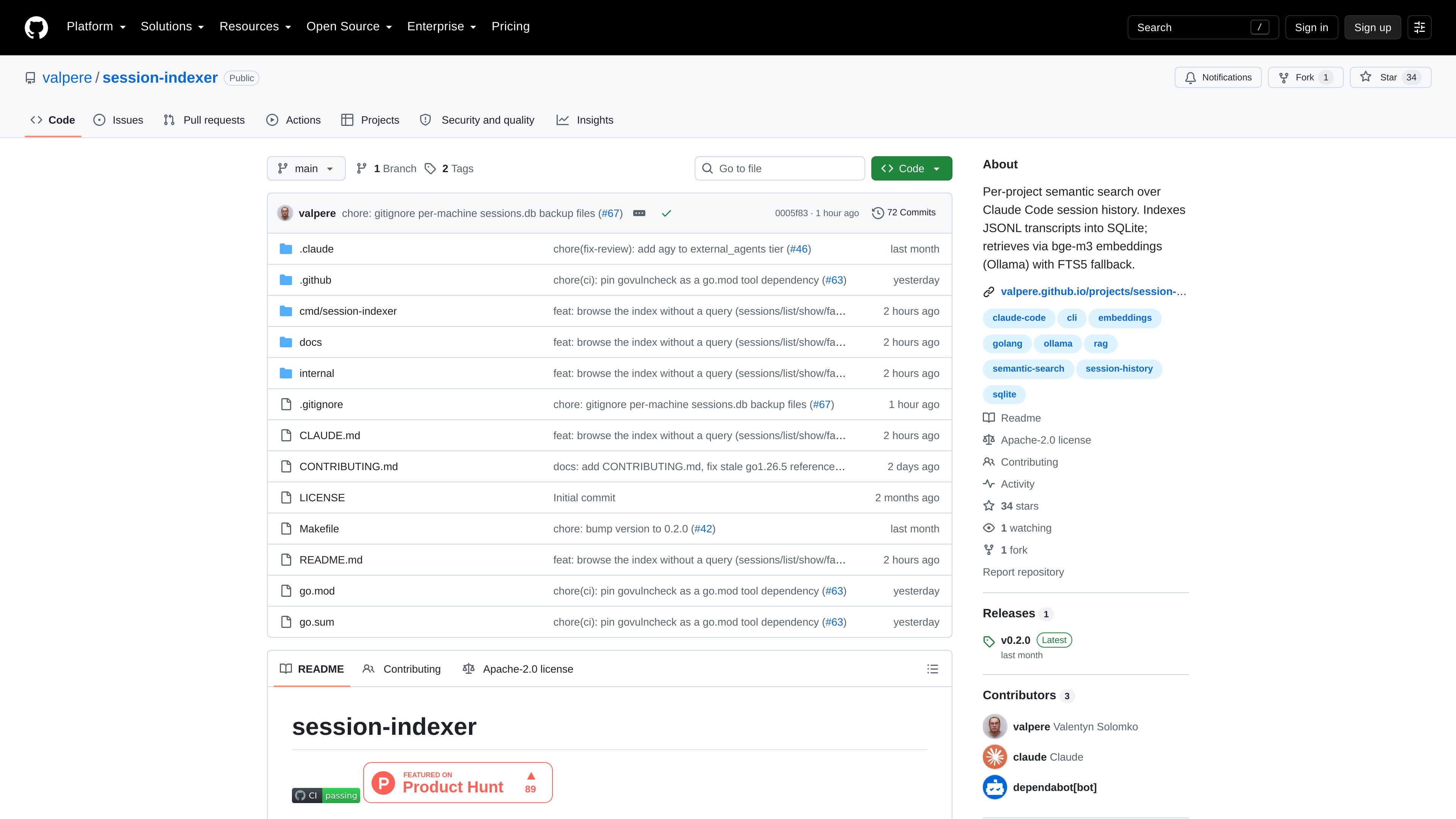
Indexes JSONL transcripts into SQLite
The project stores session history in SQLite, which makes the transcript data queryable in a structured local database instead of leaving it only as raw files.

session-indexer est un outil pour développeurs hébergé sur GitHub qui indexe les transcriptions de sessions Claude Code dans SQLite et permet de les rechercher par sens. Il est conçu pour retrouver l’historique JSONL par projet, avec FTS5 en solution de repli lorsque la recherche basée sur des embeddings n’est pas disponible.
Session-indexer is a developer tool for searching Claude Code session history on a per-project basis. It indexes JSONL transcripts into SQLite and then lets users retrieve past sessions with semantic search powered by bge-m3 embeddings through Ollama, with FTS5 available as a fallback.
The project is presented as a GitHub repository and appears to be aimed at developers who want a local, queryable record of Claude Code sessions rather than a generic note-taking or search app. Its core purpose is to make past sessions easier to find by turning transcript files into a searchable index.
The project stores session history in SQLite, which makes the transcript data queryable in a structured local database instead of leaving it only as raw files.
The page description states that search is performed using bge-m3 embeddings via Ollama, which indicates embedding-based matching for searching by meaning rather than exact text alone.
When semantic retrieval is not used or not available, the project can fall back to SQLite FTS5, providing a text-search path over indexed transcript content.
The product is described as per-project search over Claude Code history, suggesting the index is organized around individual project contexts rather than one global transcript pool.
The repository contains a docs directory and a .claude directory, indicating that usage and project-specific configuration/documentation are part of the codebase.
A developer can search session history for a specific project when they need to recover a decision, command, or troubleshooting thread from earlier Claude Code work.
Semantic search is useful when the user remembers the topic of a session but not the exact phrase used in the transcript.
If the embedding path is not in use, FTS5 provides a fallback for users who still need text-based retrieval over the indexed transcripts.
Developers can keep JSONL transcripts in SQLite so session history is easier to inspect and reuse later.
It indexes JSONL transcripts from Claude Code session history into SQLite.
The project uses bge-m3 embeddings through Ollama for semantic retrieval, with FTS5 as a fallback.
The source describes a repository that indexes data into SQLite and does not indicate a hosted SaaS product.
Yes. The page explicitly mentions FTS5 fallback.
The repository includes docs and project files, but the provided page text does not show a full usage guide.
Les données de trafic sont fournies à titre indicatif uniquement.
| juil. | 0 |
|---|---|
| août | 0 |
| sept. | 0 |
Les analyses de trafic ne sont pas encore disponibles.
Les analyses de trafic ne sont pas encore disponibles.

skillsmp.com
SkillsMP est une marketplace gratuite pour découvrir des compétences d’agents open source dans des dépôts GitHub publics, avec recherche, navigation, API REST et accès MCP pour Claude Code, Codex CLI et ChatGPT.

dreamflow.app
Dreamflow est un outil visuel de création avec AI pour applications mobiles prêtes pour la production. Il permet aux équipes et aux développeurs indépendants de créer des apps Flutter avec des prompts AI, l’édition visuelle, le contrôle du code et des options de déploiement web et mobile.

murmell.com
Murmell est un canevas accessible dans le navigateur pour exécuter des agents de codage IA dans des environnements cloud isolés et partagés. Il permet de coordonner Claude Code, Codex, Kimi et OpenCode sur un même projet, sans configuration locale ni conflits de fichiers.

www.tryport22.com
port22 est une app iOS et un agent macOS pour surveiller et contrôler les sessions d’agents de codage exécutées dans un terminal. Il diffuse les transcriptions sur iPhone, alerte lorsqu’une saisie est requise et prend en charge Claude Code, Codex et OpenCode.

omlx.ai
oMLX est un serveur d’inférence LLM natif pour macOS, basé sur MLX, qui exécute localement sur Apple Silicon des modèles compatibles de langage, vision-langage, embeddings et reranking. Conçu pour les workflows d’agents de programmation, il fonctionne avec Claude Code, OpenClaw, Cursor et les clients compatibles avec OpenAI.

resumecontext.com
ResumeContext est un service de mémoire partagée pour les équipes d’agents de programmation. Il enregistre les sessions en local, les synchronise avec une archive de projet et la met à disposition des agents via MCP, afin qu’ils puissent retrouver les travaux antérieurs et poursuivre entre agents, comptes ou machines.