
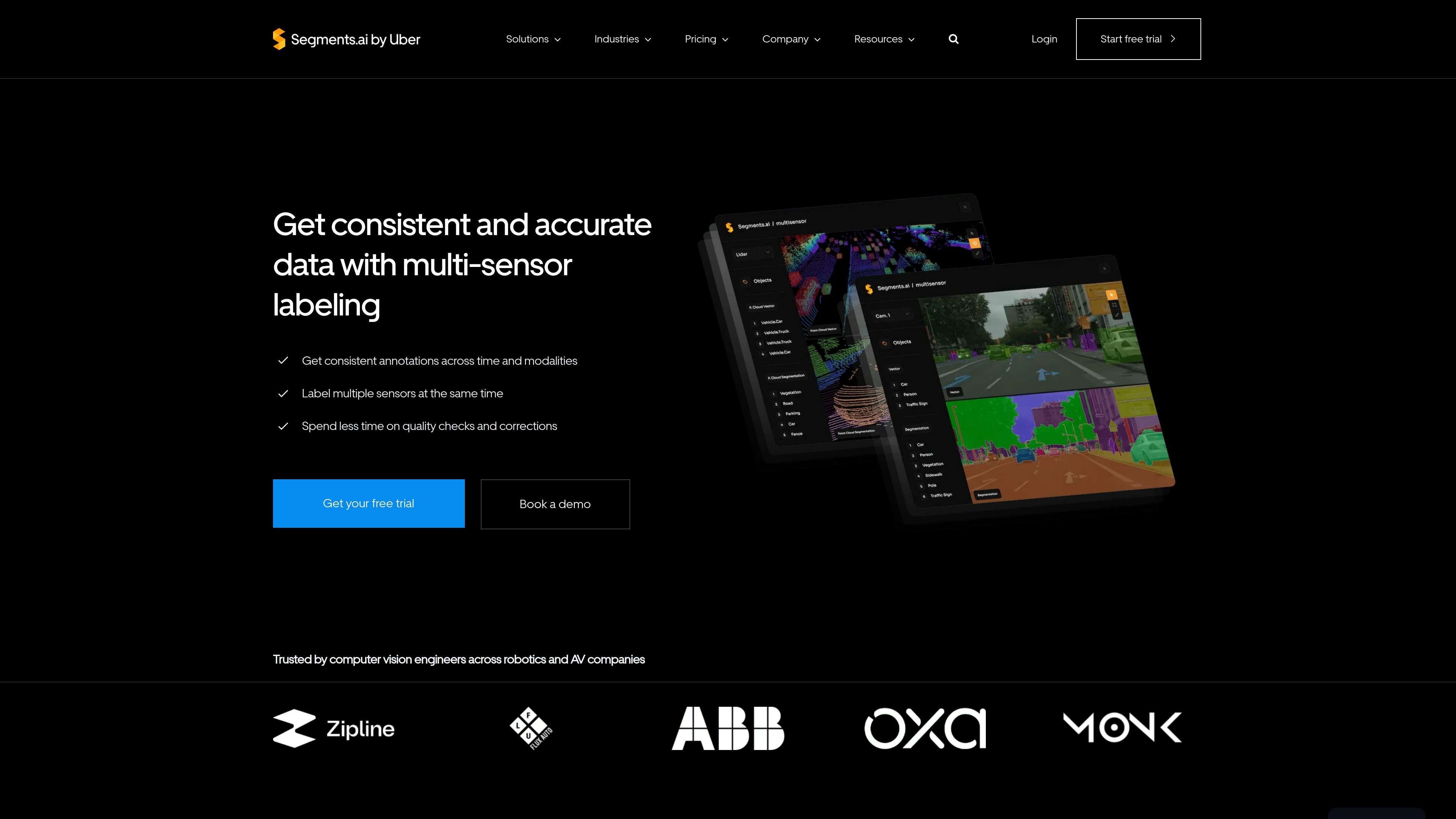
Multi-format labeling interfaces
Annotate camera images, point clouds, and sequences in the same platform, with support for image, point cloud, and sequence interfaces.

Segments.ai est une plateforme d’annotation de données multisenseurs destinée aux équipes de robotique et d’autonomie. Elle prend en charge l’annotation d’images, de nuages de points et de séquences, avec accès au SDK Python et à l’API pour intégrer l’annotation aux pipelines ML existants.
Segments.ai is a multi-sensor data labeling platform for robotics and autonomy teams, with a focus on image annotation, 3D point cloud labeling, and workflows that combine camera and LiDAR data. The product page positions it as a tool for building better datasets and accelerating the labeling process without moving away from existing ML pipelines.
The platform includes web-based interfaces for images, point clouds, and sequences, plus ML-assisted tooling, sensor fusion interfaces, and programmatic access through a Python SDK and API. Pricing is organized into Core, Fusion, and Enterprise plans, with the higher tiers adding advanced integration, security, and workflow customization options.
Annotate camera images, point clouds, and sequences in the same platform, with support for image, point cloud, and sequence interfaces.
Use ML-powered labeling tools, active learning, and model-assisted labeling pipelines to speed up annotation and improve consistency.
Manage datasets and labeling operations with QA and organization management tools, plus metrics dashboards on higher-tier plans.
Work with sensor fusion interfaces for advanced multi-sensor projects that combine image and point cloud data.
Integrate labeling into existing pipelines with a Python SDK, public API, webhooks, and cloud bucket connections.
Export labels to popular ML workflows and frameworks, with documented support for PyTorch, TensorFlow, and Hugging Face on the SDK page.
Teams building datasets for robotics or autonomy can annotate camera and LiDAR data in one place instead of splitting work across separate tools.
Computer vision teams can label 2D images with bounding boxes, segmentation, keypoints, polygons, and polylines, using ML-assisted features to reduce repetitive work.
Perception teams working with LiDAR can label point clouds, including workflows for dynamic objects and static objects described by batch mode and merged point cloud tools.
Engineering teams can connect Segments.ai to their ML pipeline with the Python SDK, API, cloud storage providers, and webhooks to automate dataset handling.
Organizations that need oversight on labeling quality can use QA and organization management tools, and higher-tier metrics dashboards, to manage the labeling process more systematically.
Segments.ai provides a 14-day free trial. The pricing page also mentions free academic licenses for students or researchers, and the team says it is open to discussing options for startups based on stage and needs.
Yes. The platform supports image, point cloud, and sequence interfaces, along with cloud bucket integrations, Python SDK and API access, and exports to popular ML workflows.
The source describes web-based labeling for 2D images and 3D point clouds, plus programmatic dataset management through the Python SDK and API. It also mentions sensor fusion interfaces for advanced multi-sensor setups.
The source highlights image annotation, point cloud labeling, and multi-sensor labeling for robotics and autonomy. It does not provide a full list of all supported annotation formats beyond examples such as bounding boxes, segmentation, keypoints, polygons, and polylines.
Segments.ai is positioned for machine learning engineers, computer vision teams, data scientists, and robotics/autonomy workflows. The pricing page also distinguishes between Core, Fusion, and Enterprise plans for different levels of setup complexity and automation.
Les données de trafic sont fournies à titre indicatif uniquement.

prolific.com
Prolific est une plateforme de données humaines qui aide les équipes d’IA, les chercheurs et les organisations à recueillir des réponses, des jugements et des annotations auprès de participants vérifiés. Elle propose un accès en libre-service et des services gérés pour les projets nécessitant des données humaines soumises à un contrôle qualité.

baxo.ai
Baxo est une plateforme de gestion de la performance et de feedback des employés alimentée par l’AI, conçue pour les équipes qui souhaitent accélérer les cycles d’évaluation, mener des sondages flash et intégrer la reconnaissance. Elle aide les managers à recueillir des retours structurés et à les transformer en rapports d’évaluation et en insights de développement.

thunderphone.com
ThunderPhone est une plateforme d’agents téléphoniques IA permettant de créer, tester et déployer des agents vocaux pour les appels entrants, sortants et passés depuis le web ou une application. Elle s’adresse aux équipes qui ont besoin d’une gestion des appels en production intégrant téléphonie, prise en charge des langues et workflows au sein d’une même pile.

gatling.io
Gatling est une plateforme de test de charge pour créer, exécuter, analyser et automatiser des tests de performance avec des workflows code-first, low-code et no-code.

typebot.io
Typebot est une plateforme no-code pour créer des chatbots et des formulaires conversationnels, les intégrer à des sites web et les connecter à WhatsApp, aux webhooks et à des services d’automatisation. Elle propose des offres gratuite, payantes et Enterprise.

vdf.ai
VDF AI est une plateforme d’orchestration d’agents IA pour les entreprises, qui coordonne agents, modèles, outils, recherche et workflows sous une gouvernance centralisée. Elle s’utilise en service cloud géré ou se déploie dans un cloud privé, un centre de données, un environnement souverain, un compte AWS ou une infrastructure isolée.