
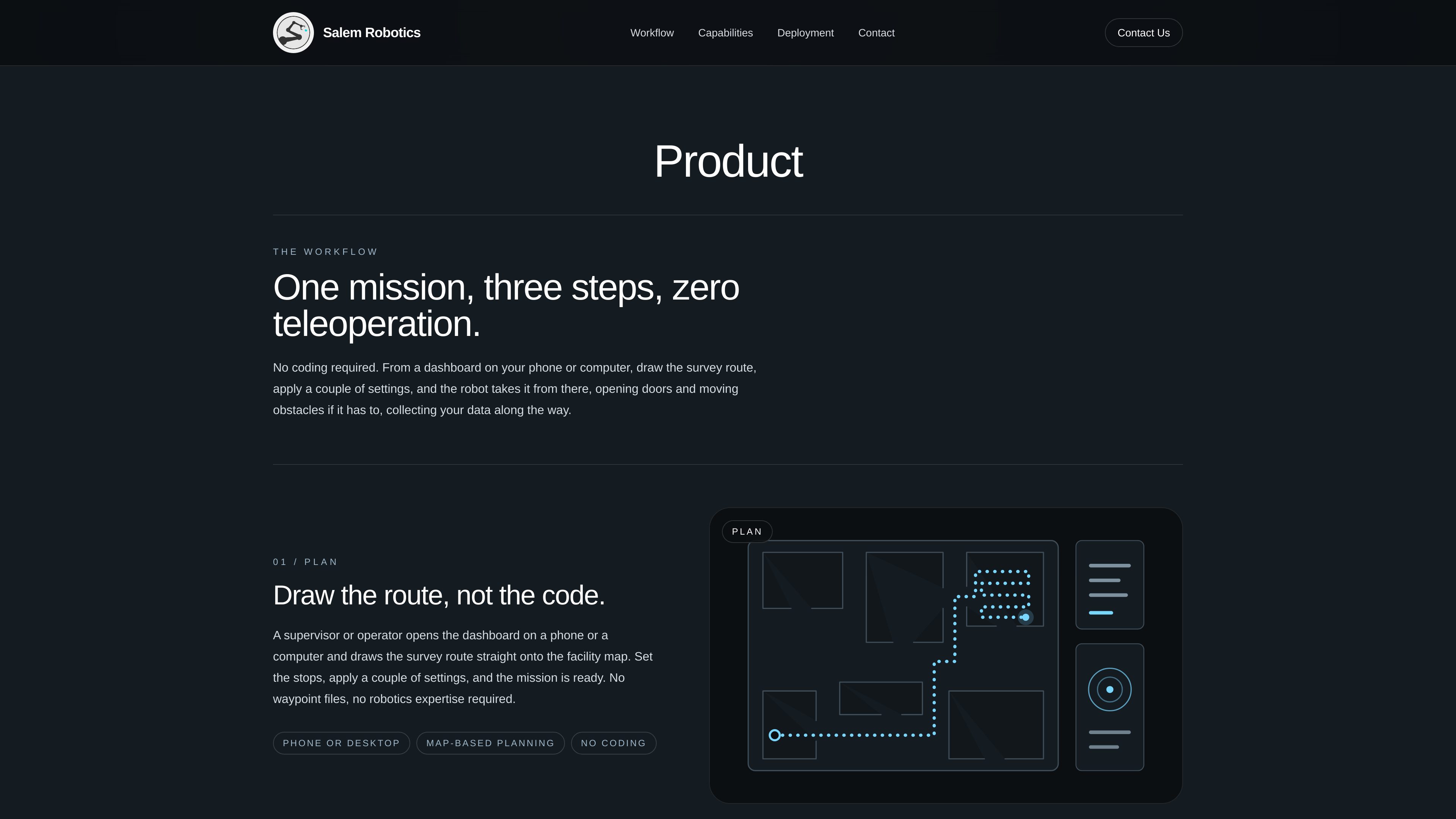
Map-based mission planning
A supervisor can draw the survey route directly on a facility map from a phone or desktop dashboard, then set stops and mission settings without coding or waypoint files.
Salem Robotics est un logiciel d’autonomie destiné aux installations industrielles dangereuses. Il aide les équipes à planifier, mener et documenter des missions autonomes d’inspection et de collecte de données avec des robots existants ou un système fourni par Salem.
Salem Robotics is a software platform for autonomous inspection, survey, and monitoring operations in hazardous industrial environments. It combines mission planning, robot execution, data collection, and reporting so a supervisor can define a route, let the robot carry out the mission, and receive reviewable outputs at the end.
The workflow is built around three stages: plan, execute, and report. Operators draw a survey route on a facility map from a phone or desktop dashboard, set stops and a few mission settings, and then the robot handles the mission without teleoperation. During execution, Salem is described as handling tasks such as opening doors, working around people and equipment, and moving obstacles when needed.
The platform is aimed at inspection-heavy workflows such as nuclear inspection, radiological survey, LDAR, corrosion, NDT, and temperature measurement. It is designed to produce time-stamped, spatially linked records, heatmaps, and AI-assisted insights that map readings back to the facility and support compliance review. The site also says Salem is hardware-agnostic and can be deployed on existing robotic systems or as a complete Salem system.
A supervisor can draw the survey route directly on a facility map from a phone or desktop dashboard, then set stops and mission settings without coding or waypoint files.
The robot carries out the route without teleoperation and is described as handling doors, obstacles, and movement around people and equipment during the mission.
The platform supports autonomous inspection, survey, and monitoring missions and is described as suitable for nuclear, radiological, LDAR, corrosion, NDT, temperature, and other mission-specific data collection.
Each mission ends with a compliance-ready report that organizes readings into reviewable outputs instead of disconnected field notes.
Readings are mapped back to the facility as heatmaps and other location-aware artifacts, making it easier to review where data came from.
Salem can extend existing robotic systems already in use at industrial facilities, or be deployed as part of a complete Salem system.
Teams can automate recurring inspection routes that would otherwise require technicians to enter restricted areas and document results by hand.
The site positions Salem for nuclear inspection and radiological survey workflows where exposure limits, documentation, and route repeatability matter.
Facilities can use the platform to gather mission-specific measurements such as corrosion checks, NDT data, LDAR readings, and temperature measurements during the same autonomous run.
Organizations with robots already deployed on site can add Salem’s autonomy and data layer rather than replacing their hardware stack.
Compliance-focused teams can use the system to generate time-stamped, spatially linked mission records that are easier to review than handwritten notes or fragmented logs.
No. The site says operators can draw the route on a facility map from a phone or computer and set mission stops and settings without coding or waypoint files.
Yes. The company says the platform is hardware-agnostic and can extend robotic systems already working in industrial facilities.
The site describes compliance-ready reports, spatially linked readings, heatmaps, and AI insights that flag potential safety risks.
No. Nuclear is described as the initial focus, but the product copy also references adjacent hazardous industrial applications such as LDAR, corrosion, NDT, and temperature measurement.
No. The pricing page currently returns a 404, so pricing and commercial terms are not available from the provided site content.
Les données de trafic sont fournies à titre indicatif uniquement.

prized.dev
Prized aide les équipes des opérations, du support et de la finance à créer et déployer des outils internes avec l’IA. Les données de l’entreprise sont préconnectées et leur périmètre défini, les accès sont consignés dans une piste d’audit et le déploiement est protégé par la connexion de l’entreprise.

invisionapp.com
Miro est une plateforme de collaboration visuelle basée sur l’IA qui aide les équipes à transformer idées et recherches en plans structurés et en actions dans un espace de travail partagé, avec IA collaborative, canevas multijoueur, formats structurés et intégrations.

fulcrum.rocks
Ingénierie produit avec IA pour MVP, équipes et systèmes d’IA

bolta.ai
Bolta.ai est une plateforme IA de workflow pour les réseaux sociaux, destinée aux créateurs, équipes et entreprises, avec automatisation adaptée à la marque.

desktopdocs.com
Cosmos aide les équipes commerciales vidéo à trouver, organiser et partager leurs réalisations, avec un contrôle éditorial des équipes de postproduction.

balsa-ui.com
Balsa UI est un système de composants natif pour les agents et à code ouvert, conçu pour Vue et React. Il aide les équipes à créer des systèmes de design et à développer des interfaces grâce à des flux de travail assistés par des agents.