
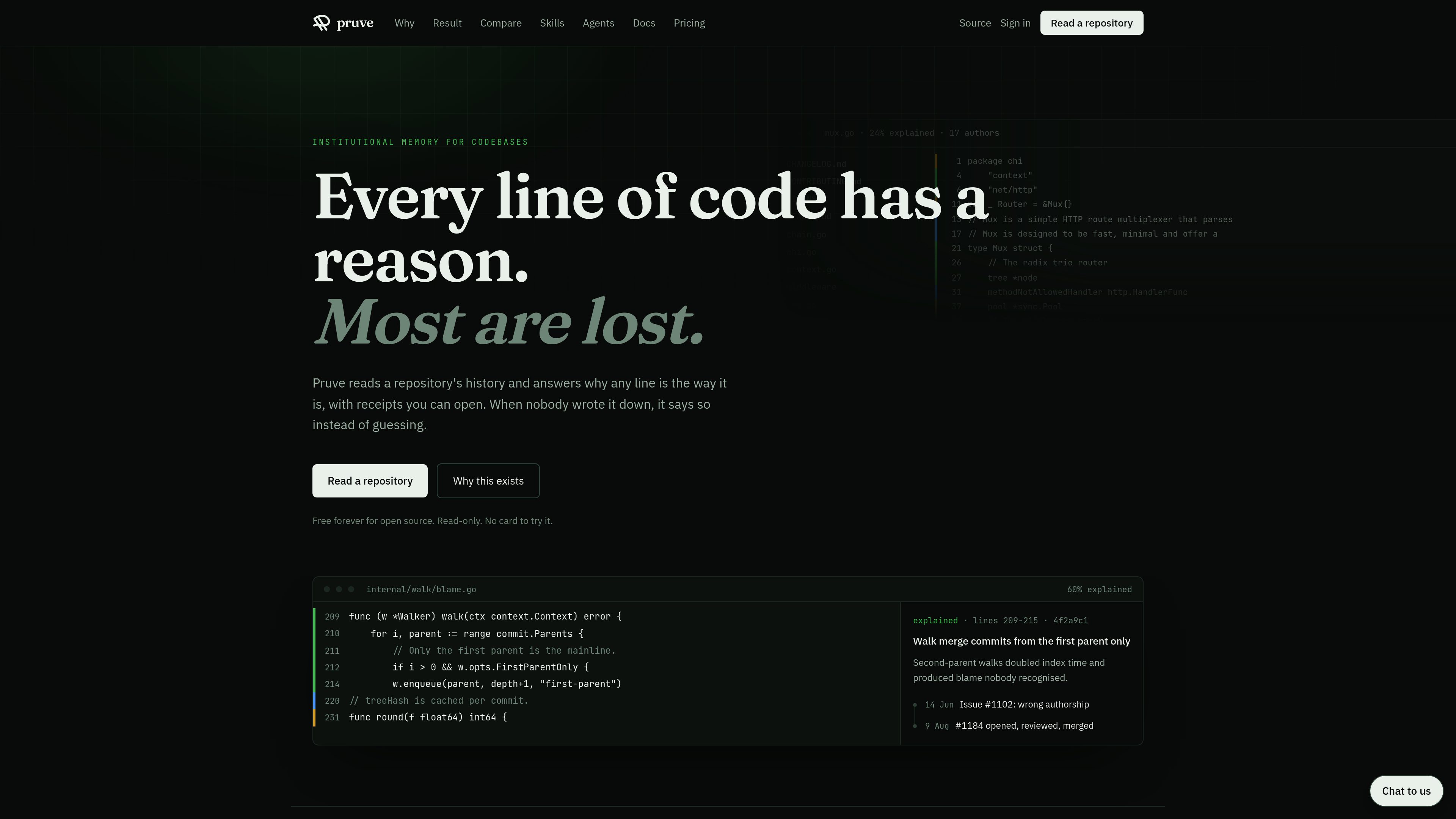
Line-level explanations with receipts
Pruve answers questions about specific lines by tracing them back to the changes and discussions that wrote them. The result is a clickable chain of evidence rather than a speculative summary.

Pruve analyse l’historique d’un dépôt pour expliquer pourquoi certaines lignes de code sont telles qu’elles sont, avec des éléments justificatifs consultables. Il fournit un contexte en lecture seule issu de dépôts GitHub ou GitLab aux développeurs, responsables produit et agents IA.
Pruve is a read-only product for exploring why code exists the way it does. It reads a repository’s history and ties individual lines back to the change that introduced them, so you can open the supporting discussion, commit, review thread, or agent session instead of relying on guesswork.
The product is built around evidence. When a line can be explained, Pruve shows the receipts behind it; when it cannot, it says so plainly. That makes it useful for understanding unusual constants, merge decisions, undocumented behavior, and other code that is hard to interpret from the source alone.
Pruve answers questions about specific lines by tracing them back to the changes and discussions that wrote them. The result is a clickable chain of evidence rather than a speculative summary.
It classifies changes as explained, described, or undocumented, then surfaces that coverage in dashboards, file trees, and the code gutter so readers can see which parts of a codebase have recorded reasoning.
Indexing can pull from commit messages, pull request bodies, review comments, linked issues, and agent sessions, which lets the product preserve the discussion around a change, not just the diff.
Pruve reads repository history and file contents without writing back to the code host. The only optional write action mentioned is a PR check run for the documentation gate.
The product exposes read-only MCP tools so agents can inspect reasoning before editing code. This is meant to let automated workflows ask “why” before making a change.
Teams can optionally fail pull requests that have no recorded reasoning anywhere, turning missing context into an explicit review signal.
A developer can click a line, see the change that introduced it, and read the discussion that explains why it was added instead of reverse-engineering the intent from the implementation.
When a merge commit drops discussion context, Pruve can surface the issue, benchmark, review comment, or agent session that explains why a choice was made.
Teams can scan a codebase to see which files or folders have recorded reasoning and which areas are still undocumented, making gaps visible before they become maintenance problems.
An AI agent can use MCP tools to inspect receipts before editing code, helping it avoid changes based on invented rationale.
Teams that want explicit evidence for pull requests can use the documentation gate to flag changes that lack recorded reasoning.
No. The product is read-only. The documentation says it does not push code, comments, or branches. The only write-related action mentioned is an optional PR check run for the documentation gate.
It indexes repository history and related discussion, including commits, pull requests, review threads, issues, and agent sessions when they are available.
It says so rather than guessing. The product is designed to report what it searched and stop if there is no evidence.
Coverage is counted as explained, described, or undocumented changes. Those counts are used in the product’s dashboards and line gutters.
Yes. The pricing page says open source is free forever, with free and unmetered read-only access for receipts.
Les données de trafic sont fournies à titre indicatif uniquement.

docsalot.dev
Docsalot est une plateforme de documentation proposant un parcours de prise en main de la CLI conçu d’abord pour les agents, destiné aux utilisateurs de Claude Code, Codex et d’autres agents de programmation. Elle aide les équipes à installer la CLI, à configurer leurs flux de documentation et à gérer des tâches comme la création, la récupération, la prévisualisation, l’envoi, la publication et la migration de documents.

documentation.ai
Documentation.AI est un logiciel de documentation et de base de connaissances avec IA pour les équipes produit, développement et support. Créez et gérez des documents, références API, centres d’aide et bases de connaissances grâce à l’édition assistée par IA et aux réponses intégrées.

www.eraser.io
Eraser est un outil d’IA pour la conception et la documentation techniques, qui aide les équipes à générer des diagrammes, des notes et des documents de conception à partir d’invites et de diagrammes sous forme de code.

codewiki.google
Code Wiki est un centre de documentation alimenté par l’IA qui génère des résumés de code, des diagrammes d’architecture et des Q&A sur les dépôts pour accélérer l’intégration et l’exploration.