
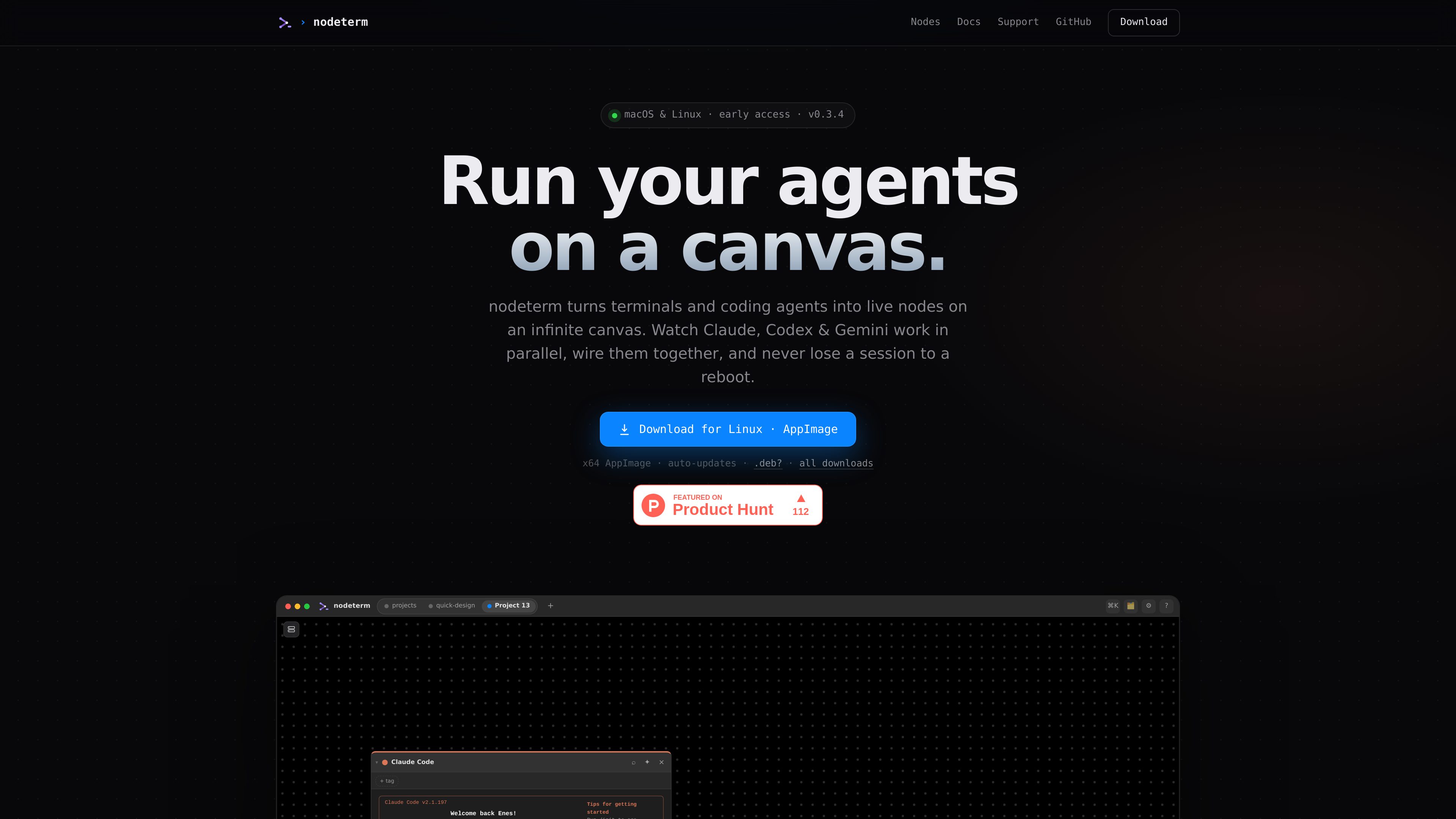
Infinite canvas layout
Pan and zoom across an open canvas to arrange terminals, agents, and related work items by project or task instead of by tab order.
nodeterm est un gestionnaire de terminaux basé sur des nœuds, qui exécute des agents de codage sous forme de nœuds actifs sur un canevas infini. Il s’adresse aux utilisateurs qui souhaitent organiser spatialement terminaux, sessions d’agents et éléments associés de leur espace de travail sur macOS ou Linux.
nodeterm turns terminals and coding agents into live nodes on an infinite canvas. Instead of managing work in tabs, users place sessions spatially, zoom in and out, and keep related terminals, agents, and notes in view together.
The product is designed for persistent development workflows. Terminals run in tmux-backed sessions that can survive app quits and machine reboots, while agent nodes show live state such as RUNNING or NEEDS YOU, and can be wired together so one agent can read another's context.
Pan and zoom across an open canvas to arrange terminals, agents, and related work items by project or task instead of by tab order.
Run supported agent CLIs as visible nodes and watch their state change while they work, including badges for running sessions and sessions waiting for input.
Connect nodes with an edge so one Claude node can read another node's context on demand, making branching conversations easier to follow.
Keep terminal sessions alive inside tmux so processes and scrollback can return after closing the app or rebooting the machine.
Use sticky notes, group frames, a Monaco code editor, git diff views, and Claude chat nodes on the same canvas.
Use the macOS or Linux desktop app, a browser-based Server Edition on a headless Linux box, or an iOS companion for phone access.
Useful when you are running multiple coding agents across different projects and need to see which ones are busy, which ones are waiting, and which ones have spawned subagents.
Helpful for shell sessions, processes, and scrollback that need to survive quitting the app or restarting the computer without losing state.
Fits workflows where terminals, notes, code edits, diffs, and chat need to stay connected on one canvas rather than scattered across separate windows.
Supports workflows where one agent should continue from or inspect another agent's context, such as when splitting a task into related threads.
The iOS companion and relay-based session access make it possible to attach to an existing session from a phone when you are away from the computer.
nodeterm is a node-based terminal manager that presents terminals and coding agents as live nodes on an infinite canvas.
The source explicitly mentions Claude Code, Codex, Gemini, and opencode as supported agent CLIs.
Yes. The documentation says terminals run inside tmux sessions that outlive the app, and sessions can be restored after a machine reboot.
The desktop app is described as available on macOS and Linux. The docs also mention a Server Edition for headless Linux and an iOS companion.
No pricing details were accessible from the reviewed pages. The pricing URL returned a 404 page.
Les données de trafic sont fournies à titre indicatif uniquement.

air.dev
JetBrains Air est un environnement de bureau pour exécuter plusieurs agents de codage en parallèle, isoler les tâches et examiner les modifications depuis un même espace de travail. Il prend en charge Codex, Claude Agent, Gemini CLI et Junie sur macOS et Linux ; la prise en charge de Windows est prévue.

matrix-os.com
Matrix OS est un ordinateur cloud et un espace de travail IA accessible depuis un navigateur, qui donne accès aux fichiers, applications, terminaux, aperçus et workflows d’agents sur tout appareil.

www.tryport22.com
port22 est une app iOS et un agent macOS pour surveiller et contrôler les sessions d’agents de codage exécutées dans un terminal. Il diffuse les transcriptions sur iPhone, alerte lorsqu’une saisie est requise et prend en charge Claude Code, Codex et OpenCode.

clarilayer.com
ClariLayer est une couche de contexte personnelle pour les agents d’IA dédiés au code et à l’analyse. Elle les aide à conserver définitions de données, notes et jointures d’une session à l’autre. Elle confronte aussi le contexte enregistré aux éléments du data warehouse ou de HubSpot afin de signaler les écarts sous forme de réserves.

airuncode.com
AIRUNCODE est un environnement d’exécution d’agents local-first qui permet de faire tourner des agents de code pilotés par la voix sur votre propre machine. Il s’adresse aux utilisateurs qui souhaitent une exécution locale et accéder aux fournisseurs d’IA à leurs tarifs d’origine.

lmstudio.ai
LM Studio exécute des LLM en privé sur macOS, Windows et Linux, avec API locales, SDK et workflows MCP.