
AI-guided incident investigation
HyperProbe can pick up an alert from PagerDuty, Datadog, or Slack, read logs and traces, locate a suspected code path, and plan the debugging flow.

HyperProbe est un outil de débogage en production assisté par l’IA. Il place des sondes en lecture seule dans le code d’applications en cours d’exécution pour capturer l’état des variables en temps réel, sans redéploiement ni redémarrage. Il aide les équipes d’ingénierie et d’astreinte à enquêter sur les incidents dont les journaux et les traces ne révèlent pas la cause.
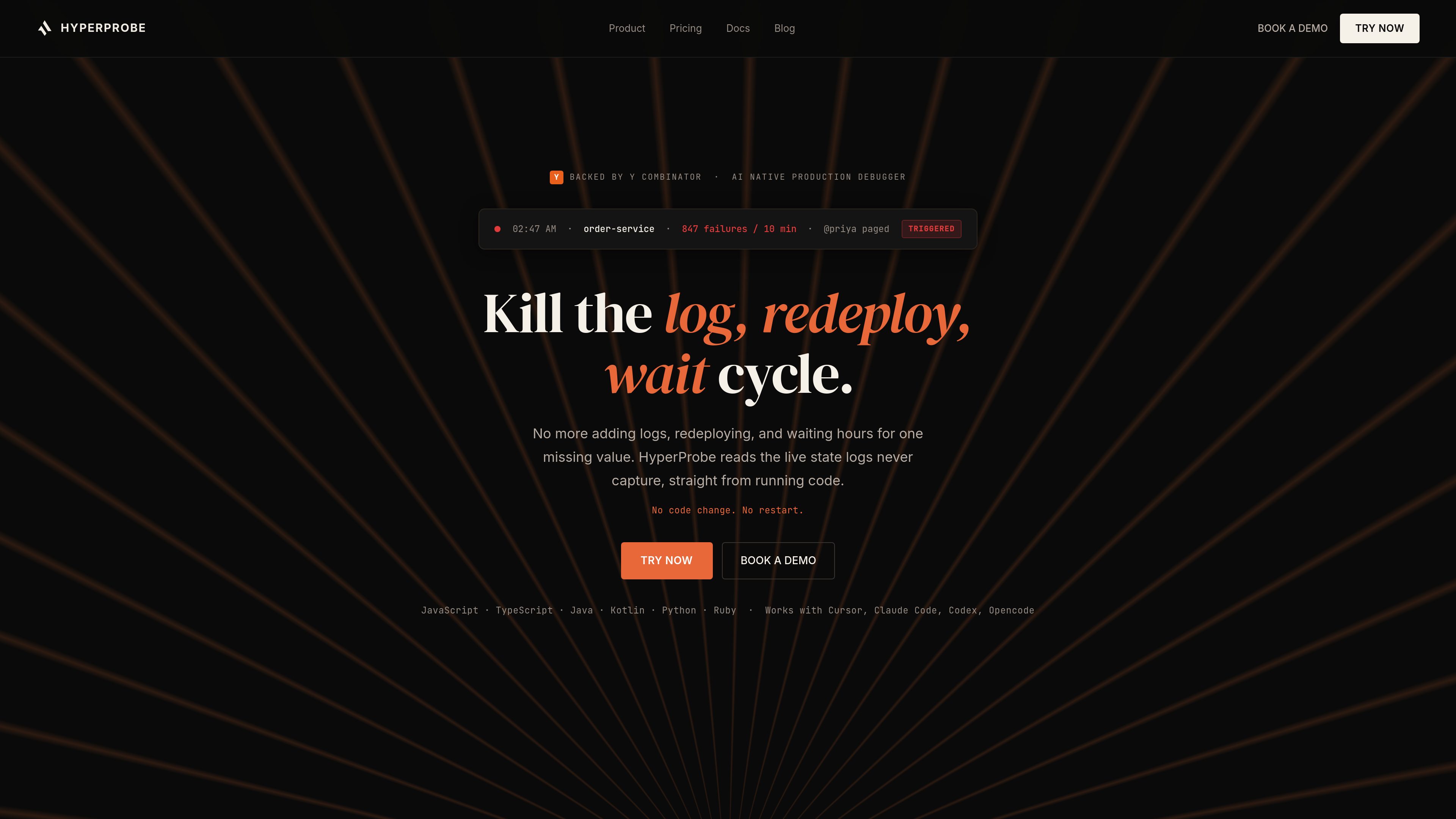
HyperProbe is an AI-assisted production debugger for investigating failures in running applications. It reads logs and traces, identifies a suspected file and line, and places a read-only probe on that code path. When the line is reached by live traffic, the probe captures the variable state at that moment, giving engineers evidence that may not exist in application logs.
The workflow is designed for incidents that are difficult to reproduce or that do not produce a useful exception. Probes are non-blocking and asynchronous: the service continues handling requests, and the probe clears after its configured limits are reached. HyperProbe supports JavaScript, TypeScript, Java, Kotlin, Python, and Ruby, and provides an MCP server for coding agents including Cursor, Claude Code, Codex, and Opencode.
HyperProbe can pick up an alert from PagerDuty, Datadog, or Slack, read logs and traces, locate a suspected code path, and plan the debugging flow.
A probe acts as a virtual breakpoint on a selected line and captures the exact variable state observed on real traffic without writing memory or executing code.
Each probe supports a time-to-live, rate limit, and hit-expiry count. The probe clears when one of those limits is reached, helping bound collection on high-traffic services.
The SDK and probe workflow are intended to inspect a running service without adding a log line, restarting the process, or pausing request threads.
An MCP server lets supported coding agents drive probe placement and use the captured evidence during an investigation. The site says installation can be initiated through a prompt to a coding agent and typically takes about 15 minutes.
Default PII redaction runs at the agent before capture, and every probe is recorded in an immutable audit trail. Enterprise adds custom redaction rules, approval gates, and organisation-level policy ceilings.
Inspect values behind successful responses with incorrect content, swallowed exceptions, or business metrics that decline without an alert.
Capture state during a live spike or race condition when reproducing the problem locally would take too long or fail to reproduce the timing.
Follow an alert through logs and traces, then inspect a downstream or upstream handler when the stack trace points away from the actual cause.
Examine live request data when a vendor introduces a new status or field that the application does not handle.
It captures a read-only snapshot of live variable state at a specific line when the probe is reached by real traffic. The probe cannot write memory or execute code.
No. The site describes probes as asynchronous and non-blocking, with no thread pauses or request waits. HyperProbe is designed to work without redeploying or restarting the service.
Every probe has a time-to-live, rate limit, and hit-expiry setting. It clears when any configured limit is reached. Enterprise can also apply organisation-level ceilings and approval policies.
The listed runtimes are JavaScript, TypeScript, Java, Kotlin, Python, and Ruby. The site lists Cursor, Claude Code, Codex, and Opencode as supported coding agents through its MCP server. Go is on the roadmap.
Yes, on Enterprise. The control plane and capture store can run in the customer’s VPC, with the site stating that captured values do not leave that network. Managed cloud deployment is available on the Free and Professional plans.
Les données de trafic sont fournies à titre indicatif uniquement.

dreamflow.app
Dreamflow est un outil visuel de création avec AI pour applications mobiles prêtes pour la production. Il permet aux équipes et aux développeurs indépendants de créer des apps Flutter avec des prompts AI, l’édition visuelle, le contrôle du code et des options de déploiement web et mobile.

workweave.ai
Weave est une plateforme d’intelligence de l’ingénierie qui mesure la production des équipes, le travail assisté par l’IA et l’impact des revues de code pour les équipes qui développent des logiciels. Elle propose les offres Starter, Pro et Enterprise, ainsi qu’un déploiement on-premise pour les grandes organisations.

workweave.dev
Weave est une plateforme d’intelligence de l’ingénierie qui mesure la production des équipes et la contribution de l’IA dans le code, les revues et les workflows associés, afin de comprendre la productivité, la qualité et l’impact du développement assisté par IA.

ultracite.ai
Ultracite est un preset sans configuration pour ESLint, Biome et Oxlint qui aide les équipes et l’IA à écrire du code cohérent et sûr au niveau des types. Il génère les réglages de l’éditeur, les instructions des agents et les hooks pour aligner les standards entre workflows humains et IA.

argminai.com
Argmin AI aide les équipes à évaluer les fonctionnalités d’AI avant leur mise en production grâce à des workflows, des règles, de la documentation et quelques exemples, sans équipe ML ni code d’évaluation personnalisé.

revolte.ai
Revolte est une plateforme de livraison logicielle basée sur l’IA, destinée aux équipes d’ingénierie. Ses agents contribuent au développement, aux tests, au déploiement et aux opérations en production, tandis que les ingénieurs définissent les exigences, examinent les résultats et autorisent les actions importantes.