
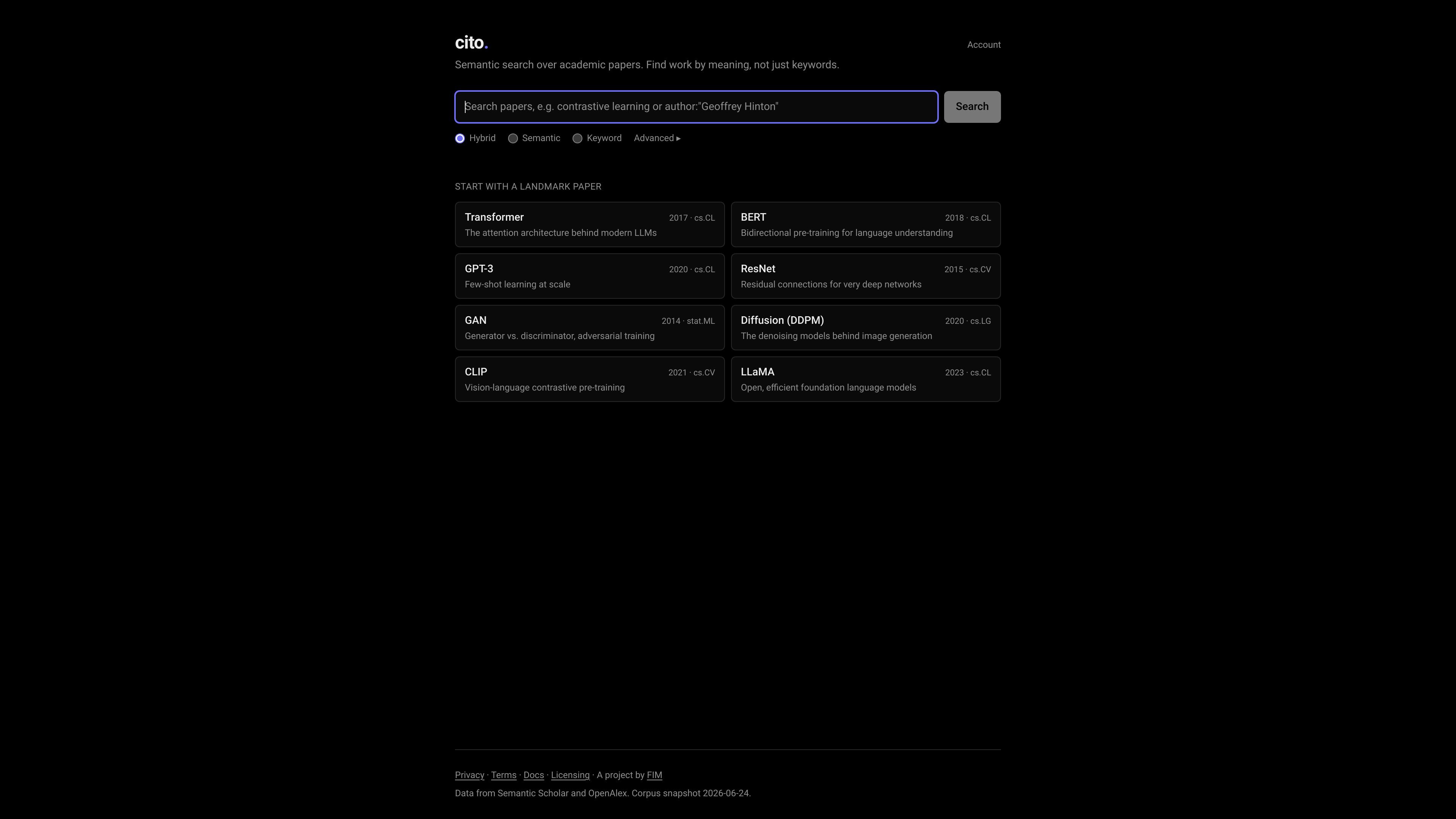
Semantic paper search
Search across about 148 million academic papers using semantic matching, so queries can find related work even when the wording differs.

Cito est un service de recherche programmatique d’articles scientifiques qui combine recherche sémantique et recherche par mots-clés sur un corpus local d’environ 148 millions d’articles. Les chercheurs et développeurs peuvent trouver des articles par sens ou par termes exacts, avec les métadonnées et les liens sources de chaque résultat.
Cito is a fast programmatic search service for academic literature. It searches a local corpus of roughly 148 million papers and combines semantic and keyword retrieval into one ranked result set, so users can find papers by meaning as well as by exact terms.
The product is aimed at people who need reliable paper discovery through an API rather than a browser search box. Because the corpus is self-hosted, Cito does not inherit upstream rate limits at query time, and the results are generated from its own indexes for reproducible behavior.
Search across about 148 million academic papers using semantic matching, so queries can find related work even when the wording differs.
Match exact terms, jargon, authors, and acronyms with BM25 search over titles and abstracts, which helps narrow down precise paper references.
Combine semantic and keyword rankings with reciprocal-rank fusion, giving weight to papers that score well in both systems.
Use only the semantic retriever or only the keyword retriever when a workflow calls for one mode; the docs expose mode=semantic and mode=keyword.
Get reproducible ordering from the same query and corpus snapshot, with no third-party API calls at query time.
Receive structured paper metadata and direct open-access PDF links when available, instead of a full-text hosting layer.
Look up a landmark paper or a topic area by concept rather than exact wording, which is useful when you only know the idea behind the work.
Search for papers that mention a specific method, acronym, model name, or author term and want exact lexical matches to surface alongside related semantic results.
Build a research or discovery feature into an application using the API, with reproducible ranking from a fixed corpus snapshot.
Move from a search result to the source paper by using the provided metadata and open-access PDF link when one exists.
Use the licensing terms and attribution guidance to republish search results in a product, dataset, or paper without guessing about data rights.
Cito is a programmatic search service for academic literature. It combines semantic search and keyword search over a local corpus of roughly 148 million papers, then fuses the results into one ranked list.
The docs say Cito uses SPECTER2 for semantic retrieval and BM25 over titles and abstracts for keyword retrieval. You can also run either mode alone with mode=semantic or mode=keyword.
Cito returns metadata such as title, authors, venue, publication date, DOI, citation count, and abstract when available. When an open-access copy exists, it also includes a direct PDF link to the source host.
Yes. The licensing page states that Cito is built on openly licensed scholarly data and that you may use results in commercial products, research, and publications, as long as you keep the required attribution string from API responses: “Data from Semantic Scholar”.
Cito does not proxy or re-host full text. PDF links point to the original publisher or repository, and any use of a downloaded PDF is governed by that origin's terms.
Les données de trafic sont fournies à titre indicatif uniquement.

byteask.ai
ByteAsk est un service MCP hébergé pour agents de programmation, qui fournit des réponses techniques textuelles avec citations de pages issues de sources primaires, ou indique « aucune correspondance fiable » lorsqu’il ne peut pas vérifier un résultat.

qdrant.tech
Qdrant est un moteur de recherche vectorielle open source écrit en Rust pour la récupération par AI, la recherche sémantique et la mise en correspondance par similarité. Il associe recherche vectorielle et filtrage des payloads JSON, avec des déploiements cloud, hybrides, privés et edge.

ontosight.ai
Assistant de recherche IA pour rechercher des sources, dialoguer avec des documents et rédiger avec citations

parallel.ai
Parallel est une plateforme d’API de recherche web et d’analyse pour les développeurs IA et les équipes de pointe, avec des API de recherche, extraction, chat, surveillance et recherche structurée.

paperguide.ai
Assistant de recherche IA pour trouver des articles, analyser la littérature, gérer les références et rédiger des documents académiques

txyz.ai
TXYZ est une plateforme de travail intellectuel basée sur l’IA, conçue pour lire, rechercher et rédiger à partir de contenus universitaires et scientifiques. Elle propose l’analyse de PDF et d’URL, des réponses liées à leurs sources, une bibliothèque de recherche personnelle, un accès API et une tarification par niveaux.