

OS-level telemetry
Monitors from the kernel rather than relying on the agent’s own logs, so activity can be reviewed independently of what the agent reports.

ContextFort monitors AI coding and browser agents at the OS level so engineering teams can see files, processes, and network activity in real time. It is positioned for environments where agents like Cursor or Claude Code run with broad system permissions.
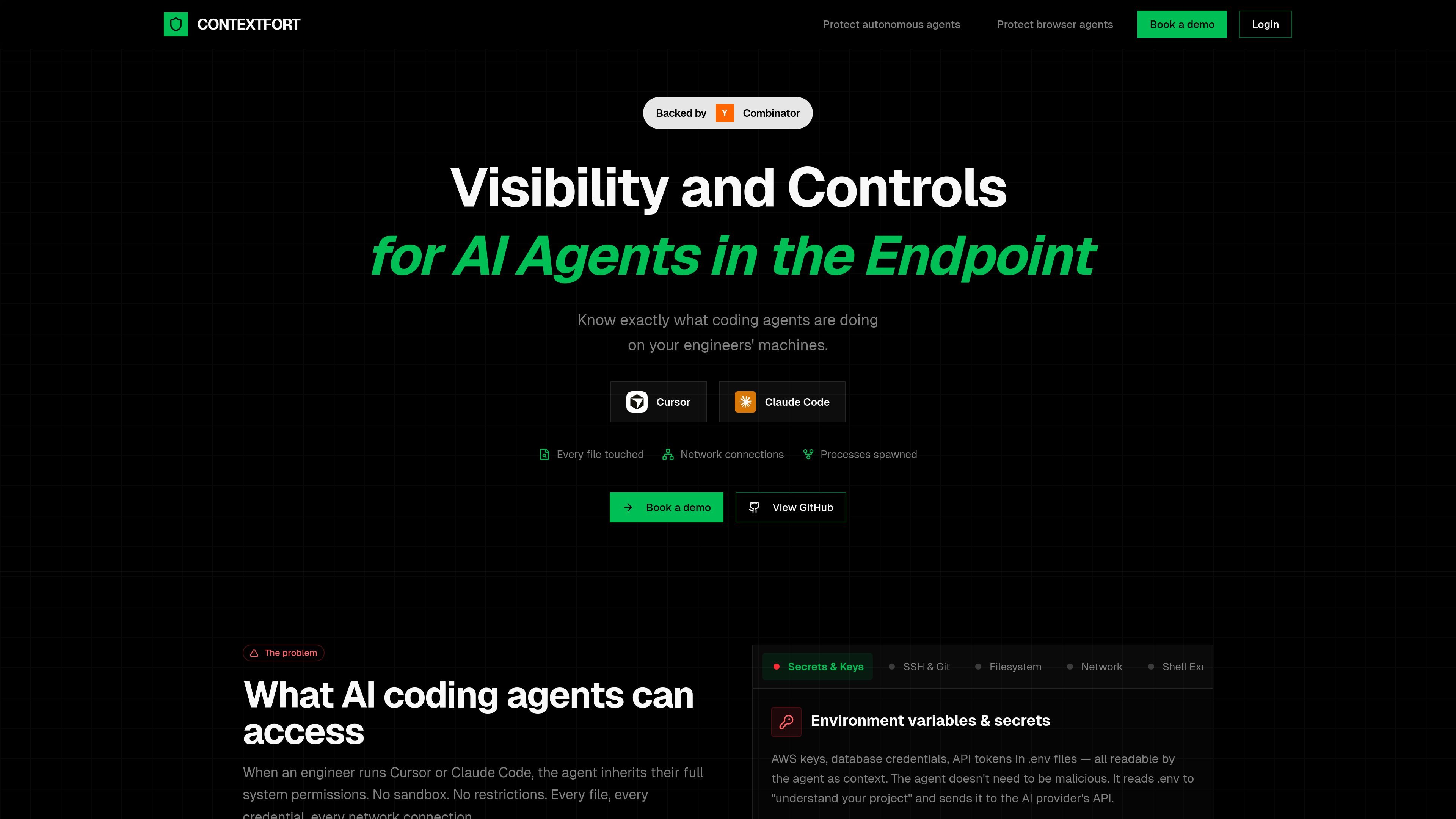
ContextFort is an endpoint visibility product for AI coding and browser agents. The site positions it as a way to detect and track AI agents in real time so engineering teams can see what those agents are doing on developers’ machines.
Its core purpose is to provide independent, OS-level visibility into file access, network activity, and spawned processes. The product is framed as a response to the access that agents like Cursor and Claude Code inherit when they run with a user’s system permissions.
Monitors from the kernel rather than relying on the agent’s own logs, so activity can be reviewed independently of what the agent reports.
Captures every file the agent reads or writes, including source code, credentials, SSH keys, and environment files such as `.env`.
Tracks outbound connections initiated during agent activity so teams can see what data may have been sent and where it went.
Records subprocesses and shell activity, giving visibility into commands, installs, and build steps launched by the agent.
Maintains an audit trail of agent actions that the product says the agent cannot tamper with after the fact.
Describes platform coverage across Linux, macOS, and Windows using eBPF, Apple’s Endpoint Security Framework, and ETW plus Minifilter.
Review what an AI coding agent accessed during a session, including files opened, commands launched, and network connections made.
Investigate whether an agent read sensitive files such as `.env`, SSH keys, or cloud credentials while working on a repository.
Track subprocesses and shell execution when an agent installs packages, runs builds, or spawns helper processes.
Correlate outbound network activity with agent behavior to understand what data may have left the machine.
ContextFort is designed for engineering environments where AI coding or browser agents run with broad system access. It helps teams understand what those agents touched so they can review activity after the fact.
The source describes OS-level monitoring for file access, network activity, and process trees, plus an independent audit trail. It is presented as monitoring from the kernel rather than relying on agent self-reported logs.
The site references Linux, macOS, and Windows support through eBPF, Endpoint Security Framework, and ETW plus Minifilter, respectively.
The public site does not provide setup steps, pricing details, or integration documentation. It points users to book a demo or view the GitHub repository for more information.

Orca is an Agent Development Environment for shipping with coding agents, running multiple CLI agents in parallel across isolated worktrees, with desktop and mobile workflows.

Firebase Studio is a web-based workspace for full-stack app development with Gemini-assisted coding, app previews, cloud emulators, collaboration, and browser deployment.

EZsite AI is an AI website builder that turns a URL into a fullstack React or Vue.js app with hosting, custom domains, code export, and backend features.

AI Magicx is a unified AI workspace for chat, image, video, voice, music, email and developer tasks, helping teams and creators manage multiple models in one place.

Paper is a design tool that connects canvas, code, and AI agents so teams can create, share, and ship work in one workflow. Includes desktop app and MCP access.

blop is a QA agent that writes browser tests as code in your repo, runs them in CI, clusters repeated failures, and can open PRs to fix broken tests.