
Config-driven training setup
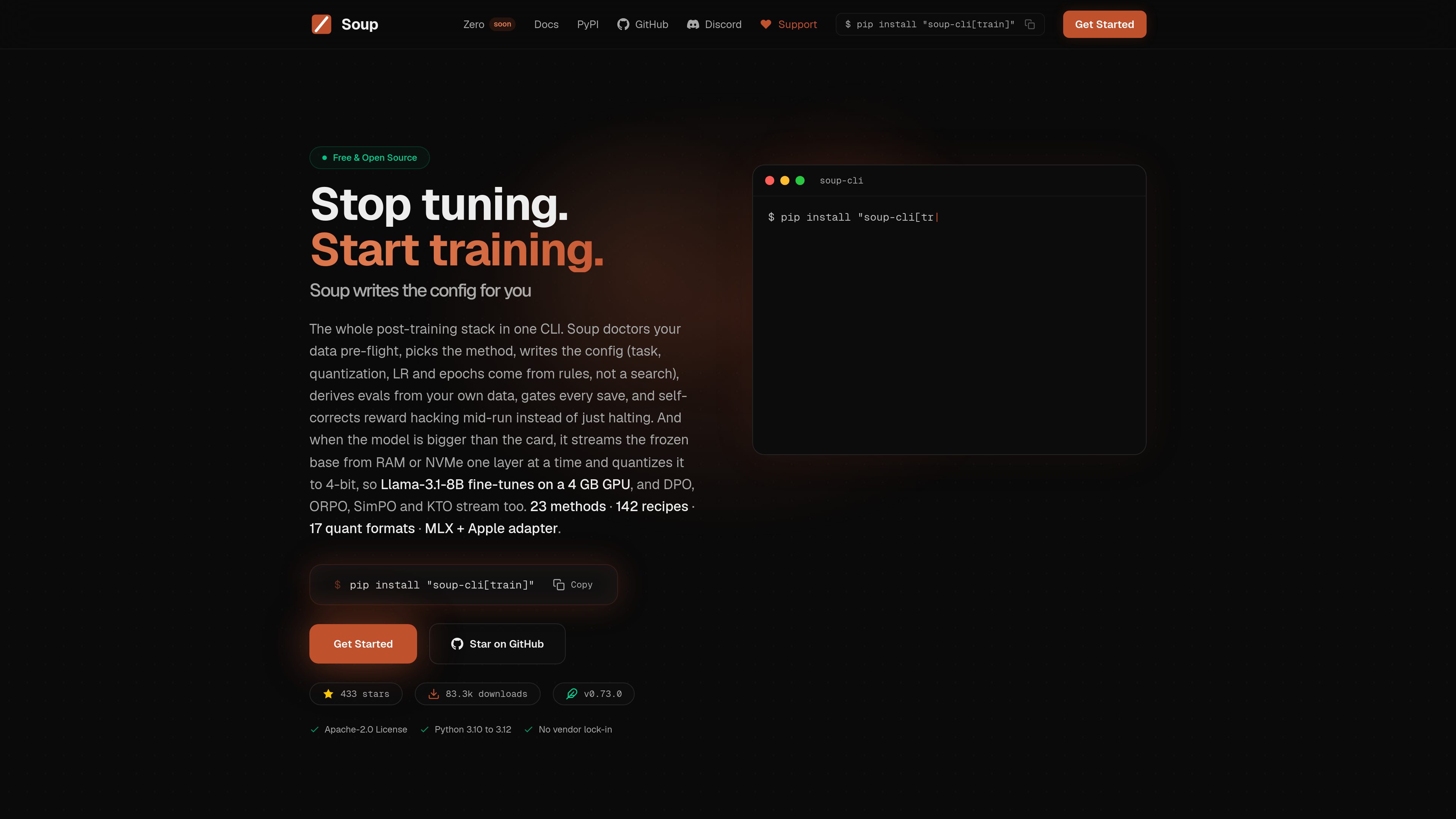
`soup init` creates a `soup.yaml`, and the site states that Soup writes much of the training configuration automatically, including task, quantization, learning rate, and epochs when rules determine them.

Soup CLI es una herramienta de línea de comandos de código abierto para el postentrenamiento y los flujos de trabajo relacionados con modelos, como el ajuste fino, el entrenamiento con preferencias, la evaluación, la combinación de modelos, el despliegue y la preparación de datos. Está pensada para quienes quieren gestionar el entrenamiento y la puesta en marcha de modelos con una sola CLI sin conexión, en hardware propio o prestado.
Soup CLI is an offline, CLI-first toolkit for post-training language models and related workflows. It combines training setup, data preparation, evaluation, model merging, inference serving, export, and deployment commands in one interface.
Its core training workflow is designed to work from a config file generated by the tool, with rules that set many defaults automatically. The site emphasizes methods such as supervised fine-tuning and preference training, plus layer streaming so the frozen base model can stay in CPU RAM or NVMe instead of occupying full VRAM.
The product is positioned for users training on limited hardware, including cases where a model is too large to fit resident in GPU memory. The docs also show commands for migrating configs from other tools, browsing recipes, running eval gates, and pushing or deploying models to external runtimes.
`soup init` creates a `soup.yaml`, and the site states that Soup writes much of the training configuration automatically, including task, quantization, learning rate, and epochs when rules determine them.
Soup can stream the frozen base layer-by-layer from CPU RAM or NVMe into VRAM so only one layer is resident at a time, which the site says supports training models that do not fit on the card.
The training docs and home page mention support for supervised fine-tuning and preference methods including DPO, ORPO, SimPO, and KTO, with the training page stating 23 task values in the schema.
`soup train` supports `--gate` to run evaluation suites at epoch boundaries and halt on regression, and the home page says Soup derives evals from the user’s own data and gates saves on a ship/don’t-ship verdict.
`soup migrate` imports configs from tools like LLaMA-Factory, Axolotl, and Unsloth, while `soup recipes` lets users list, inspect, search, and copy from 142 ready-made recipes.
The reference includes commands for chat, serving, export, merge, push, evaluation, data validation, deduplication, generation, and dataset publishing, making the tool a broader model ops CLI rather than a training-only utility.
Use Soup when a base model is too large to load fully into VRAM and you need a streaming approach that keeps the frozen base in RAM or on NVMe.
Use it for DPO, ORPO, SimPO, or KTO runs where you want the reference model to come from the same streamed base rather than loading a second resident copy.
Use `soup migrate` to convert existing setups from LLaMA-Factory, Axolotl, or Unsloth into Soup YAML with minimal manual rewriting.
Use gating and checkpoint-related flags when you want runs to stop on eval regressions or automatically resume and push checkpoints during training.
Use Soup when you want a single workflow for data review, training, evaluation, adapter merging, deployment, and export to serving formats.
Soup CLI is a command-line tool for post-training workflows such as training, evaluation, merging, deployment, data preparation, and dataset handling.
Yes. The site says Soup can stream the frozen base from CPU RAM or NVMe layer by layer so the model does not have to stay resident in VRAM.
The site explicitly mentions SFT, DPO, ORPO, SimPO, and KTO, and the training docs describe 23 task values in the schema.
Yes. `soup migrate` is documented for importing configs from LLaMA-Factory, Axolotl, and Unsloth.
No. The CLI reference also documents chat, serving, export, merge, push, eval, and data commands.
Los datos de tráfico son solo como referencia.
| may | 0 |
|---|---|
| jun | 0 |
| jul | 0 |
Las analíticas de tráfico aún no están disponibles.
Las analíticas de tráfico aún no están disponibles.

www.coldtea.ai
Coldtea es un entorno de entrega de software impulsado por IA para equipos que quieren gestionar en un solo lugar el control de calidad, la monitorización de producción, la detección de errores, la creación de tareas y las correcciones. Se ejecuta en tu máquina para detectar regresiones e incidencias de producción después de escribir el código.

zeabur.com
Plataforma de nube con asistencia de IA para gestionar despliegues, servidores, dominios, DNS, correo y acceso a modelos mediante una aplicación web y agentes.

antideploy.com
Antideploy es una plataforma de despliegue que analiza el código de la aplicación, determina el runtime y la infraestructura necesarios, los construye y sirve la aplicación mediante HTTPS. Permite desplegar desde GitHub, una carpeta local, una API o agentes de programación sin escribir un Dockerfile ni configuración YAML.

nuphos.ai
Nuphos es un espacio de trabajo de DevOps nativo de IA para equipos de ingeniería. Ofrece un entorno compartido donde los agentes de IA pueden aprender la infraestructura, investigar problemas y operar sistemas de producción con aprobación humana y registros de auditoría.

rootly.com
Rootly es una plataforma de gestión de incidentes nativa de IA para equipos de ingeniería que reúne respuesta a incidentes, operaciones de guardia, SRE con IA, retrospectivas y páginas de estado para detectar, gestionar y resolver incidentes más rápido.

dagster.io
Dagster es una plataforma de orquestación de datos nativa de IA para crear, programar, observar y operar canalizaciones de datos confiables.