
Interaction publishing
Send user-agent conversations, session information, agent versions, metadata, and retrieved learnings to Reflexio so the system can analyze completed turns.

Reflexio es una plataforma de aprendizaje para agentes de IA que convierte los resultados de las interacciones y las correcciones de los usuarios en pautas de comportamiento recuperables. Los desarrolladores pueden conectar un ciclo de reflexión, evaluación y recuperación a agentes existentes mediante API alojadas, un SDK de Python, REST o una CLI y un backend locales.
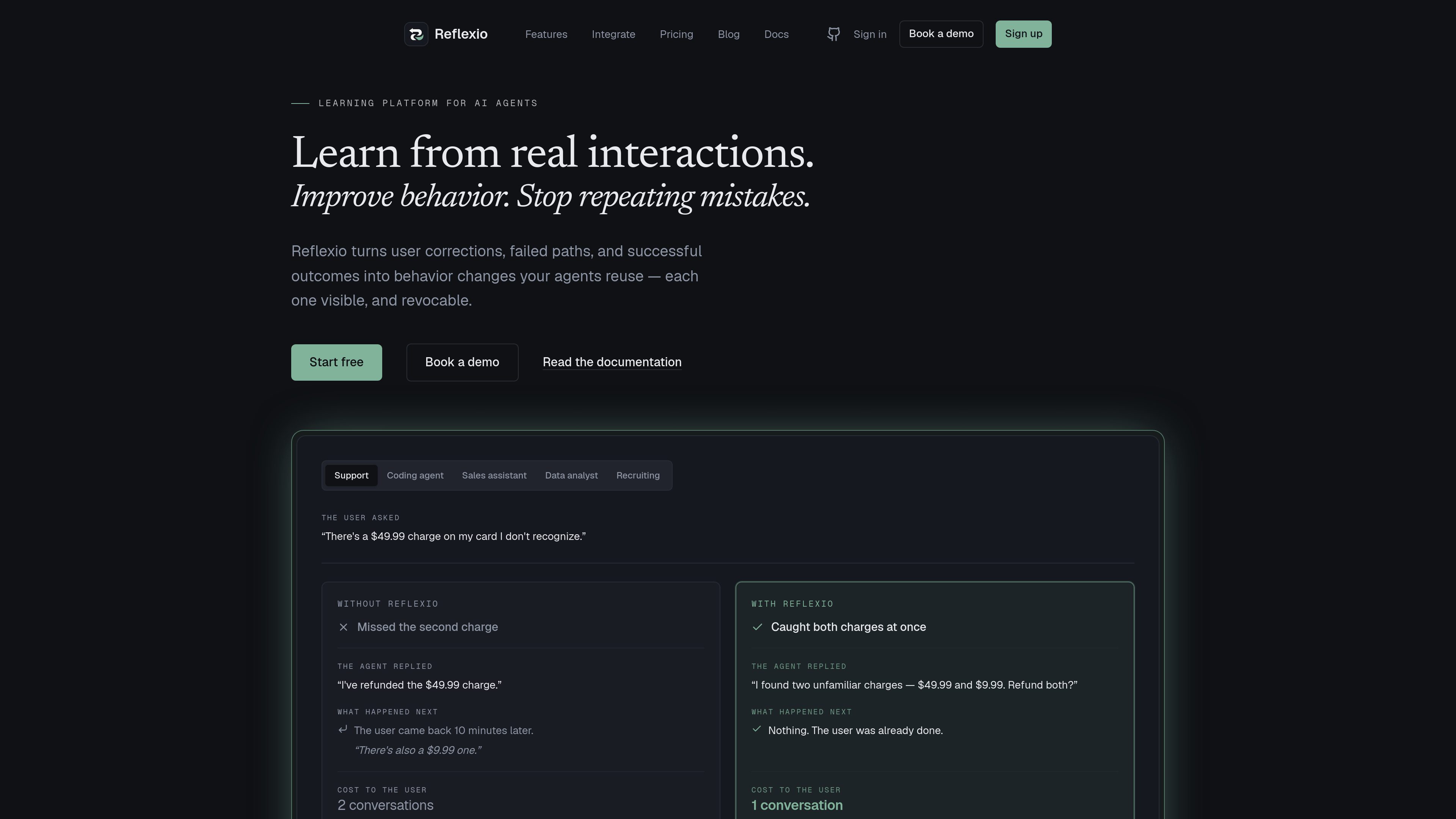
Reflexio is a behavioral learning platform for AI agents. Instead of only storing what users said, it captures interactions, corrections, and outcomes to identify how an agent should behave differently in similar situations. The resulting learnings can be retrieved before a later response and are intended to reduce repeated mistakes without retraining the underlying model.
The platform supports a loop in which an agent retrieves relevant profiles or playbooks, produces a response, and publishes the completed interaction back to Reflexio. Developers can use the hosted service, connect through Python or REST, or run the open-source local backend and CLI. Learnings can be reviewed, approved, rejected, revised, and evaluated against an un-augmented response.
Send user-agent conversations, session information, agent versions, metadata, and retrieved learnings to Reflexio so the system can analyze completed turns.
Search profiles and user or agent playbooks before an agent responds, then inject selected context into the model prompt. Retrieval can be filtered and limited for the application’s token budget.
Convert corrections, triggering conditions, and successful or failed outcomes into actionable signals about how the agent should act in future situations.
Compare a candidate response with an un-augmented control response and use the resulting evidence to revise learnings over time.
Inspect learned rules and their statuses, approve or reject them, and remove rejected learnings from retrieval. The API also includes profile, playbook, configuration, evaluation, and data-rights operations.
Connect through a Python SDK, REST API, CLI, or integration skill. The service can be managed by Reflexio, use customer model credentials or storage, or run in a customer AWS, GCP, or Azure account.
A support agent can learn to inspect the full window of recent charges before resolving one unfamiliar transaction, reducing the chance of asking the customer to return with a missed issue.
Developers can use business-specific extractors and playbooks to capture recurring coding feedback, such as how an agent should respond to a syntax or implementation error.
A sales agent can use retrieved profiles and learned playbooks to apply recurring interaction guidance when handling later conversations.
Teams can publish analyst-agent interactions and retrieve relevant learned behavior for subsequent analysis tasks, while retaining a reviewable learning record.
Teams that need local development or a customer-controlled environment can use the open-source CLI and local FastAPI backend, or discuss a BYOC deployment in their own cloud account.
The documented minimum loop retrieves profiles and playbooks before the agent responds, passes selected context to the LLM, and publishes the completed interaction afterward. The site says the SDK can wrap existing LLM calls without an agent rewrite.
No. The product describes a retrieve-and-publish learning loop rather than model retraining. Learned behavioral context is retrieved and injected at inference time.
The site documents a Python SDK, REST access, a CLI, and an integration skill for coding agents. The local open-source package includes the Python SDK, CLI, and local FastAPI server.
Yes. Learnings are presented as reviewable rules with statuses such as approved, pending, and rejected. The site states that rejecting a learning removes it from retrieval, and the API includes playbook and configuration management.
Reflexio offers a managed service, split arrangements using customer model credentials or storage, and BYOC/self-hosted deployment in AWS, GCP, or Azure. The documentation also describes a local open-source backend using SQLite by default.
Los datos de tráfico son solo como referencia.

build.reflex.dev
Plataforma web para convertir indicaciones en aplicaciones Python y desplegarlas en Reflex Cloud, tu propia nube o entornos locales, con plantillas listas para producción e integraciones con herramientas de agentes y programación.

agentql.com
Herramienta para desarrolladores que extrae datos estructurados de páginas web y automatiza interacciones mediante consultas en lenguaje natural, SDK y API REST.

www.maximem.ai
Plataforma de memoria agéntica y gestión de contexto para agentes de IA, con memoria estructurada y recuperación de contexto mediante SDK, API, MCP y adaptadores nativos.

groq.com
Plataforma de inferencia para desarrolladores y equipos que necesitan servir modelos con rapidez y costes predecibles mediante Groq LPU y GroqCloud.

lmstudio.ai
Aplicación de IA local y plataforma para desarrolladores que permite ejecutar modelos de lenguaje de forma privada en macOS, Windows y Linux, con APIs locales, SDK y despliegues sin interfaz gráfica.

braintrust.dev
Plataforma de observabilidad de IA para rastrear el comportamiento en producción, evaluar modelos y detectar regresiones antes de que lleguen a los usuarios.