
Local, offline inference
Runs LLMs without API keys or hidden usage fees, which makes it suitable for private or network-limited workflows.

NobodyWho es un motor de inferencia para ejecutar LLM de forma local y eficiente en dispositivos compatibles. Está pensado para desarrolladores que buscan inferencia de modelos sin conexión, entradas multimodales y flujos de trabajo locales de voz y texto sin claves de API.
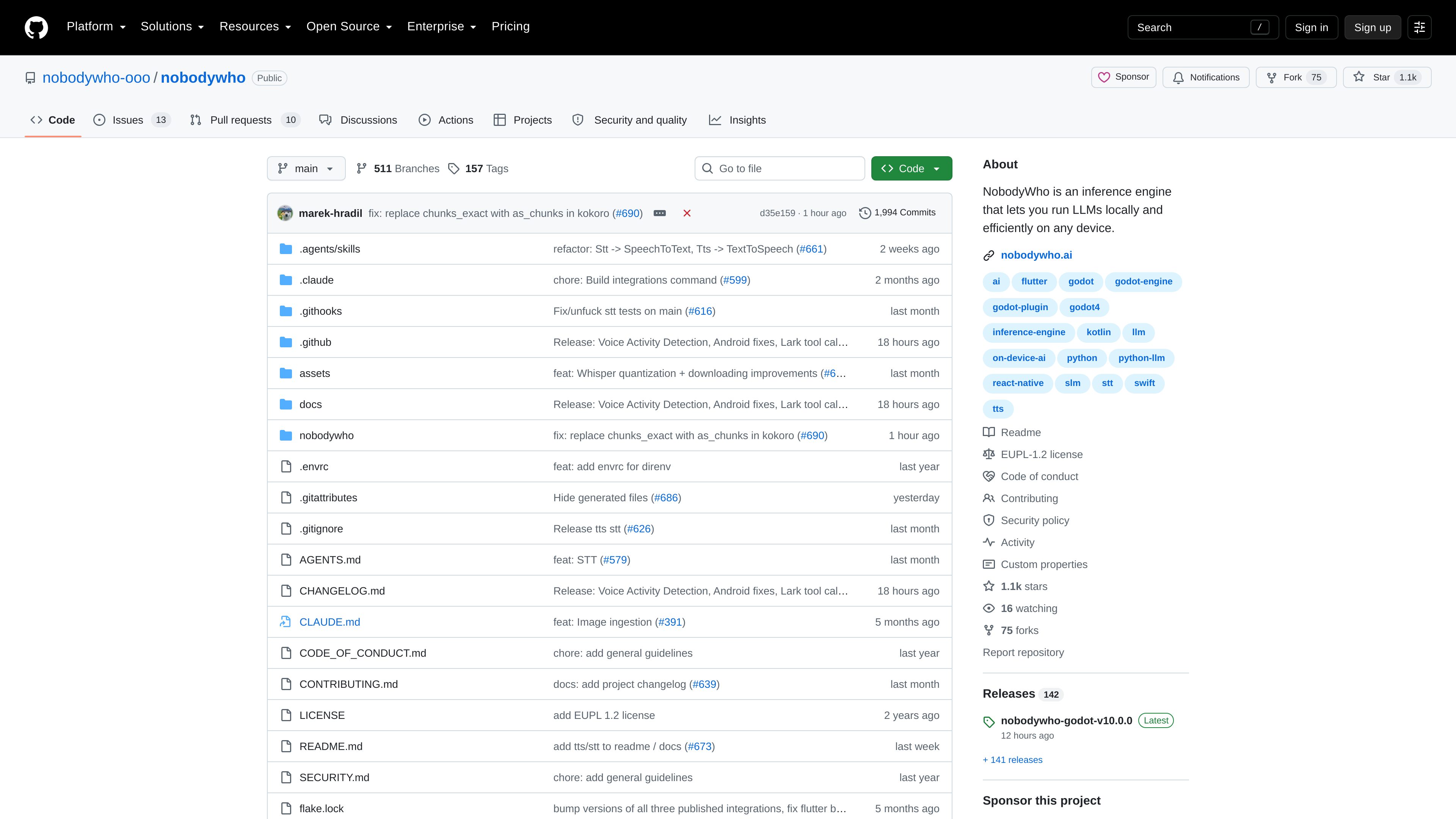
NobodyWho is an on-device inference engine for running large language models locally. The project describes itself as a way to use LLMs efficiently on any device, with an emphasis on offline operation and local execution rather than hosted API calls.
The repository README highlights support for chat models, structured tool calling, multimodal input, text-to-speech, speech-to-text, and model downloading from Hugging Face or any direct URL. It also points to GPU-accelerated inference through Vulkan or Metal, conversation-aware context shifting, and compatibility with GGUF models powered by llama.cpp.
Runs LLMs without API keys or hidden usage fees, which makes it suitable for private or network-limited workflows.
Works with chat LLMs such as Gemma, Qwen, and Mistral, with the broader claim of compatibility with many GGUF-format models.
Generates structured grammars from function signatures, reducing the need to write schemas manually.
Accepts image and audio information as part of LLM interactions.
Includes text-to-speech backends such as Kokoro, Pocket TTS, and Supertonic, plus speech-to-text via Whisper.
Can load models directly from Hugging Face or from any URL, which simplifies distribution and testing.
Build local chat experiences that do not depend on external model APIs.
Add LLM capabilities to Kotlin, Swift, Python, Flutter, React Native, or Godot projects using the documented platform packages.
Combine Whisper transcription with local text-to-speech for voice-enabled workflows.
Use type-safe function calling when you want the model to trigger structured actions from application code.
Load GGUF models from Hugging Face URLs and experiment with local inference across supported runtimes.
No. The README states that it runs locally and offline, with no API keys needed.
The repository says it can run chat LLMs such as Gemma, Qwen, and Mistral, and that it is compatible with thousands of pretrained LLMs in GGUF format.
Yes. The README mentions text-to-speech and speech-to-text support, including Kokoro, Pocket TTS, Supertonic, and Whisper.
The project lists Kotlin, Swift, Python, Flutter, React Native, and Godot.
The README says models can be loaded from Hugging Face or any URL.
Los datos de tráfico son solo como referencia.
| jun | 0 |
|---|---|
| jul | 0 |
| ago | 0 |
Las analíticas de tráfico aún no están disponibles.
Las analíticas de tráfico aún no están disponibles.

talkcody.com
Agente de programación con IA gratuito y de código abierto para macOS, Windows y Linux, con varios proveedores de modelos, almacenamiento local y flujos de trabajo sin conexión.

ampcode.com
Amp es un agente de programación para flujos de trabajo en la terminal y el editor. Usa modelos líderes, admite hilos y subagentes, y funciona desde la CLI, editores compatibles o la interfaz web.

codegpt.co
Asistente de programación con IA para desarrolladores y equipos que buscan flexibilidad de modelos, uso con sus propias claves y generación de código basada en la planificación, con autocompletado y servicios de IA personalizados.

hcompany.ai
H Company crea productos de IA para automatizar navegadores, acceder a modelos multimodales y desplegar flujos de trabajo empresariales.

chonkie.ai
Chonkie es una herramienta para desarrolladores y una capa de contexto de código abierto para dividir texto en fragmentos, generar embeddings y entrenar modelos personalizados. Ayuda a mejorar los flujos de recuperación e integrarse con LlamaIndex.

runcomfy.com
Plataforma ComfyUI en la nube para ejecutar, guardar y desplegar flujos de trabajo desde el navegador, sin instalación local.